
British Asparagus Recipes: Six Quick Weeknight Dinners for the 2026 UK Season
The British asparagus season traditionally starts on St George’s Day, 23 April, and runs to the summer solstice. For roughly eight weeks, home-grown spears show up at greengrocers, farm shops and most supermarkets – and after that, they’re gone until next spring. The window is short, so the useful thing isn’t a list of elaborate dinner-party ideas. It’s a clutch of British asparagus recipes that work on a Tuesday night, in a normal kitchen, with whatever’s already in the fridge.
In This Article
- Why British asparagus is worth the eight-week window
- Charred asparagus with lemon, parmesan and a poached egg
- One-pan salmon with asparagus and Jersey Royals
- Asparagus, pea and pancetta pasta
- Ginger and soy stir-fry with asparagus and king prawns
- Asparagus and goat’s cheese tart (the shortcut version)
- Asparagus frittata for solo suppers
- What to look for when you shop: a quick buyer’s guide for British asparagus recipes
- Make-ahead and batch-cooking notes
This guide is built around six weeknight dinners that make asparagus the point, not a garnish. They take between 15 and 35 minutes, scale well for one or two, and lean on British growers rather than air-freighted Peruvian spears. A quick buyer’s guide at the end covers how to pick a good bundle and what to do with the stems you’d normally throw away.
Why British asparagus is worth the eight-week window
Home-grown spears taste noticeably different to the imported bundles you get in January – sweeter, grassier, with less of the stringy quality that comes from a long cold-chain journey. The BBC Good Food seasonal calendar lists asparagus as one of the defining May ingredients in the UK for good reason: it’s grown in Lincolnshire, Worcestershire, the Vale of Evesham and Norfolk, and most of what’s harvested in the morning is on a shelf by the afternoon.
The Fairtrade-style ethics are simpler too. Buying British in season means shorter supply chains, less refrigeration and more money to growers whose whole year hinges on this eight-week run. At roughly £3-£4 a bundle in 2026, it’s also not as expensive as its reputation suggests – particularly if you build a meal around it rather than serving it as a side.
Charred asparagus with lemon, parmesan and a poached egg
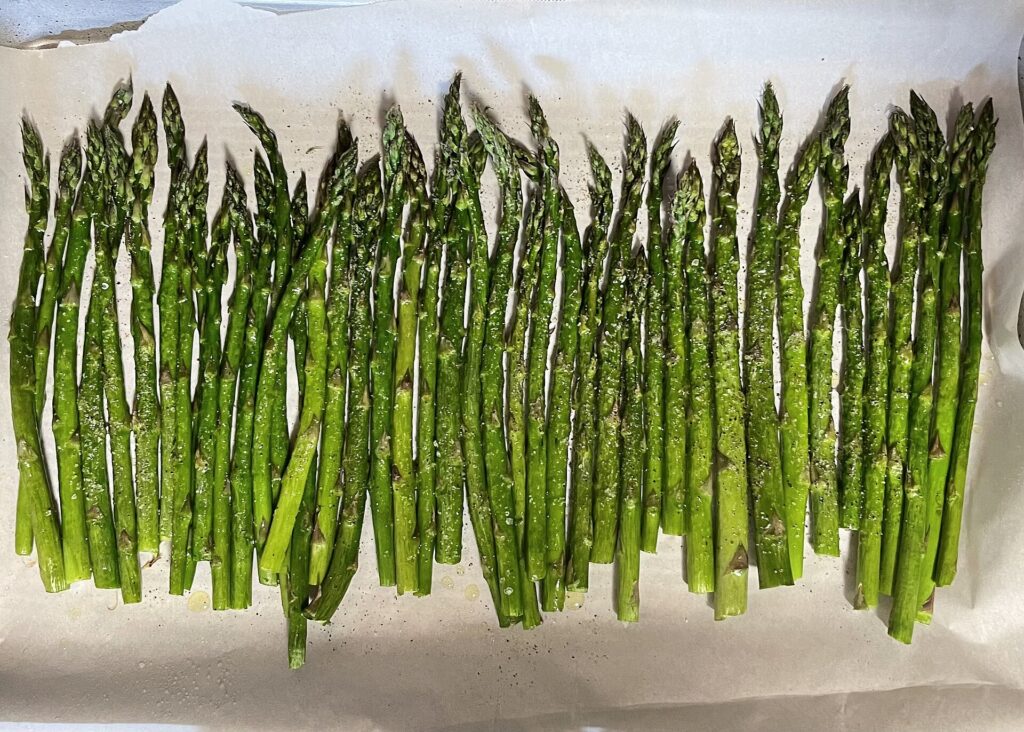
The simplest of the lot, and still the one I cook most often. Heat a dry griddle or heavy frying pan until it’s properly hot. Toss a bundle of trimmed spears in a splash of olive oil and a pinch of salt, then lay them flat and leave them alone for three minutes before turning. You want dark char marks, not steamed grey-green.
While they cook, poach an egg and toast a thick slice of sourdough. Pile the asparagus on the toast, slide the egg on top, grate over parmesan (or a sharp Lancashire if you want to keep it British) and finish with lemon zest and a crack of pepper. Start to finish: about 12 minutes.
One-pan salmon with asparagus and Jersey Royals
This is the weeknight workhorse. Parboil a handful of Jersey Royals for eight minutes, drain, then tip them onto a baking tray with trimmed asparagus, a salmon fillet, olive oil, lemon slices and a scattering of capers. Roast at 200°C for 12-14 minutes, until the salmon flakes and the asparagus is just starting to blister.
One tray, minimal washing up, and the two standout British spring ingredients doing most of the heavy lifting. Swap the salmon for a trout fillet if you want something cheaper, or for halloumi if you’re skipping fish – both work with the same timings.
Asparagus, pea and pancetta pasta
A 20-minute pasta that feels a lot more considered than it is. Fry 60g of diced pancetta until crisp, add sliced asparagus (stems in first, tips a minute later) and a handful of frozen peas. Deglaze the pan with a splash of pasta water, then toss through cooked orecchiette or rigatoni with grated pecorino and a squeeze of lemon.
The trick is cutting the stems on the diagonal into thin coins so they cook at roughly the same rate as the pasta. Don’t bother blanching separately – it’s not that kind of dish. If you’ve got a handful of wild garlic left over from earlier in spring, chop it through at the end. They’re overlapping seasons and a natural pair.
Ginger and soy stir-fry with asparagus and king prawns
Asparagus is often written into Italian or French recipes, but it’s excellent in a quick Asian-style stir-fry. Cut the spears into 3cm lengths. Heat a wok until smoking, add a splash of groundnut oil, then prawns, sliced ginger and a crushed garlic clove. Once the prawns are pink, add the asparagus and a splash of Shaoxing wine or dry sherry. Finish with soy sauce, a pinch of sugar and a drizzle of sesame oil.
Serve over rice or soba noodles. Total time: around 15 minutes from fridge to table, which puts it in the same category as our 15-minute weeknight dinners round-up. Keep a bag of frozen prawns in the freezer and this becomes a genuine default meal.
Asparagus and goat’s cheese tart (the shortcut version)
A ready-rolled sheet of puff pastry does most of the work here. Score a 2cm border around the edge, spread the middle with soft goat’s cheese seasoned with lemon zest and thyme, then lay trimmed asparagus spears across in a single layer. Brush the pastry border with beaten egg and bake at 200°C for 20 minutes, until the pastry is deeply golden and the asparagus is just tender.
This is the one I’d cook if someone drops in unannounced. It looks like you’ve made an effort; in practice, it’s 25 minutes of mostly oven time. A peppery rocket salad is all it needs.
Asparagus frittata for solo suppers
For one person, nothing beats a frittata. Sweat some sliced spring onions in a small ovenproof pan, add chopped asparagus, pour over three beaten eggs seasoned with salt and pepper, scatter with feta or goat’s cheese, and finish under the grill for three or four minutes until set and golden on top. Eat warm or at room temperature – it’s arguably better the next day, cold, cut into wedges.
Frittatas are also a useful way to use up the woodier ends of the spears. Slice them thinly on the diagonal and they’ll cook down into something tender rather than the fibrous disappointment you’d get from snapping them and chucking them in whole.
What to look for when you shop: a quick buyer’s guide for British asparagus recipes
A good bundle should feel firm, with tightly closed tips and a fresh cut at the base. If the ends look dry or woody, it’s been sitting around. The Guardian’s food writers have long made the case for buying from farm shops and veg boxes during the season if you can – the turnaround is faster and the spears tend to be thicker.
Store unwashed spears upright in a jar with 2cm of water in the base, loosely covered with a bag, in the fridge. They’ll keep for five or six days this way, versus two or three if you throw them in the crisper drawer.
To prep, hold each spear near the base and bend gently – it’ll snap at the point where the woody bit ends. Save those ends in a bag in the freezer; they’re brilliant blitzed into soup later in the season with potato and onion.
Make-ahead and batch-cooking notes
Asparagus doesn’t love being cooked twice, so it’s not a natural batch-cook ingredient. What does work: roast a whole bundle at the start of the week, cool quickly and keep in the fridge for salads, grain bowls or to chop through pasta. It’ll hold for three days.
Blanching and shocking in iced water also works if you want to prep ahead for a dinner the next night – the spears keep their colour and bite, and you just need a 30-second finish in a hot pan before serving. If you’ve got a glut from a farm shop trip, pickling is the move: a simple brine of white wine vinegar, water, sugar, salt, peppercorns and a bay leaf will keep blanched spears good in the fridge for a month. They’re excellent on a cheese board or chopped through a potato salad.
One more note on pairings. Asparagus has a natural affinity for fat and acid – butter, olive oil, cream, lemon, vinegar, yoghurt. Build a meal around any two of those and you’re most of the way there. It also pairs beautifully with eggs in almost any form, which is why the frittata, the tart and the poached-egg-on-toast version all work so reliably for weeknights.
Finally, don’t over-think timings. A medium spear needs about three minutes in a hot pan, four on a grill, eight in boiling water, or 12 in a 200°C oven. Thicker spears want a minute or two longer; pencil-thin ones need noticeably less. Once you’ve got those rough times in your head, you can improvise around whatever protein and carb you’ve got in the house.
Good prep is easier with the right blade – our guide to the best chef knife for a UK kitchen explains what to look for.
Six weeks from now, the season’s over. Which of these are you most likely to actually cook this week – the stir-fry, the traybake, or the tart?




Perfect timing – picked up a bunch at the farmers’ market in Sevenoaks on Saturday and had been wondering what to do with it other than the usual grilled-on-toast routine. The goat’s cheese tart shortcut is the one I’ll try first, sounds like a proper weeknight winner. Quick question on the pancetta pasta – do you pre-blanch the asparagus or just chuck it into the pasta water in the last few minutes? I’ve done both and the timing always catches me out.
Hi Paula – the goat cheese tart is a killer if you have still got some bunches left. I do mine on a sheet of bought puff with a smear of pesto under the spears, ten minutes in a hot oven and it is done. Sevenoaks farmers market is a good shout this time of year.