
Small-Space Home Office UK 2026: How to Set Up Without a Spare Room
The spare-room home office was always a luxury most UK households didn’t have, and the hybrid shuffle of the last few years has only made that plainer. If you’re working from a corner of the bedroom, a slice of the dining table or a cupboard conversion, the question isn’t whether you can make it functional. It’s whether you can make it functional without wrecking your back, your broadband or the way the room actually feels to live in. With the clocks forward and more of us working flexibly again, now’s the natural moment to fix what’s been annoying you since winter.
In This Article
- Why small-space home offices are still a UK problem
- Start with the chair, not the desk
- Make the desk work harder than a desk
- Lighting that works on a grey Tuesday
- Sound, focus and not hating your housemates
- The tech you actually need (and what you don't)
- Making the room feel like a home again after 6pm
Why small-space home offices are still a UK problem
Britain’s housing stock is among the smallest in Europe, and a hybrid-work survey from the Office for National Statistics shows a steady chunk of workers are still splitting their weeks between office and home. That means most of us aren’t trying to design a one-off “workplace” – we’re trying to fit a couple of days a week of proper focused work into rooms that are already doing other jobs. The kitchen table has to survive homework, meals and a 10am video call. The box room is also the airing cupboard. The “office” is really a desk shoved into the bedroom that no one wants to see from the bed.
What makes this a design problem rather than a purchasing one is that you can’t solve it by throwing money at a desk. The limit isn’t your budget. It’s square metres, sight-lines and the fact that this room has other tenants. The trick is to get the few things that genuinely matter right, and let the rest stay compromised.
Start with the chair, not the desk
Almost everyone gets this wrong. They buy a nice desk first, then try to pair it with whatever dining chair is going spare. Six months later their lower back is a disaster. Your chair is the only thing you’re in physical contact with for hours at a stretch, and it’s the piece of kit that quietly decides whether you’re still at this desk in five years.
If you’ve got the space, a mid-range ergonomic chair from a UK retailer (Herman Miller’s cheaper Sayl line, the reliably solid IKEA Markus, or a refurbished Humanscale on eBay) will outlive three desks. If you haven’t got the space, a saddle stool or a well-set kitchen chair with a lumbar cushion will do for part-time use, as long as you actually stand up once an hour. Which? has been running office-chair tests focused specifically on smaller British homes and hybrid-work patterns, and the headline finding is boringly consistent: the best value sits in the £250-£450 range, not the £900 showpieces. Below £100, you’re mostly buying lumbar pain on a delayed fuse.
The small-space shortcut: if your chair lives under a dining table when you’re not using it, pick one that can. A low-profile mesh back that slides fully under a table gives you back the room when the working day ends.
Make the desk work harder than a desk
In a proper office, a desk is just a surface. At home, it’s also the thing the room is organised around, and often the first thing a guest sees. Pick it for both jobs.
For a genuinely small room, a wall-mounted fold-down desk is the underused answer. Hinged to a stud wall, it drops to give you 90cm of working width in the evening and folds up flat in the morning so the room reads as a bedroom again. You can get these for under £150, or build one in an afternoon. If sitting all day is the real problem rather than the footprint, a walking pad slides under most of these and out of sight at six.
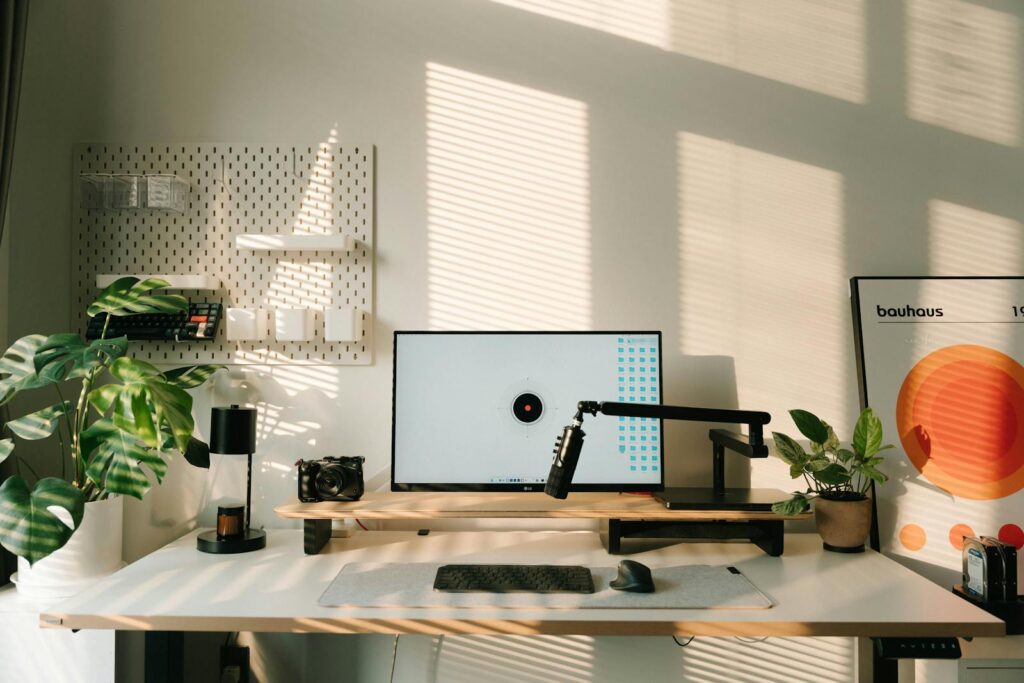
If the desk has to stay out, a 100-120cm width is the UK small-room sweet spot. Anything bigger and you’ll be wrestling it through the door; anything smaller and you can’t fit a monitor and a notebook side by side. A slim cable tray screwed to the underside keeps the back of the desk from looking like the floor of a server room. An electric sit-stand base adds about £200 and genuinely earns its keep if you’re on the desk more than 20 hours a week. If you’re on it less, a monitor arm and a cheap under-desk footrest is usually the better spend.
The trap to avoid: the “gaming” desk with RGB lighting and a carbon-fibre finish. It’s almost impossible to make that fit into a British bedroom without the room looking like it belongs to a 17-year-old.
Lighting that works on a grey Tuesday
We under-light our home offices because British ambient light is so poor we’ve stopped noticing. A grey day in Manchester in February is genuinely half the lux of a normal indoor office. Your eyes are working harder than you think, which is why you’re tired at 3pm.
Two lights, not one, is the rule. An overhead fitting for the room and a dedicated task light for the desk. The task light matters more than the overhead. Look for one with a colour temperature you can shift – cool white (around 5000K) in the morning, warmer (3000K) after dark. Anglepoise’s more affordable range and BenQ’s screen bars both do this well. If you’re on video calls, a small key light positioned slightly above and to the side of the camera will do more for how you come across than upgrading your webcam.
Don’t point a lamp at your monitor. Point it at the wall behind, or at the desk surface itself. Reflected light is kinder. And if your desk faces a window, you want the window to your side, not behind you (backlight) or in front of you (glare).
Sound, focus and not hating your housemates
If you live with anyone – family, flatmates, one loud cat – the acoustic problem is usually bigger than the visual one. The two fixes that actually work in a UK flat are soft furnishings and good headphones, in that order.
A rug under the desk, a curtain on the wall behind you and a bookshelf full of books will absorb more noise than any £300 acoustic panel kit. If you can’t hang curtains, a large canvas or upholstered headboard on the wall behind your chair will help on calls. You’re not soundproofing – you’re stopping your voice bouncing around a hard-surfaced room and sounding tinny to the person on the other end.
For the rest, a proper pair of noise-cancelling headphones is probably the single best-value thing you can buy for a small home office. Our round-up of the best noise-cancelling headphones under £100 has a few pairs that genuinely punch above their price, and for most hybrid workers that’s the right budget. Anything more and you’re buying audio quality that matters for music, not for calls.
The tech you actually need (and what you don’t)
The temptation is to gear up. Resist most of it. The list of things that pay for themselves in a small UK home office is shorter than the internet suggests:
A second screen, even a 24-inch one, is the single biggest productivity upgrade for anyone who works across documents. A monitor arm gets it off the desk surface so you can still use the table. A proper webcam only matters if your laptop camera is genuinely terrible and you’re on video more than an hour a day – otherwise the laptop camera plus decent light is fine. A mechanical keyboard is a pleasure but a quiet membrane keyboard is kinder to your household.
The things that are usually dead money: “ergonomic” vertical mice for people who don’t have wrist pain, curved ultrawide monitors in a bedroom (too big, too dominant), desktop speakers if you already have headphones, and almost any “smart” desk accessory that needs its own app. Our budget tech round-up has a more realistic view of what’s worth £50 or less – most of the genuinely useful bits for a home office sit in that bracket rather than the premium one.
One quiet hero nobody talks about: a 4-port USB-C hub with Ethernet. British home Wi-Fi is fine until it isn’t, and a £30 dongle will save you one dropped meeting, which is all the justification it needs.
Making the room feel like a home again after 6pm
The single most common mistake in UK home offices is letting the desk take over the room. By November, the bedroom reads as an office with a bed in it, and that does quiet damage to how you sleep and how you switch off.
Three small moves close the working day properly. Cable management so nothing dangles visibly – a cord cover or even a strip of wood across the back of the desk hides a multitude of sins. A closed storage box or caddy for the laptop, cables and notebook when you finish, so the desk surface is clear. And a lamp on a timer or smart plug that switches the desk light off at a set time, which sounds silly until you realise it’s the cue your brain has been missing.
The wider shift UK homes are making – away from the cold, hyper-minimal interiors that dominated the late 2010s and towards something warmer and more lived-in – applies here too. A home office room doesn’t have to look like an office. We wrote about why British interiors are moving on from cold minimalism, and the small-space office benefits more than most from that change: a desk in a room full of books, rugs and one ugly-but-loved armchair is a nicer place to spend a Wednesday afternoon than a sterile white corner.
A small home office is a setup problem, but it’s also a scheduling one. If you’re hybrid and at home two days a week, the setup only has to be good enough for those two days. If you’re full-remote, it has to be good enough for every day, and that changes the maths on almost every decision above – especially the chair. According to recent BBC coverage of the post-pandemic office, the hybrid arrangement has settled into something closer to permanence rather than a transition, so it’s worth treating your home setup as a long-term piece of your working life rather than a stopgap. Spend accordingly on the things you touch every day, and cheap out happily on the rest.
So: what’s the one thing about your current setup you’d change tomorrow if you had a spare £200 and an afternoon free?





Living in a Bristol one-bed with the desk in the bedroom and this is basically my daily life. The back-wrecking point is underplayed honestly – I went through two years of shoulder pain before I finally admitted the bedside table wasn’t a desk. Question though: any thoughts on fold-down wall desks versus a proper compact one from somewhere like John Lewis? Trying to work out if the wall-mount route is worth the faff.
Fold-down from experience – the Jarvis one IKEA used to do was fine for a year but the hinges started wobbling once I had a proper monitor on it. Went to a compact John Lewis 90cm desk in the end and it’s been far better for posture and for leaving work setup out overnight. Wall-mount’s only worth it if you genuinely pack away daily, which most of us don’t.
Pingback: The Kitchen Trends Reshaping British Homes This Spring - Lifestyle Reviewer
Pingback: Video Call Gear for UK Home Workers in 2026: What Actually Matters - Lifestyle Reviewer
Pingback: Home Office Lighting UK 2026: A Practical Guide to a Better-Lit Workspace | Lifestyle Reviewer
Pingback: Cable Management Home Office UK 2026: A Practical Guide to a Tidier Desk | Lifestyle Reviewer