
Easy Traybake Dinners for UK Weeknights: One-Tin Meals for Spring 2026
If your weeknight cooking has drifted into the same three meals on repeat, the traybake is a route out without asking much of you. One tin, one temperature, thirty to forty minutes in the oven and a proper dinner on the table – it is the format that gets British kitchens through term-time, long working weeks and the awkward bit of spring when you want something warm but not wintry. As we move deeper into the 2026 spring produce window, it is also the best way to make the most of new-season ingredients without standing over a hob.
In This Article
- Why the traybake earns its place on a UK weeknight
- The kit that actually matters
- The traybake formula that works every time
- Five traybakes to put on rotation this spring
- Common traybake mistakes (and how to dodge them)
- Making it work for different households
- Why this should be your default, not your fallback
Why the traybake earns its place on a UK weeknight
The traybake works because it strips cooking back to what actually matters on a Tuesday: everything goes in one tin, you do not hover, and the washing up takes thirty seconds. It forgives distraction, which is the real test of a weeknight recipe. Something on the school run went sideways? The tin is fine in the oven for an extra ten minutes. A meeting overran? It holds under foil.
The format also suits how most of us shop now. A pack of chicken thighs, whatever’s in the vegetable drawer, a few storecupboard aromatics – nothing demands a special trip. That matters when food inflation is still showing up in weekly shops, and when the gap between a planned meal and a takeaway often comes down to how many steps the recipe asks of you at 6.45pm.
Spring 2026 is a particularly good moment to lean into this. British asparagus is arriving, Jersey Royals will follow within weeks, and the supermarkets are stocking wild garlic in short windows. Traybakes let you drop these in without turning the meal into a project.
The kit that actually matters
You do not need a rack of specialist cookware. What you do need is one decent tin that can take heat without warping. A sturdy rimmed baking tray roughly 38 x 26cm is the workhorse – big enough for a meal for four without crowding. Crowding is the silent killer of traybakes: pack it too tight and you get soggy steam instead of caramelisation.
Beyond that, keep a bottle of decent olive oil within reach, a good flaky salt (Maldon or Cornish sea salt both do the job), and a lemon. These three things fix more weeknight dinners than any new gadget will. A sharp paring knife and a medium mixing bowl for tossing ingredients cover the rest.
If you are cooking for one or two, a smaller ceramic oven dish works well and doubles as your serving vessel, which saves another bit of washing up. For families of four or more, two tins on different shelves beat one overloaded tin every time.
The traybake formula that works every time
Most weeknight traybakes boil down to the same four-part structure. Get this into your head and you can improvise without a recipe.
One protein. Chicken thighs (skin on, bone in for flavour and forgiveness), sausages, a side of salmon, firm white fish, halloumi, or a tin of chickpeas drained and dried. Pick one.
Two vegetables that roast in similar time. Potatoes, squash and carrots are the thirty-to-forty-minute crowd. Peppers, courgette, red onion, fennel and tomatoes are the twenty-to-twenty-five-minute lot. Asparagus, tenderstem, spring greens and cherry tomatoes need ten to fifteen. Match to your protein’s cooking time, or add the quick ones later.
One flavour anchor. Harissa, pesto, a spice mix like ras el hanout, lemon and garlic, or a simple mustard-honey glaze. This is what stops a traybake tasting like a default.
One finishing hit. Fresh herbs, a squeeze of lemon, a drizzle of tahini, a spoon of yoghurt, a scatter of feta. This is the difference between something that looks roasted and something that looks cooked. Do not skip it.
Oven at 200C fan / 220C conventional. Tin in the middle of the oven. That’s it.
Five traybakes to put on rotation this spring
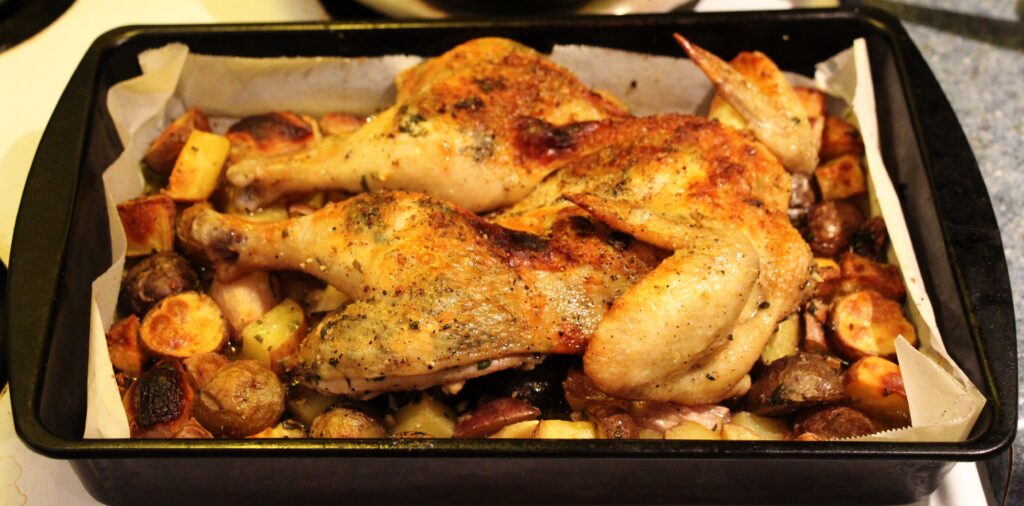
1. Lemon and oregano chicken with Jersey Royals and tomatoes. Bone-in chicken thighs, halved Jersey Royals (or any small waxy potato), cherry tomatoes on the vine added in the last ten minutes, a good lashing of olive oil, a whole lemon sliced, oregano, salt. Forty minutes at 200C fan. Finish with torn basil.
2. Harissa salmon with asparagus and chickpeas. Drained chickpeas tossed in harissa and oil, roasted for fifteen minutes. Add asparagus spears and a side of salmon brushed with more harissa. Back in for twelve to fifteen minutes until the salmon flakes. Yoghurt, lemon and a handful of mint to serve.
3. Sausage, leek and butter bean traybake. Good pork sausages, leeks cut into rounds, a tin of butter beans drained, a splash of cider or white wine, a tablespoon of Dijon, a sprig of thyme. Thirty-five minutes, stirring once. Crusty bread on the side.
4. Halloumi, courgette and red onion with pesto. Thick slices of halloumi, courgette in half-moons, red onion wedges, cherry tomatoes. Roast for twenty minutes. Finish with a generous spoon of pesto stirred through, plus toasted pine nuts. A meatless Tuesday that does not feel like a compromise.
5. Wild garlic and new potato chicken. The one to cook now, while wild garlic is still about. New potatoes, chicken thighs, a little butter, twenty-five minutes in. Stir through a rough wild garlic pesto in the last five minutes of cooking so the leaves wilt but keep their colour. For more on what to do with the rest of the bunch, our guide to wild garlic recipes for UK weeknight dinners has more ideas.
Common traybake mistakes (and how to dodge them)
The number one issue is overcrowding. If your ingredients are touching on all sides, they will steam rather than roast. Use two tins, or cook in batches. It is worth the extra minute.
The second is ignoring cooking times. Throwing cherry tomatoes in with potatoes at the start gets you potato-shaped pebbles and tomato mush. Learn the three tiers (long, medium, quick-cook) and stagger accordingly.
The third is underseasoning. A traybake takes more salt than you think because the heat concentrates the flavour of everything else. Season the raw vegetables in the bowl before they go in, not just at the end.
Fourth, the skimped fat. A proper traybake wants two to three tablespoons of oil over a full tin – any less and the edges go papery instead of crisp. And fifth, the cold finish. If you are not adding something fresh, bright or creamy at the end, the meal will feel flat no matter how well it roasted.
BBC Good Food’s editors made a similar point in their traybake recipe collection, flagging seasoning and finishing touches as the two moves that separate a good tray from a dull one.
Making it work for different households
For one or two people, scale to a smaller oven dish and save portioning for the plate. A whole chicken leg, a handful of potatoes and one vegetable is a proper dinner – do not overthink it.
For families with young children, keep the heat on the side. Cook the tray mild and hand over chilli oil, pickled chillies or hot sauce at the table for the adults. Sausage traybakes are particularly good for this, because the carbs and soft roasted vegetables appeal to the under-tens without any negotiation.
For batch cooks, traybakes reheat better than most weeknight meals. Roast a big tray on a Sunday, portion for lunches, and stir leftovers through grains or a salad through the week. Roasted vegetables in particular hold their dignity in the fridge for three days. The seasonal ingredients we flag in our round-up of the best spring vegetables for UK kitchens are all good candidates.
For anyone eating less meat, the halloumi and chickpea formulas are genuine meals rather than side dishes. Pair with a grain – farro, pearl barley, freekeh – cooked separately and dressed while still warm. If you are leaning into the asparagus season, our British asparagus recipes for spring 2026 show how to put it front and centre.
Why this should be your default, not your fallback
The traybake gets sold as a weeknight compromise, but the truth is it is often the better choice. You get the browning of roasting, the forgiveness of the oven, the single-pan clean-up and enough structure to improvise. The Guardian’s food team have called the roasting tin “the most democratic pan in the kitchen,” and that feels about right – it asks very little and gives back disproportionately.
Building a handful of these into your week takes the decision out of the evening. You know the format. You know roughly what’s in the fridge. You know it will be on the table in forty-five minutes from walking through the door. For most of us, that is the real definition of an easy weeknight dinner.
What traybake formula has actually stuck in your rotation – and is there one you keep meaning to try but haven’t?




The ‘forgives distraction’ line lands – I’ve left one in for an extra 15 minutes while wrestling bath time and it’s still been fine. Our go-to at the moment is sausages, cherry toms on the vine and new potatoes with a splash of cider vinegar over the lot. What’s your favourite early-spring veg to throw in at the moment – I can never decide whether purple sprouting or asparagus lands first in the shops down here.
Sausages and new pots is the exact recipe our house has been on all April. We chuck in leeks if there are any going – soaks up the fat beautifully. The cider vinegar tip is getting nicked though.
Pingback: Slow Cooker Spring Recipes UK: Weeknight Dinners That Mostly Cook Themselves | Lifestyle Reviewer
Pingback: Jersey Royals Recipes: Easy Weeknight Dinners for Peak British New Potato Season | Lifestyle Reviewer
Pingback: 15 Minute Weeknight Dinners UK: Fast, Fresh Meals for Busy Spring Evenings | Lifestyle Reviewer