
The Tech That’s Actually Making Family Travel Easier in 2026
Family travel tech in 2026 has quietly become something worth paying attention to. If you’ve ever spent half a holiday untangling charging cables, panicking over a missing suitcase, or trying to entertain a bored seven-year-old on a four-hour flight, you’ll know that even small tech upgrades can make a genuine difference. This year, a handful of gadgets and services have moved from “nice to have” to “why didn’t I get this sooner” territory.
In This Article
- Apple's Updated AirTag Is a Game-Changer for Family Travel Tech
- Universal Chargers That Actually Reduce the Cable Chaos
- Free In-Flight WiFi Is Finally Becoming Real
- Noise-Cancelling Headphones Sized for Children
- Translation Earbuds That Work Better Than You'd Expect
- Digital Luggage Scales – Still the Most Underrated Family Travel Tech
- What's Worth It and What Isn't
Here’s what’s actually worth your money – and what you can safely ignore.
Apple’s Updated AirTag Is a Game-Changer for Family Travel Tech
Apple released its second-generation AirTag in early 2026, and for families who travel regularly, it’s probably the single most useful upgrade of the year. The new model features a louder built-in speaker (handy when your toddler has hidden it inside a shoe), improved Ultra Wideband range, and better Precision Finding that works from further away.
At £29 for a single tag or £99 for a four-pack, the pricing hasn’t changed from the original. But the functionality has. You can now track luggage more reliably through airports, keep tabs on backpacks during school trips, and – perhaps most importantly – locate that one bag your partner swears they packed but can’t find anywhere.
For families flying this spring, slipping an AirTag into each checked bag is about as close to peace of mind as you’ll get. It won’t stop an airline losing your luggage, but it’ll tell you exactly where it’s ended up. According to Apple, the battery now lasts over 18 months with typical use, which means you can set it and forget it for most of the year.
Universal Chargers That Actually Reduce the Cable Chaos
Every family holiday involves the same ritual: someone forgets a charger, someone else brings three but none of them fit the hotel sockets, and by day two you’re all fighting over the one plug that works. It’s tedious, and it’s entirely avoidable.
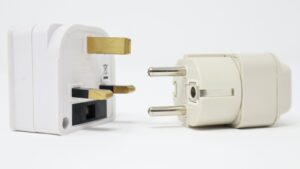
The TESSAN 65W universal travel adapter has become something of a quiet bestseller this year. It covers US, UK, EU, and Australian plug types in a single compact unit, with both USB-C Power Delivery and USB-A ports built in. The 65W output is enough to fast-charge a laptop, which means you can leave the bulky manufacturer charger at home.
For a family of four, one of these plus a couple of short USB-C cables covers pretty much everything. It’s not glamorous tech, but it’s the kind of thing that saves you twenty minutes of frustration every single evening of your trip. If you’re looking for more packing suggestions, we’ve put together a full guide to the travel gadgets worth packing before your next holiday.
Free In-Flight WiFi Is Finally Becoming Real
For years, airlines have promised decent in-flight connectivity and delivered something that barely loads a text email. That’s started to change in 2026, and British Airways is leading the charge in the UK market.
BA recently rolled out free Starlink WiFi across its fleet, and the difference is noticeable. We’re talking speeds that can handle video streaming, not just slowly refreshing a news app. For families, this is significant. Kids can watch their own content on tablets without downloading everything beforehand, and parents can actually stay connected if they need to.
Other airlines are following suit, though the rollout varies. EasyJet and Ryanair are both trialling satellite-based WiFi on select routes, though neither has confirmed free access yet. If you’re booking flights this spring, it’s worth checking whether your airline offers onboard connectivity – it can turn a stressful flight with children into something almost pleasant.
Noise-Cancelling Headphones Sized for Children
Adult noise-cancelling headphones have been brilliant for years, but finding a decent pair for kids used to mean choosing between flimsy character-branded ones that broke within a week or adult models that didn’t fit properly. That’s changed.
Several manufacturers now make proper active noise-cancelling headphones with volume-limiting features designed specifically for children’s ears. They cap the output at 85 decibels – the level recommended by the World Health Organisation – while still blocking enough ambient noise to make flights and train journeys far more bearable.
The best models fold flat for packing, have 20-plus hours of battery life, and come in colours that kids will actually choose to wear. Expect to pay between £40 and £70 for a good pair, which is a fraction of what you’d spend on in-flight entertainment or a new tablet to keep them occupied.
Translation Earbuds That Work Better Than You’d Expect
If your family holidays tend to take you beyond English-speaking countries, translation earbuds have improved dramatically. Timekettle’s latest models offer real-time translation across more than 40 languages, and while they’re not perfect, they’re good enough to handle restaurant orders, ask for directions, and have basic conversations with locals.
They work best for European languages – French, Spanish, Italian, and German translations are impressively smooth. Asian languages are improving but still have the occasional stumble. The key improvement in 2026 is latency: the gap between someone speaking and the translation appearing in your ear has dropped to under two seconds, which makes actual conversations feel much more natural.
At around £200 for a pair, they’re not cheap. But if you travel to non-English-speaking destinations two or three times a year, they’ll pay for themselves in reduced stress and better experiences. Your kids might even pick up a few phrases along the way, which is more than most language apps manage.
Digital Luggage Scales – Still the Most Underrated Family Travel Tech
This isn’t new tech by any stretch, but digital luggage scales remain one of the most underrated items you can pack. With budget airlines now charging £10 to £15 per kilo for overweight bags, a £12 digital scale pays for itself the first time it saves you from an excess baggage fee at the check-in desk.
Modern versions weigh to within 0.1 pounds, fold into a pocket-sized form factor, and take about five seconds to use. Hook the strap around your bag handle, lift, and read the display. That’s it. For families who always seem to accumulate extra stuff during a holiday – souvenirs, gifts, that enormous stuffed animal your child absolutely had to have – it’s a small investment that prevents a very annoying surprise at the airport.
According to Which?, excess baggage charges across major UK airlines have risen by roughly 15% since 2024. A luggage scale is about the simplest hedge against that you’ll find.
What’s Worth It and What Isn’t
Not everything marketed as family travel tech deserves your attention. Smart suitcases with built-in batteries are still banned by most airlines (the battery has to be removable, which defeats much of the convenience). Portable WiFi hotspots are increasingly redundant now that most EU roaming is included in UK phone contracts again. And those GPS tracker watches for children, while well-intentioned, tend to have patchy coverage and monthly subscription fees that add up quickly.
The tech that genuinely makes family travel easier in 2026 tends to be the stuff that solves a specific, recurring problem. AirTags for luggage anxiety. A universal charger for socket chaos. Noise-cancelling headphones for sanity on flights. None of it is particularly exciting on paper, but all of it makes the actual experience of travelling with children meaningfully better.
If you’re planning a spring or summer trip, start with the basics. You don’t need every gadget on this list – but one or two of them will almost certainly save you time, money, or a headache at some point during the journey.