

The Travel Gadgets Worth Packing Before Your Next Holiday
There is a particular kind of holiday stress that no amount of advance planning can fully prevent: the sinking feeling at baggage reclaim when your suitcase fails to appear. Or the frantic hunt through every pocket of your bag for a charger that somehow vanished before you even boarded. (If that charger anxiety sounds familiar, our roundup of the best portable power banks UK 2026 is the quickest fix.) Travel is genuinely wonderful, but the logistics around it can grind you down fast – especially with young children in tow. For families specifically, our guide to family travel tech gadgets 2026 covers the kit that keeps the peace on long journeys.
In This Article
- Apple AirTag 2 – finally, a tracker that earns its keep
- A compact power bank that works for everyone
- Noise-cancelling earbuds for the whole family
- One universal travel adapter – and actually using it
- Smart glasses – not yet for everyone, but worth knowing about
- The simple kit that still makes the biggest difference

The good news is that a handful of well-chosen gadgets can remove a surprising amount of that friction. Not the gimmicky kind that clutter up your bag and add weight for no return, but practical, well-designed kit that solves real problems. Here are the ones actually worth spending money on ahead of your next trip.
Apple AirTag 2 – finally, a tracker that earns its keep
Apple launched the second-generation AirTag in January 2026, and the improvements are meaningful rather than cosmetic. The original AirTag was already one of the most useful travel accessories you could buy – small enough to slip into a luggage zip pocket, cheap enough to lose without too much grief, and genuinely effective at locating bags through Apple’s vast Find My network. The new version builds on that foundation in three specific ways.
Precision Finding – the feature that uses your iPhone’s Ultra Wideband chip to guide you directly to a lost item with on-screen arrows and distance readings – now works from 50 per cent further away. That matters in a busy terminal or a hotel room where your bag has been stashed behind furniture. The speaker is also 50 per cent louder and carries twice as far, which means you can actually hear it ring when you’re on the other side of a luggage carousel. If you’ve ever had to crouch beside a slow-moving belt pressing your ear against bags that aren’t yours, you’ll understand why this matters.
The most significant new feature, though, is airline location sharing. If your bag goes missing – a problem that, according to aviation data, affected around 4.5 bags per 1,000 passengers in Europe last year – you can now share your AirTag’s location directly with participating airlines via the Find My app. Instead of telling a harassed check-in agent that your bag is “somewhere in the terminal,” you can show them exactly where it is. It’s a small shift, but in the middle of a delayed connection it could be the difference between retrieving your luggage before your hotel checkout and waiting two days for a courier.
AirTag 2 also adds support for Precision Finding on Apple Watch Series 9 and later, so you no longer need to pull out your phone at all. One AirTag costs £29, a four-pack is £99. If you check bags regularly, buying a four-pack and keeping one in each piece of luggage is straightforward maths.
A compact power bank that works for everyone
USB-C has, at long last, become genuinely universal. Airlines are catching up with USB-C seat ports, and most newer hotels have them too. That means the main thing you need from a power bank in 2026 is density – as much battery capacity as possible in as small a physical footprint as possible, with a USB-C port capable of fast-charging modern phones and tablets.
The Anker 737 Power Bank remains a strong pick for families, offering 24,000mAh with 140W output via USB-C and two additional USB-A ports for older devices. It’s large enough that you will want to check it in your hold luggage rather than carry it on, but for a family holiday where everyone’s devices need charging nightly, the capacity justifies the size. For lighter trips, Anker’s Nano series offers 10,000mAh in something roughly the size of a pack of cards – genuinely pocketable and airline carry-on friendly at under 100Wh.
One thing to check before you travel: the UK Civil Aviation Authority stipulates that power banks must be carried in hand luggage, not checked bags, and must be under 100Wh (roughly 27,000mAh). Airlines vary on whether they allow multiple banks per passenger, so it is worth confirming with your carrier before you pack.
Noise-cancelling earbuds for the whole family
A long-haul flight with a toddler who cannot settle is nobody’s idea of a good time – including the toddler’s. One underrated fix is a decent pair of noise-cancelling earbuds for adults, not because they will drown out a crying child (they won’t, and you probably don’t want them to), but because the constant roar of aircraft engine noise is one of the main reasons long-haul flights leave you exhausted. Removing that background drone for a few hours makes a noticeable difference to how you feel on arrival.
The Sony WF-1000XM5 earbuds remain the benchmark for compact noise cancellation, with genuine all-day battery life and a case that recharges them twice over. For children old enough to use earbuds safely, there are volume-limited options specifically designed for younger ears – the BuddyPhones Play+ wireless headphones cap at 85dB and fold down small enough to fit in a coat pocket. If the kids are occupied with a film and you can take the edge off the engine noise, the last two hours of a flight become considerably more bearable.
One universal travel adapter – and actually using it
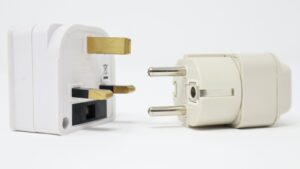
Travel adapters are the item most people either forget to pack or leave at home because they assume the hotel will have one. Many do, but the hotel adapter is typically shared, often missing, and usually occupies a single socket on the other side of the room from the bed. A compact multi-region adapter with built-in USB-C and USB-A ports solves this neatly.
The TESSAN 65W adapter is a sensible option that covers UK, EU, US, and Australian sockets in one block, with a 65W USB-C PD port fast enough to charge a laptop. At around £20 it is not glamorous, but it means you arrive in your hotel room and immediately have everything plugged in and charging, rather than spending the first twenty minutes hunting for sockets behind furniture.
Smart glasses – not yet for everyone, but worth knowing about
This one sits in the “interesting but not quite there” category for most travellers, but it is moving faster than many expected. The Solos AirGo V2 smart glasses launched in early 2026 with built-in AI assistant capabilities, real-time translation, and object recognition – the kind of features that, in principle, could be useful when navigating a foreign city or airport where you do not speak the language.
In practice, the technology still requires patience. Real-time translation works well for simple phrases but struggles with fast, colloquial speech. Battery life is limited compared to standard glasses. And the cultural awkwardness of wearing tech on your face in a restaurant has not entirely disappeared. But for travellers who already wear prescription glasses and are comfortable with early-adopter technology, the Solos AirGo V2 is genuinely the most polished version yet of a concept that has been promising much for several years. It is one to watch if not quite one to rush out and buy.
The simple kit that still makes the biggest difference
No gadget list is complete without acknowledging that the most useful travel gear is often the least flashy. A packing cube set – the kind with a compression layer – turns a suitcase from a jumbled mass into something organised enough that you can actually find things without unpacking everything. A lightweight dry bag from £8 upwards protects electronics and documents if you’re near water. A reusable silicone cable organiser weighs nothing and prevents the tangle of charger cables that somehow accumulates in every bag regardless of how carefully you pack.
The AirTag 2 is the standout new product this season because it addresses a genuinely frustrating problem with a meaningful upgrade. But the rest of it is about building a kit that travels with you reliably, charges everything without drama, and keeps noise and discomfort at a manageable level. Done right, it means arriving somewhere new feeling like yourself rather than like someone who has just survived a small ordeal. That, more than any single gadget, is the goal.




Pingback: Family Travel Tech That's Making Holidays Easier in 2026