

Booker Prize 2026 Winner: Why M John Harrison’s 198-Page Novel Was the Right Call, and the ‘First Sci-Fi Winner’ Label Is the Wrong One
The shortest book on the list won. At 198 pages, M John Harrison’s The End of Everything is thinner than most of the paperbacks you’ll see stacked by the tills this Christmas, and on Monday night at Old Billingsgate it beat 162 other novels to become the Booker Prize 2026 winner. Harrison is 81, the oldest winner in the prize’s history, and he’s spent the best part of 60 years being filed under science fiction by people who never quite got round to reading him. He’d never been shortlisted before. His publisher, Serpent’s Tail, had never won.
In This Article
- The Booker Prize 2026 winner nobody in the room was betting on
- What 198 pages of the end of England actually reads like
- Is it really the first science fiction winner?
- 81, and not a lifetime achievement award
- Where to start with M John Harrison (it may not be this book)
- What the win means for your Christmas list and your library queue
- A strange, good decision, and what it asks of the Booker next
And yet the most repeated line about this result – that it’s the first science fiction novel to win the Booker – is the least interesting thing you could say about it.
The Booker Prize 2026 winner nobody in the room was betting on
Let’s get the confession out of the way. When we went through the Booker Prize 2026 shortlist back in September, we said Harrison deserved it and Douglas Stuart would get it. The logic seemed sound enough. Stuart had already won with Shuggie Bain, John of John was the most emotionally direct book of the six, and five judges trying to agree on something usually land on the book nobody hates. A second win would have made him only the fifth author to take the Booker twice. It was a good story.
It was the wrong story. The panel – chaired by the classicist Mary Beard, with Jarvis Cocker, Raymond Antrobus, Rebecca Liu and Patricia Lockwood – spent a whole day arguing over the six books before agreeing unanimously on Harrison. Unanimous is the word that matters there. Booker panels have a long habit of splitting the difference, and this one could easily have done so; Marlon James’s The Disappearers had serious champions among critics, and Luke Kennard’s Black Bag was the book most people actually enjoyed. Instead they went for the strangest novel on the list, by the man least likely to be on the front table at Waterstones, and they didn’t hedge it. I’ll take being wrong about that.
Harrison seemed as surprised as anyone. “I really didn’t expect to be up here this evening,” he said in his acceptance speech, before adding, with a straight face, “here at the end of everything.”
What 198 pages of the end of England actually reads like
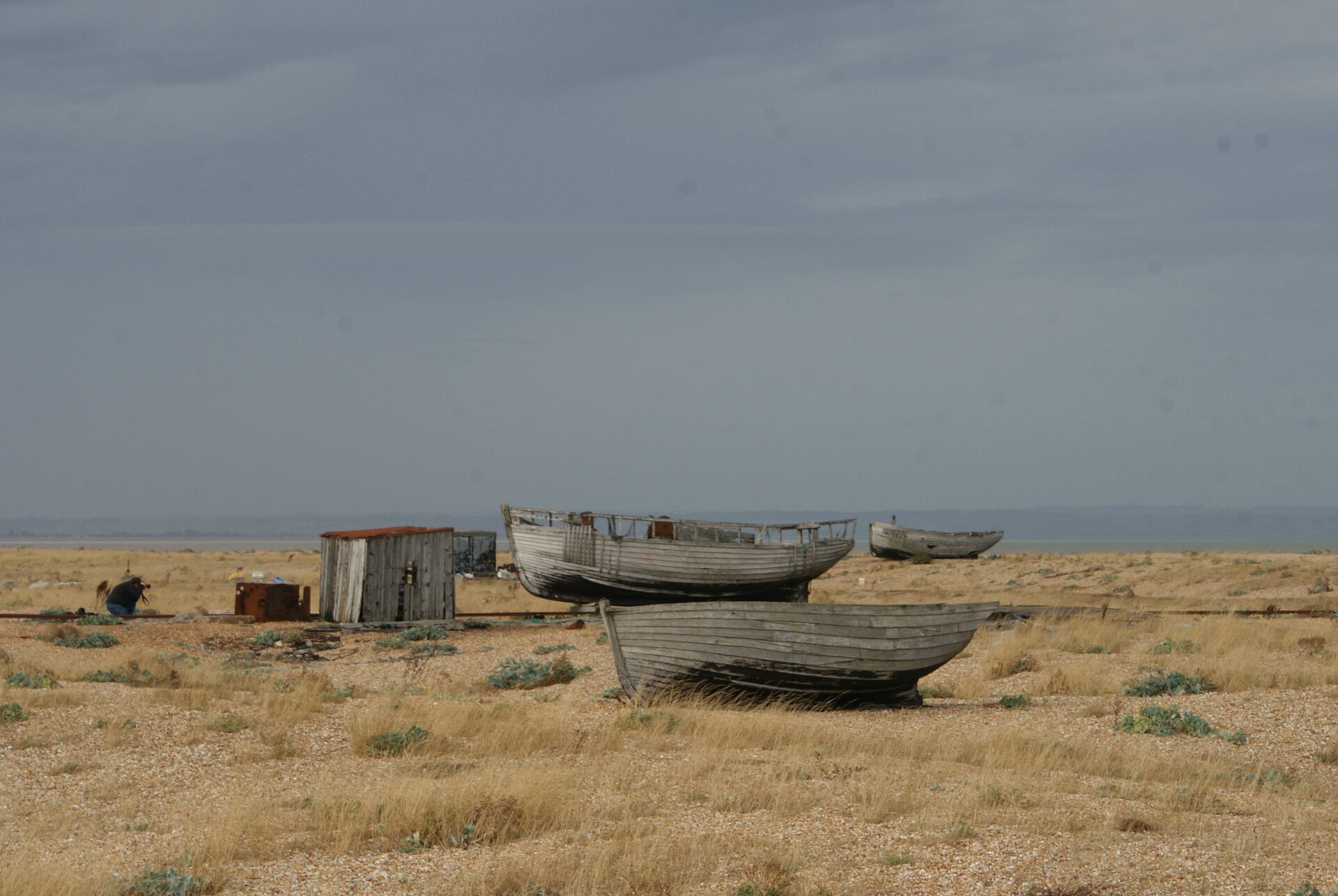
The plot, such as it is, goes like this. Phillip Tennent scrapes a living on the Kent coast in a town called Dalston-on-Sea, picking over whatever the Channel washes up. He lives with his aunt Marnie, who carries a pistol and is losing her memory. Europe, as the blurb puts it, “has been mislaid”. Something called the iGhetti – enormous, powerful lifeforms nobody can explain – are slowly invading. Phillip finds a bundle on the beach that turns out to be a kind of biological gadget, and in the judges’ own summary it becomes “a blob of jelly which quickly grows, develops speech and starts to tell his human minders what to do”.
If that sounds like a pitch for a Channel 4 comedy-drama circa 2008, it’s not far off in tone. The book is funny. It’s also bleak, oblique and in no hurry to explain itself, which is where readers will divide.
The reviews have been close to rapturous. Helen Macdonald in The Observer said, “I don’t think I’ll read a better book this year, perhaps decade.” Michel Faber in The Guardian called it “dreamlike and baffling”, which I’d suggest is both a compliment and a warning. But not everybody’s sold. Colm McKenna, writing in The Irish Times on the night of the win, was “less convinced”, arguing that the book makes it hard to properly engage with and that “who it’s for exactly is unclear.” That’s a fair hit, and I’ve some sympathy with it. There are stretches in the middle where you’re not entirely sure what you’re reading, and the book seems perfectly happy for you to stay that way.
Beard pushed back on the idea that it’s a difficult book, at least in the conventional sense. “It’s not difficult in terms of fancy words or confusing sentences,” she said. “As a reader, you are with the characters in not knowing what is happening.” That’s the key to it. Harrison isn’t withholding information to be clever; his characters genuinely don’t understand the disaster they’re living through, and he won’t let you understand it any better than they do. He described it to the Guardian as “a disaster story in which the disaster is the failure to comprehend.” Once you accept that, the confusion stops feeling like a puzzle you’re failing and starts feeling like the point.
One practical warning. The 198 pages are a trap. This is short, not quick. I read it over two evenings and a train to Ashford, and the second half went considerably slower than the first because I kept flicking back to check what I’d missed. Budget for that.
Is it really the first science fiction winner?
Gaby Wood, the Booker Prize Foundation’s chief executive, chose her words carefully. “Many past Booker Prize authors have borrowed facets of science fiction in their work,” she said. “But M. John Harrison is the first Booker winner to have emerged from the bona fide SF world.”
That’s accurate, and it’s also doing a lot of quiet work. Margaret Atwood shared the prize in 2019 with The Testaments, a dystopian sequel set in a future theocracy. Her 2000 winner, The Blind Assassin, has a pulp science fiction story folded inside it. Kazuo Ishiguro was shortlisted for Never Let Me Go, a novel about cloned children raised for their organs. The Booker has been rewarding speculative fiction for 25 years. What it hasn’t done is reward someone who came up through the magazines and the genre awards, rather than arriving at the end of the world via the literary fiction tables.
So the “first sci-fi winner” headline flatters the Booker more than it describes Harrison. It lets the prize look brave for crossing a line it’s been stepping over for decades. And Harrison himself doesn’t want the label. At the press conference after the ceremony he said genre categories “cripple you” as a writer, and that the win “gives you permission to be what you are without a label stuck on your forehead all the time”. Speaking to The Bookseller later in the week, he described genre as an overly “tight suit”.
Beard put it more bluntly: the win is “a recognition of what some people would see as the blindingly obvious: you find great books in every genre.” I’d go further. If this result means anything beyond Harrison himself, it should be that British publishers stop shelving writers like him in a separate room. Anyone who’s tried to find Christopher Priest or Gwyneth Jones in a high street bookshop knows exactly which room I mean – the one at the back, past the graphic novels, where the lighting’s slightly worse.

81, and not a lifetime achievement award
There was always going to be a temptation to read this as a gold watch. Harrison published his first short story in 1966. He’s won the Boardman Tasker Prize for mountain writing for Climbers, the Arthur C Clarke Award for Nova Swing and the Goldsmiths Prize for The Sunken Land Begins to Rise Again. He sat on the Booker judging panel himself in 2022. On paper, a late-career honour for a respected figure looks exactly like this.
Beard wasn’t having it. “He’s only 10 years older than me,” she told reporters. “We are not celebrating octogenarians.”
She’s right, and the book makes the case for her. The End of Everything doesn’t read like a summing up. It reads like someone who’s still annoyed about the present – Harrison has said the idea first came out of the 2008 financial crisis, and that “current affairs provided the themes and the satire” – and the jokes have the bite of someone a third his age. He told The Bookseller that being the oldest winner ever feels “weird because I still feel 26”, which is the sort of thing everyone over 60 says, except that in his case the prose backs it up.
Atwood held the age record before this, at 79 when she shared the prize in 2019. Her win had more than a whiff of the lifetime award about it, partly because it was shared and partly because The Testaments was nobody’s idea of her best novel. Harrison’s is different. The judges didn’t give it to him for the career. They gave it to him for a book that’s better than almost anything else published this year, and the age is a footnote that happens to make a nice headline.
There’s a less comfortable point in here too. Harrison had to wait until his 13th novel and his ninth decade to get onto a Booker shortlist at all, despite a body of work that writers from China Miéville to Robert Macfarlane have cited with something close to reverence. That isn’t a story about one brilliant late flowering. It’s a story about how long the prize, and the British literary press around it, managed to look past him.
Where to start with M John Harrison (it may not be this book)
Here’s my contrarian bit. If you’ve never read Harrison and you’re buying one book off the back of this win, The End of Everything is the obvious choice and probably not the best one. It’s his most recent, it’s got the sticker on, and it’s short. But it’s also late Harrison at his most compressed, and it assumes you’re comfortable being disorientated for long stretches. Some readers will love that from page one. Plenty will bounce off by page 40 and decide the Booker’s lost its mind.
A rough guide, depending on what sort of reader you are:
If you like literary fiction and want something grounded: start with Climbers (1989). It’s a novel about rock climbing in the north of England, almost entirely free of anything fantastical, and it’s where you can see how precise his eye for landscape and failure is. Then go to The Sunken Land Begins to Rise Again, the Goldsmiths winner, which is the closest thing to a bridge between that book and this one – two damaged people in post-Brexit London and the Severn valley, and a creeping sense that something’s living in the water.
If you like science fiction and want the big stuff: Light (2002) is the one people press on you, the first of his Kefahuchi Tract novels, and Nova Swing follows it. They’re dense, gleeful and occasionally exhausting. They’re also the reason so many British SF writers of the last two decades cite him at all.
If you want to understand the man: Wish I Was Here, his 2023 “anti-memoir”, is a slippery, fragmentary book about not wanting to write a memoir. It’s not for everyone and it won’t explain anything neatly, but it’s very funny about the business of being a writer.
The early Viriconium books I’d leave until last. They matter historically, and fans will argue with me, but they’re the ones most likely to put a newcomer off.
If you’d rather listen, Harrison’s sentences work well read aloud, and it’s worth checking our best British audiobooks of 2026 guide for which services make the numbers work before you commit to a subscription. And if you’re reading on a screen, the cheaper Kindles do this kind of book perfectly well – our best e-reader under £100 round-up explains why the entry model is enough.
What the win means for your Christmas list and your library queue
Booker winners sell. That’s the whole commercial point of the prize, and it’s why publishers fight to get onto the shortlist in the first place. A win in early November lands right at the start of the Christmas buying season, and the effect on a backlist author can be far bigger than on a writer whose last novel was already a hit. Expect bookshops to be restocking Harrison’s older titles over the next few weeks, and expect library reservation queues for The End of Everything to get long fast. If you’re borrowing rather than buying, reserve it this weekend, not next month.
As a present, it’s a tricky one. I’d give it without hesitation to anyone who loved Station Eleven or the stranger end of Ali Smith, and to anyone who reads a lot of literary fiction and claims to be bored of it. I’d think twice before giving it to a relative who likes Richard Osman and expects the Booker sticker to mean a cosy read. My dad, who reads one prize-winner a year on principle and has strong opinions about endings, is getting it anyway. I’ll report back on Boxing Day.
The independent angle matters as well. Serpent’s Tail is an imprint of Profile Books rather than one of the big conglomerates, and this is its first Booker win. That doesn’t make every Serpent’s Tail book a masterpiece, but it does mean a smaller house has done the thing the big groups usually do, which is good for everyone who wants British publishing to look less like four companies in a trench coat.
A strange, good decision, and what it asks of the Booker next
Every few years the Booker gets accused of choosing books that read like they were built to win the Booker – capably written, historically serious, a bit worthy. This year’s panel did the opposite. They picked a short, odd, funny, bleak novel by a writer who’s spent most of his career outside the room, and they agreed on it in a day. Harrison’s own prediction at the press conference was simple: “We will see more books like this.”
I hope he’s right, though I’m not convinced yet. One result doesn’t change how books get shelved, reviewed or marketed, and next year’s panel could just as easily pick a 600-page family saga and everyone will forget this happened. The test isn’t whether the Booker can reward a science fiction writer once. It’s whether the next Harrison, currently being published by a small press and reviewed in the genre magazines, gets onto a longlist at 45 rather than 81.
If you’re after more of this autumn’s books season, our pieces on Cheltenham Literature Festival and the Edinburgh Book Festival are a good place to find which shortlisted authors are touring next year. The full prize details are on the Booker Prizes site.
So which Harrison are you starting with – the jelly blob on the Kent coast, or the climbers in the north of England?