
Perimenopause Skincare UK: How to Rebuild Your Routine When Oestrogen Drops
Something unsettling happens to a lot of women’s faces somewhere between 40 and 45. The cleanser that used to work now leaves skin tight. Foundation clings to dry patches by mid-morning. Jawlines soften. The glow, whatever you thought of that word, quietly goes out. This is the bit the beauty industry has spent decades dancing around: perimenopause, and the way falling oestrogen plays out across the face.
In This Article
- What perimenopause actually does to skin
- Why your old routine has stopped working
- The ingredients that earn their place in a perimenopause skincare routine
- What to buy, and roughly what it costs
- A morning routine that actually holds up
- An evening routine with proper repair
- How long before any of this works
- What is not worth the money and when to see a GP
Getting perimenopause skincare right isn’t about fighting ageing. Plenty of women are entirely comfortable with getting older. It’s about adjusting a routine so skin stops feeling borrowed. The good news is that the genuinely useful ingredient list is short. The less good news is that you need to be more deliberate than you were in your thirties, and several products currently sitting in your bathroom are probably working against you.
What perimenopause actually does to skin
Perimenopause is the runway into menopause itself, usually starting somewhere in your early-to-mid forties and lasting anywhere from a couple of years to more than a decade. Oestrogen levels do not fall in a neat line – they swing, sometimes sharply, and then eventually settle lower. The NHS lists over 30 symptoms associated with this shift, and skin changes are among the most visible.
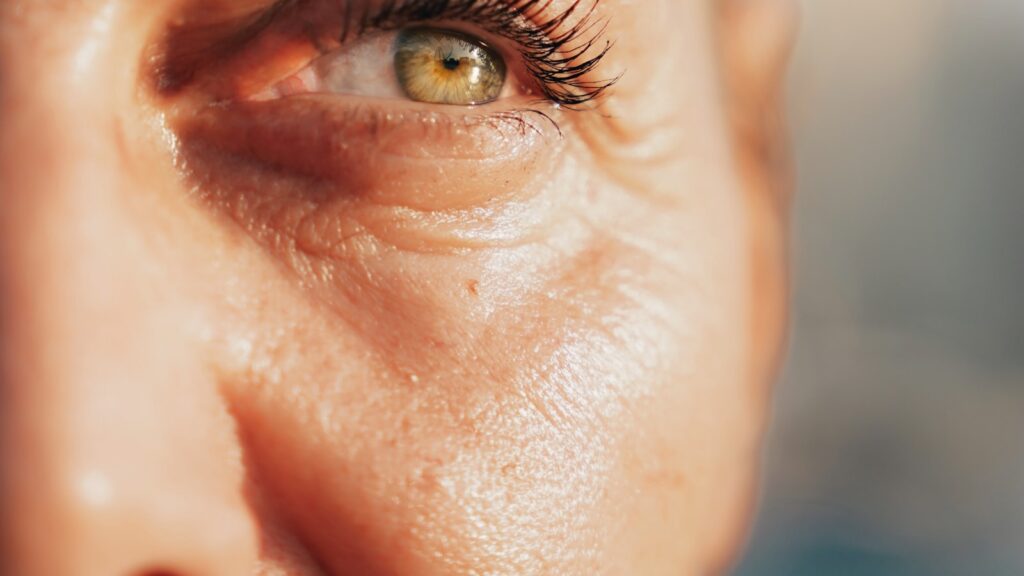
The mechanism is not complicated. Oestrogen helps maintain collagen, skin thickness, sebum production and the skin’s ability to hold water. As levels drop, collagen goes with it – research consistently shows women lose around 30% of their skin collagen in the first five years after menopause, with the decline starting earlier in perimenopause. We’ve covered that post-menopause drop – and why most “meno” creams don’t address it – in our menopause skincare guide. The practical effects are dryness, thinning, a duller tone, slower healing, more pronounced lines around the eyes and mouth, and for many women a late flare of adult acne or rosacea-style redness as the oestrogen-to-testosterone balance tips.
Most women first notice the change in winter. Skin that used to sail through central heating suddenly flakes along the jaw. Hot flushes leave patches of redness that take an hour to settle. Sleep is interrupted, and poor sleep shows up on the face within days. The symptoms tend to cluster, which is part of why perimenopause skin can feel like it has changed overnight even though the underlying shift has been creeping up for a while.
If flushes are leaving redness that won’t settle, it may be rosacea rather than hormones alone. Our guide to rosacea triggers covers the common culprits and what a GP can prescribe.
Why your old routine has stopped working
A routine built in your thirties is usually calibrated for a different skin – oilier, more resilient, faster to heal. Foaming cleansers that felt fine at 34 now strip the barrier at 44. Strong acids that used to clear congestion now trigger days of redness. Lightweight gel moisturisers no longer hold hydration through a British winter, let alone under the hot air of an office.
The shift is not that your products have become bad. It’s that your skin’s margin for error has shrunk. The barrier takes longer to recover, so anything that upsets it has a longer consequence. This is why the most important move in perimenopause skincare is often subtraction – fewer steps, gentler actives, and a hard look at anything that tingles, foams aggressively or promises to “resurface”.
The ingredients that earn their place in a perimenopause skincare routine
A useful perimenopause skincare routine tends to rest on five or six ingredients, used consistently rather than rotated in and out.
Retinoids remain the most evidence-backed ingredient for stimulating collagen and improving texture. The British Association of Dermatologists recognises topical retinoids as a first-line anti-ageing active, but perimenopausal skin usually cannot tolerate the concentrations a 30-year-old can. A low-strength retinol or retinaldehyde, two or three nights a week, buffered with moisturiser, is enough. Prescription tretinoin is an option for those who want faster results and are willing to ride out the initial dryness.
Peptides are the quieter sibling. They do not deliver the dramatic results of retinoids but they support barrier function and signal the skin to produce more collagen, with almost no irritation risk. A peptide serum layered under moisturiser is a low-effort addition that many women tolerate when retinol becomes too much.
Niacinamide at 4-5% helps with redness, uneven tone and barrier repair. It plays well with almost everything else and is the one ingredient worth having in both morning and evening routines.
Ceramides and cholesterol, sold in various proportions in barrier creams, are what replaces the lipids your skin is no longer producing in the same quantity. If your skin feels tight within a few minutes of cleansing, this is the gap you are feeling.
Azelaic acid deserves a special mention for perimenopausal skin that has started to flush or break out in new places. It calms redness, addresses post-inflammatory pigmentation and is gentle enough for daily use. We have a full guide to azelaic acid that covers concentrations and timing, and a separate piece on azelaic acid for rosacea if redness is your main complaint.
Sunscreen is the one non-negotiable. Thinner, slower-healing skin pigments more readily, and UV is responsible for the majority of visible ageing regardless of hormone status.
What to buy, and roughly what it costs
None of this requires a £200 routine. Most of it can come from Boots.
For cleansing, La Roche-Posay’s Toleriane Dermo-Cleanser (about £13) removes makeup without stripping, and CeraVe’s Hydrating Cleanser does a similar job for under a tenner – it’s on offer somewhere most weeks. On the moisturiser side, CeraVe Moisturising Cream (around £13 for a big tub) has the ceramide-cholesterol mix perimenopausal skin is short of, and it’s the one we’d hand to anyone starting from scratch. Weleda Skin Food, at about £9, has a cult following that products three times the price would struggle to earn. But it’s too greasy under makeup – treat it as a night cream.
For peptides, The Inkey List’s Peptide Moisturiser (around £15) is the cheap way in. No7’s Future Renew range got some ribbing for its “world first” launch campaign, but the peptide research behind it is more credible than most of what sits beside it on the shelf, and the serum runs about £35. The Ordinary’s Azelaic Acid Suspension 10% costs about £10; the texture is slightly gritty and nobody loves it, but it works. Paula’s Choice makes a nicer-feeling 10% booster at roughly four times the price – that’s what you’re paying for.
And for sunscreen, Altruist SPF 50 – founded by a British consultant dermatologist – costs about £11 for two 100ml tubes. At that price the usual excuse for not reapplying disappears.
Retinoids deserve a small table, because strength and format matter more here than brand loyalty:
| Product | Format and strength | Rough price | Best suited to |
|---|---|---|---|
| The Ordinary Retinal 0.2% Emulsion | Retinaldehyde, entry strength | About £12 | First-timers testing tolerance |
| La Roche-Posay Retinol B3 | 0.3% gradual-release retinol | Around £38 | Skin that has reacted badly to retinol before |
| Medik8 Crystal Retinal 3 | Retinaldehyde, stepped strength ladder | Around £45 | Anyone who wants a clear upgrade path |
| Prescription tretinoin (online dermatology clinics) | 0.025%–0.1% tretinoin | From about £25 a month | Fastest results, most initial dryness |
A morning routine that actually holds up
Mornings in perimenopause skincare benefit from restraint. A gentle cream or milk cleanser – or for many women, a simple splash of water – followed by an antioxidant serum (vitamin C if your skin tolerates it, niacinamide if it does not), a richer moisturiser than you used in your thirties, and broad-spectrum SPF 30 or higher.
The single biggest upgrade most women make in their forties is the moisturiser. Gel-creams that felt plenty in your thirties tend to evaporate off drier, thinner skin. A proper cream with ceramides, cholesterol and some form of humectant will hold up longer and leave a better base for makeup.
On sunscreen, the British Association of Dermatologists recommends a minimum SPF 30 daily, year-round, with generous reapplication if you are outdoors for extended periods. And no, the SPF in your moisturiser doesn’t count for much – we’ve explained why in our piece on SPF moisturiser versus sunscreen. Tinted mineral formulas are the easiest sell for women who feel their old base makeup no longer sits well.
An evening routine with proper repair
Evenings are where the active ingredients live. A double cleanse on makeup days – oil or balm first, then a gentle cream cleanser – followed by a targeted serum on alternate nights. Retinol or retinaldehyde two or three times a week. Peptides or azelaic acid on the off-nights. A richer night cream or facial oil over the top if your skin is particularly dry.
The temptation when skin starts visibly changing is to layer harder and faster – acids, retinol, vitamin C, the lot. This almost always backfires. Barrier damage in perimenopausal skin takes weeks to repair, not days, and the sensitisation often gets blamed on “my skin has become sensitive” when the real problem is a routine that has been pushed too hard.
If you are noticing new hormonal shedding around the hairline at the same time, a separate conversation is worth having – we have a piece on hair loss treatment in the UK that covers the perimenopausal overlap.
How long before any of this works
Slower than the adverts suggest, faster than you might fear.
Barrier repair is the quick win. Swap a foaming cleanser for a cream one and move to a ceramide moisturiser, and most women feel the difference – less tightness, makeup sitting better – inside two to four weeks. Redness from an over-worked routine settles on a similar timescale, provided you stop picking at it with new products every fortnight.
Retinoids are the long game. The collagen studies that make dermatologists confident in them ran for months, not weeks, and the visible payoff on lines and texture sits somewhere around the twelve-week mark at the earliest. The first month can look worse before it looks better. That’s normal, and it’s the point where most people give up – usually about two weeks before it would have started paying off.
Pigmentation is slowest of all. Azelaic acid and daily SPF will shift post-inflammatory marks, but you are measuring progress in months. Take a photo in the same light once a month rather than staring in the mirror every morning; the mirror lies about gradual change.
And one myth worth retiring on the way past: drinking more water does not hydrate perimenopausal skin in any meaningful way. Hydration failure in this skin is about the barrier not holding water in, not a shortage of supply. The eight-glasses advice is fine for everything else it does, but it will not fix a flaking jawline – a ceramide cream will.
What is not worth the money and when to see a GP
Most “menopause skincare” lines are standard formulations with a price uplift and a mauve-pink box. There is nothing wrong with the products themselves, but there is rarely anything in them that justifies the premium over a well-formulated cream aimed at dry, mature or sensitive skin. Pay attention to ingredient lists, not marketing categories.
Collagen drinks, despite a well-organised PR push, still have thin evidence behind them for skin outcomes. The same money spent on a proper retinoid and SPF is the better bet. Phytoestrogen creams sold as “natural HRT” are similarly weak on clinical data – they are not harmful, but they are not doing the heavy lifting their marketing suggests.
At-home devices are the other category worth a word. LED masks have a reasonable-but-not-spectacular evidence base for redness and collagen stimulation over long-term use. Microcurrent devices are pleasant and lift-flatter the face short-term but do not rebuild collagen. Radiofrequency and microneedling at home are worth scrutinising carefully; the in-clinic versions are far more effective and not always much more expensive when you factor in device cost plus replacement heads.
Finally: skincare can do a lot, but it cannot replicate the systemic effects of oestrogen. If perimenopausal symptoms are materially affecting your quality of life – sleep, mood, joint pain, skin included – HRT is worth discussing with your GP. The British Menopause Society publishes patient-facing information that is a useful starting point before an appointment.
What single change to your routine has actually made the biggest difference to your skin through perimenopause?




This is the first piece I’ve read that actually names what’s happening rather than just flogging a new cream. I’m 43 and my cleanser has been fighting me for about six months – only clicked reading this that the foundation-clinging thing is a symptom, not my technique. Is the collagen drop reversible at all with topicals, or is it really just slow-down management from this point?
The collagen thing is what hit me hardest to read too. My GP was straightforward with me – topicals will not reverse the structural loss but peptides and retinoids genuinely do slow the rate and make the surface look better in the meantime. Menopause HRT made a bigger difference to my skin than any serum, for what that is worth. I am 46 and six months in.