
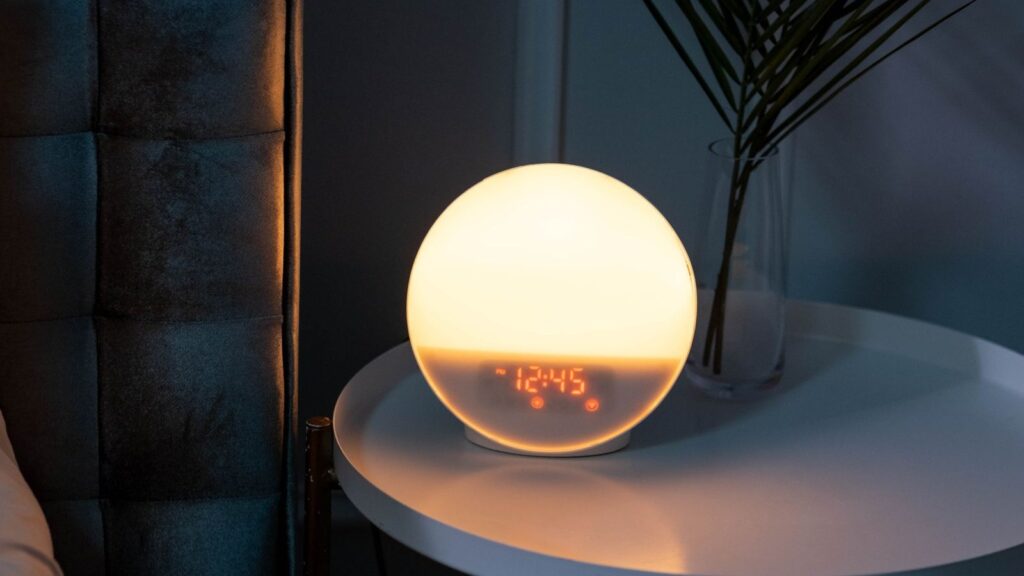
Sunrise Alarm Clock for Dark Mornings: What £105 to £190 Buys Before the Clocks Go Back on 25 October – and the 150 Lux Trap
A sunrise alarm clock can’t fix winter, and the box won’t tell you that. On Sunday 25 October the clocks go back, and by the week before Christmas the sun in London comes up just after 8am and has gone by just before 4pm. If you’ve been thinking about buying a sunrise alarm clock to get through it, the useful question isn’t which one is best. It’s what any of them can actually do at 150 to 320 lux, which is where the three Philips models sit, when a proper SAD light box delivers 10,000.
In This Article
- The sunrise alarm clock problem: it's a gentle alarm, not a treatment
- What a sunrise alarm clock does well
- What £105 buys, and why I'd skip it
- The £149 face-off: Philips HF3531 against the Lumie Bodyclock Shine 300
- Is the £189.99 Philips worth the extra £40?
- The cheap ones and the app ones
- Setting a sunrise alarm clock up so it actually works
- Before you spend anything: the free fixes
- Which one I'd buy
I haven’t tested any of the clocks below. What follows leans on the manufacturers’ own UK pages, T3’s review of the Philips SmartSleep and Tom’s Guide’s roundup, and I’ve said which is which. Where I’m giving an opinion rather than a fact, you’ll see it.
The sunrise alarm clock problem: it’s a gentle alarm, not a treatment
The idea is simple. Instead of a buzzer, a lamp brightens slowly over 15 to 90 minutes before you need to be up, so you surface rather than get dragged out of sleep. That’s it.
The NHS describes seasonal affective disorder as a type of depression that usually happens in the winter, and says light therapy uses a “SAD lamp” or light box with a bright light that simulates winter daylight. Its figure for a light box is 10,000 lux, UV-free, with a UKCA or CE mark. It also says light therapy isn’t usually available on the NHS because there isn’t enough evidence on how well it works, though many people find it helps, and that you should talk to a GP first if you have certain eye conditions or take medicines that make you sensitive to light.
Now compare. Philips lists its top SmartSleep at 320 lux, the middle one at 300 and the cheapest at 150. Do the sum: 10,000 divided by 320 is roughly 31. A light box is about 31 times brighter than the best Philips, and about 66 times brighter than the cheapest. The two jobs are different, so don’t buy one expecting the other. If you suspect SAD, our guide to SAD lamps under £50 covers the light box side, and a GP is the right first call.
What a sunrise alarm clock does well
It does one thing, and does it better than a phone. T3’s reviewer, who admits to struggling to wake up, tested the Philips SmartSleep with a 7am wake time and a 6.30am start. The light was natural rather than painful to look at, and they woke naturally most mornings. They still wanted some sound to finish the job, which tells you something.
That matches the one caveat Tom’s Guide attaches to the Lumie Bodyclock Shine 300: it may not wake you with light alone. If you sleep like a dropped brick, the light gets you most of the way and the birdsong or radio does the rest.
And there’s a decent reason to want that. A noisy alarm at 6.45am in pitch black is a nasty way to start the day. The sunrise ramp swaps the shock for a slow fade.
What £105 buys, and why I’d skip it
Philips sells the SmartSleep Wake-Up Light HF3505 at £105. It’s 150 lux, and Philips’ own page shows no adjustable sunrise length on this one, where the two dearer models have it. That’s the model I’d leave on the shelf.
Here’s the reasoning, and it’s opinion. The whole point is a ramp that finishes when you need to be up. If you can’t change the length of that ramp, you’re fitting your mornings around the lamp, not the other way round. And 150 lux is half the brightness of the £149.99 model. Saving £45 to get a dimmer light with less control is a poor trade. The two-year warranty and 30-day returns are the same across the range, so it’s not a safety net either.
It does make sense in one case: a spare room or a child’s room where you want a soft nightlight-style glow and don’t care about the finer points. For anyone buying it to survive the dark months themselves, it’s the wrong end of the range.
The £149 face-off: Philips HF3531 against the Lumie Bodyclock Shine 300
This is the real decision, and it comes down to 99p. Philips lists the HF3531 at £149.99 with 300 lux and an adjustable sunrise. Lumie lists the Bodyclock Shine 300 at £149.
On paper the Lumie has more going on. The sunrise and sunset run from 15 to 90 minutes, there are 15 sleep and wake sounds plus an FM radio, the display dims itself, and the warranty is three years against Philips’ two. There’s a 45-day trial too, though you need the original packaging and delivery isn’t refunded. Lumie also lists it as a Class I medical device, certified to UK MDR 2002 and EU MDR 2017/745. That’s a regulatory category, not proof it treats anything, and Lumie’s page doesn’t state a lux figure at all. That’s a gap I’d want filled before buying on brightness alone.
Philips has the better reputation for the light itself. Tom’s Guide picks the Philips as best for simulating natural light, and says it suits people who want a light-first wake-up without noisy audio. The same roundup rates the Lumie best for SAD, praising the warm LEDs with reduced blue light and a cosy atmosphere. T3, meanwhile, names the Shine 300 its favourite wake-up light overall, calling it more advanced and more expensive than the Philips it reviewed.
So who wins? For most people, the Lumie, on the three-year warranty and sound options alone, assuming you want the radio and the choice of sounds. If you want the plainest possible sunrise with no fuss, the Philips is easier to live with, since T3 describes its settings as customisable and its touchscreen controls as simple. One caveat: that review is from November 2024, and T3 mentions newer Philips models, so check you’re comparing like for like.
Is the £189.99 Philips worth the extra £40?
The HF3651 is the top of Philips’ UK range at £189.99, with 320 lux. Against the £149.99 model you get 20 more lux, which is a 6.7% rise and not something you’d notice in a dark bedroom. What the page does list is the RelaxBreathe light-guided relaxation programme, and it’s on this model only.
That’s a wind-down feature. A light pulses and you breathe along to it. Some people will love it. Plenty won’t use it after the first week, and I’d put myself in that group. Paying £40 for it is a bet on a habit you haven’t built yet.
Note that T3 listed the SmartSleep at £199.99 and a maximum of 315 lux, which doesn’t quite match the £189.99 and 320 on Philips’ current page. Prices and revisions move, so treat the figures here as a snapshot from mid-October and check the retailer before you pay.
One group should be wary: if you work nights or rotate shifts, a lamp timed to your wake-up still has to compete with a body clock that’s been told different things on different days. That’s a case for talking to someone who knows your schedule, not for a £150 gadget. The same goes if you’ve already been diagnosed with an eye condition. The NHS advice on light therapy is to speak to a GP first, and a brightening bedside lamp is close enough to that territory that the advice is worth following.

The cheap ones and the app ones
I can’t give you verified UK prices for the budget end, and I’m not going to guess. What I can report is what Tom’s Guide found. Its budget pick, the JALL Wake-Up Light, has 20 brightness levels, 17 coloured lights and a built-in radio, and was priced at $35.98 on sale in the US. The tester’s own catch: it feels budget and may lack longevity. The Dreamegg, the roundup’s Hatch alternative, was $59 on sale, and the tester says its light quality isn’t a patch on the Hatch but it does the job. Those are dollar prices, so don’t read them as pounds.
Then there’s Tom’s Guide’s overall winner, the Hatch Restore 3. It’s praised for sound and design, and it comes with the two things I’d steer clear of: a monthly subscription fee, and a need for a smartphone and wifi. A bedside lamp that wants an account is one more thing to break at 6am.
My view: cheap units are fine as an experiment if you accept the longevity risk, and anything that asks for a subscription is overrated for what it does. If you’re using one for a handful of winters, buy once, with a decent warranty, and be done with it.
Setting a sunrise alarm clock up so it actually works
The T3 test is a useful template: a 30-minute ramp, finishing at the time you need to be awake. Start there. Lumie’s range runs from 15 to 90 minutes, and Philips’ two dearer models let you adjust the length too, so there’s room to experiment.
Put it where the light reaches your face, not behind a lamp or tucked at the far end of a shelf. A bedside table works. A dresser across the room doesn’t. It also needs a clear line past anything you’ve stacked in front of it, which sounds obvious until you notice the pile of books you’ve built there.
Give it two weeks before you judge it. Your body clock doesn’t reset overnight, and the first few mornings are as likely to feel odd as better. That’s one reason Lumie’s 45-day trial matters more than it first looks. It covers the whole adjustment period and a good chunk of the dark weeks after it.
The sunset setting is the part people forget. Lumie’s Shine 300 and Philips’ top model simulate sunset as well as sunrise, so the lamp fades down as you fall asleep, and Tom’s Guide lists sunset timers on the Dreamegg too. Whether that helps you drop off is a personal thing. I’d try it for a week, then switch it off if you find yourself watching the fade instead of sleeping.
Before you spend anything: the free fixes
Some of the dark-morning problem has nothing to do with light. If the bedroom’s hot or the phone’s still in your hand at midnight, a lamp won’t save you. Our piece on caffeine cut-off times is worth a read if the real issue is that you aren’t sleeping well enough to wake up easily in the first place.
Open the curtains the moment you’re up. Get outside for ten minutes before work, even when it’s grey, because daylight is still brighter than any bedside lamp. Keep the wake time the same at weekends.
If you’re already thinking about the winter bills as well as the dark, the energy-saving gadgets that actually work and the car jump starter test belong to the same pre-clock-change list.
Which one I’d buy
A quick note on timing. Retailers are already warming up for Black Friday on 27 November, and wake-up lights are the kind of thing that gets knocked down in a sale. I can’t promise it will, and I haven’t seen the offers yet. But the dark mornings start on the 25th, and six weeks of waking up in the gloom costs more than the £20 or £30 a discount might save. If you want one for this winter, buy it now and use the trial window.
If I had £150 to spend this week, I’d buy the Lumie Bodyclock Shine 300 and use the 45-day trial to find out whether I actually liked waking up that way. I wouldn’t spend £190. I wouldn’t buy the £105 one. And I wouldn’t expect any of them to do what a 10,000 lux light box does, because the numbers say they can’t.
The clocks go back in under two weeks. Would a slow, bright wake-up change how you face a 7am start in December, or is the real problem that it’s still dark when you finish work?