
7 Best Festival Tech Essentials UK 2026: The Under-£80 Kit That Survives a Wet Weekend in a Field
The festival tech essentials UK 2026 list looks different this year, and not just because phone batteries keep getting worse. After a wet 2025 season that drowned more than one charging tent at Latitude, festival-goers are getting smarter about what they actually carry into a field. The right kit is no longer about the flashiest gadget – it’s about what survives four days of mud, rain and 80,000 other people queuing for the same plug socket. This is the seven-piece kit I’d take to Latitude, TRNSMT or Boomtown next month – all under £80, all tested somewhere damp.
In This Article
- Why festival tech essentials UK 2026 look different this year
- The seven-piece kit at a glance
- 1. A 20,000mAh power bank (around £45)
- 2. A waterproof Bluetooth speaker (around £55)
- 3. Wired earbuds for when the wireless ones die (around £15)
- 4. A proper head torch, not your phone torch (around £25)
- 5. A solar-charging Bluetooth tracker for your tent (around £35)
- 6. A microSD-to-phone card reader for your camera (around £15)
- 7. A waterproof phone pouch (around £12)
- The battery strategy that actually gets you to Monday
- What I'd skip from the typical festival tech list
- A note on signal and eSIMs

Why festival tech essentials UK 2026 look different this year
Two things have shifted. First, on-site charging at the big UK festivals is now mostly paid – official lockers and most secondary charging stations charge £3-£5 per phone, per top-up, and queues regularly hit 90 minutes on a Saturday afternoon. Second, modern phones drain harder in fields than they did three years ago: poor signal forces them to hunt for towers, eSIMs ping more often, and constant 4K filming chews battery in a way the iPhone 12 never did. The result is that your festival tech essentials UK 2026 kit needs to be more self-sufficient than it used to be – and lighter, because nobody wants to carry a brick across a 40-minute walk from the campsite.
There’s also the small matter of the calendar. 2026 is a fallow year for Glastonbury – Worthy Farm is resting, as our piece on why the empty weekend is reshaping British festival culture covers – which means the crowds that would have gone to Somerset are being absorbed by Latitude, TRNSMT, Boomtown, Reading and the independents. Busier sites, longer charging queues, more strain on the networks. The kit matters more this year, not less.
A good rule of thumb: assume zero mains power for the whole weekend, and one heavy downpour. Everything below is sized against that assumption.
The seven-piece kit at a glance
| Item | Typical price | The spec that matters |
|---|---|---|
| 20,000mAh power bank | £40-£50 | 20W+ USB-C Power Delivery output |
| Waterproof Bluetooth speaker | £50-£60 | Genuine IP67 rating, clip-on size |
| Wired backup earbuds | £10-£15 | USB-C plug (check your phone first) |
| USB-rechargeable head torch | £25 | 30+ hour runtime on one charge |
| Solar Bluetooth tracker for the tent | £30-£40 | Works with your phone’s native Find network |
| microSD-to-USB-C card reader | £10-£15 | Reads full-size SD and microSD |
| Waterproof phone pouch | £10-£15 | IPX8 rating, lanyard, touch-through plastic |
1. A 20,000mAh power bank (around £45)
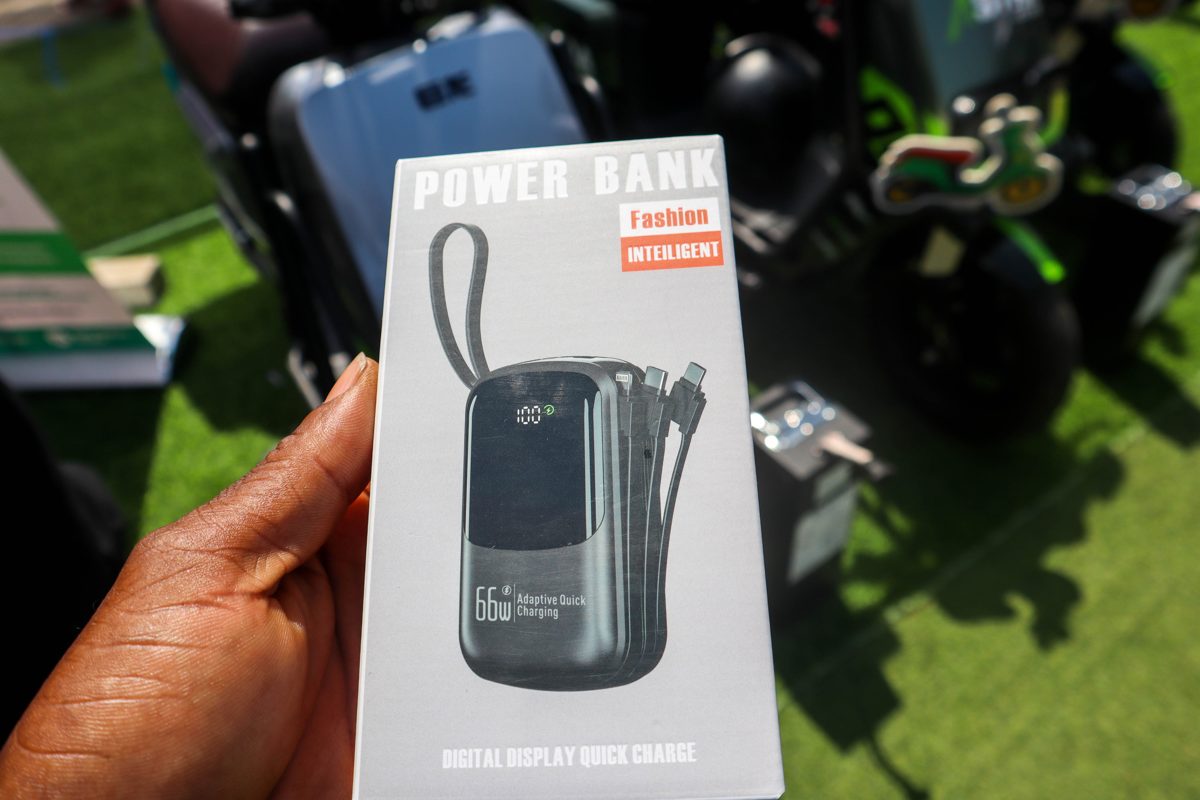
The single most important thing in any festival kit. A 20,000mAh bank with USB-C Power Delivery will fully recharge a modern smartphone three to four times, which is enough for a long weekend if you’re sensible about screen brightness. Look for one with at least 20W PD output – that’s the threshold for fast-charging most current iPhones and Pixels. Anker, INIU and UGREEN all sit around £40-£50 for honest 20,000mAh capacity in mid-2026.
Avoid the £20 no-name banks on Amazon. Which?’s ongoing portable power bank testing has repeatedly found that budget banks deliver as little as 50% of their stated capacity, which is the difference between making it to Sunday night and going dark on Saturday afternoon. For more detailed picks, our full guide to the best portable power banks UK 2026 covers seven specific models worth packing.
One practical note if you’re flying to a European festival instead: 20,000mAh (roughly 74Wh) is comfortably under the 100Wh limit airlines apply to lithium batteries in hand luggage, so it travels fine. The 50,000mAh monsters don’t. And power banks always go in the cabin, never the hold – airlines are strict on this and will pull your bag.
2. A waterproof Bluetooth speaker (around £55)
The campsite speaker is non-negotiable. The current sweet spot is the JBL Clip 5 or the Anker Soundcore Motion 100, both around £50-£60, both genuinely IP67-rated. IP67 matters: it’s the difference between “survives a splash” and “survives being dropped in a puddle and stepped on”, which is the actual environment you’re testing in.
Skip the bigger Bluetooth speakers for festivals – JBL Boomboxes and similar are heavy, get nicked, and you’ll regret carrying one across a field at 2am. A clip-on at hip size is the right answer. If you want something bigger for the garden when you’re back home, our tested guide to the best garden Bluetooth speakers covers that category properly – but don’t take any of those to a field.
3. Wired earbuds for when the wireless ones die (around £15)
Counterintuitive, but bear with me. AirPods last about five hours of continuous playback, and the case dies inside a weekend with no charging. A £15 pair of wired earbuds with a USB-C plug (or Lightning, for older iPhones) means you can still listen to a podcast on the coach home when your wireless kit is flat. Sony’s MDR-EX15LP and the SoundMagic E11C are both quietly excellent at this price. Treat them as a backup, not a daily driver, and they’ll save you on the Monday morning.
4. A proper head torch, not your phone torch (around £25)
Using your phone as a torch at 1am to find your tent is how phones die. A decent USB-rechargeable head torch – Petzl Tikkina or LedLenser MH3 are both around £25 – runs for 30+ hours on a charge, leaves both hands free, and means you can actually find the loo without holding a 6-inch glass slab in the rain. The Petzl is the lighter of the two; the LedLenser throws further. Either is a transformative bit of festival tech if you’ve never bothered before.
Bonus: it doubles as a tent light, which is much less annoying for your neighbours than a phone screen on full brightness.
5. A solar-charging Bluetooth tracker for your tent (around £35)
This is the upgrade that I’d genuinely call life-changing for a UK festival. Drop an Apple AirTag or a Chipolo One into a small solar tracker case (Pebblebee and Chipolo both now sell these for £30-£40), clip it to your tent’s apex, and you can find your camp from anywhere on site via your phone. The solar element means it won’t die mid-weekend, which is the historic failure mode of stick-on trackers.
For Android users, the Chipolo One Point is the better pick – it works natively with Google’s Find My Device network, which has full coverage at every major UK festival now. For iPhone users, an AirTag is still the cleanest answer.
6. A microSD-to-phone card reader for your camera (around £15)
If you’re shooting on anything other than your phone – a film camera with a digital back, a GoPro, a friend’s older mirrorless – a £10-£15 USB-C card reader lets you offload to your phone on site rather than carrying a laptop. Sandisk and UGREEN both do compact ones for around £12. Pair it with one of those free 5GB Google Photos uploads over festival Wi-Fi and you’ve got a backup of your weekend before you’ve even left site.
This is the festival tech essentials UK 2026 pick that almost nobody mentions but every photographer I know carries.
7. A waterproof phone pouch (around £12)
Not a case. A pouch. The clear plastic kind with a lanyard, IPX8-rated, the sort you’d take kayaking. They cost £10-£15, they fold up flat in a back pocket, and they’re the difference between a working phone and a £900 paperweight when the sky opens on Sunday. The Joto and Mpow ones on Amazon are perfectly fine – this isn’t a category that rewards spending more.
You can still operate the phone through the plastic, so you don’t have to choose between protecting it and using it. Worth noting: don’t trust them in deep water, only rain – the seams give up at depth.
The battery strategy that actually gets you to Monday
Kit is half the answer. The other half is how you use the phone, and most people get this wrong in the same three ways.
Do the heavy downloading before you leave. Offline maps of the site, your playlists, your tickets saved to your phone’s wallet, the set times as a screenshot. Every one of those things costs ten times more battery to fetch over a weak festival signal than it does over your home Wi-Fi on Thursday night.
Then manage the radio, because the radio is the real battery killer. A phone with one bar of signal drains faster than a phone playing video, because it never stops hunting for towers. Low power mode from the moment you arrive. Airplane mode overnight, and in the arena when you know you won’t reach anyone anyway. Agree physical meeting points with your group – the flag, the bar, the left side of the sound desk – because “I’ll ring you” is a plan that fails at exactly the moment you need it.
And charge deliberately, not opportunistically. Topping up by 15% here and there wastes the bank’s capacity on charging losses. The efficient pattern is one full charge overnight, phone and power bank both zipped inside the tent where it’s dry. Do that, plus low power mode, and a single 20,000mAh bank will carry two people to Monday. I’ve watched someone’s phone become the group hotspot on a Friday afternoon and die by six; don’t be the hotspot.
What I’d skip from the typical festival tech list
A few things that get recommended but really aren’t worth the weight. Portable solar panels for phones – the panels you can actually carry to a festival generate so little charge in British weather that a £40 power bank will do more for you. Smart bottles with hydration tracking – a £2 reusable bottle and a working memory does the same job. “Festival smartwatches” – any watch you wear is a festival watch; you don’t need a category for this. Handheld portable fans – five minutes of joy on the walk in, dead weight for the rest of the weekend, and the motors give up the first time one gets damp. And anything that needs to be paired with an app you haven’t already opened in six months, because you won’t open it at 11pm in a field either.
Drones deserve their own mention: nearly every major UK festival bans them outright, security will confiscate them at the gate, and the airspace over big sites is usually restricted anyway. Leave it at home however good the aerial shot would have been.
If you’re thinking more broadly about a budget UK summer kit, our guide to the 10 best budget tech gadgets under £50 UK 2026 has more general-purpose picks. And if you’re still putting an outfit together, our festival outfits UK 2026 guide covers what’s actually wearable in a wet July.
A note on signal and eSIMs
One last thing worth mentioning, because it doesn’t fit cleanly into the kit list: signal at UK festivals in 2026 is meaningfully better than it was, but it’s still inconsistent. With Glastonbury resting this year, the pressure moves to the other big sites – Three has improved at Latitude, EE is generally the strongest network at the large southern festivals, and Vodafone is still patchy at Reading. If you’re on a smaller network, an eSIM from Airalo or Holafly for the weekend is £8-£12 and gives you a backup line – useful for splitting groups, less useful for solo trips. We covered how the switching works in our guide to eSIMs for UK travellers, and the same logic applies in a Suffolk field as it does in Spain. The Guardian’s reporting on festival connectivity has good background if you want to read more.
What’s the one piece of festival tech you’ve stopped bothering to bring – and what replaced it? I’d love to hear what’s actually made it into your bag for this year’s run.