FeaturedFitnessHealth

Reformer Pilates in 2026: What £40 a Class Buys – And What a £12 Mat Class Does Just as Well

The most oversubscribed exercise class in Britain this autumn runs on a machine designed in a First World War internment camp. Reformer pilates – the one with the sliding carriage, the springs and the straps – has gone from physio-clinic curiosity to the workout your colleague, your mum and at least two of your WhatsApp groups are currently on a waitlist for. Studios are opening in converted banks and empty Wilko units. The 6.45am classes book out by Sunday lunchtime. And the price has climbed with the demand: £38 to £45 a class in central London now, £22 to £30 in most cities, before you’ve bought the grip socks.

Which raises the question nobody asks out loud in the changing room: what does the machine do that a £12 mat class in a church hall doesn’t?

I’ve spent eight months and a faintly embarrassing amount of money finding out. The answer is more interesting – and rather cheaper – than the studios would like it to be.

How a hospital bed with springs became Britain’s poshest workout

Joseph Pilates was a German boxer and circus performer interned on the Isle of Man during the First World War. To keep injured and bedridden fellow internees moving, he rigged springs to the frames of hospital beds so they could push and pull against resistance while lying down. That contraption, refined over a century and upholstered in vegan leather, is the reformer you’re now queueing to lie on.

The queue is real. ClassPass has named pilates its fastest-growing workout in back-to-back annual reports, and the boutique chains have responded the way boutique chains do – by opening everywhere at once. My nearest market town has three reformer studios and no butcher. The same post-lockdown appetite for organised, bookable fitness that filled Hyrox ballots has filled the reformer timetable, with one difference: this boom skews heavily towards women in their thirties, forties and fifties, many of whom hadn’t set foot in a gym for years.

It photographs beautifully, which hasn’t hurt. A reformer studio looks like a spa. Nobody’s dropping a barbell. And September, when the school run resets and everyone decides to become a new person, is precisely when the waitlists get silly.

The price map is its own story. London boutiques sit at £38 to £45 a class, the mid-market chains around £28 to £32, and a studio above a vape shop in a northern town will still relieve you of £18 to £22. Intro offers – three classes for £30 or so – are how most people get hooked, and the studios know it.

What a £40 class is actually like

My first one, back in January, was 7.15am in a converted picture-framing workshop. Eight machines, warm lighting, a playlist pitched somewhere between hotel lobby and slow-motion film trailer. The instructor – a former dancer, because they’re all former dancers – clocked within ninety seconds that I had the hip mobility of a filing cabinet, and adjusted my springs without making a thing of it.

The work itself is deceptive. You move slowly. You hold things. You do fifteen small pulses when your leg wanted to stop at eight, and somewhere around minute thirty a muscle you couldn’t previously name starts trembling like a washing machine on spin. I didn’t sweat much. I also couldn’t laugh without wincing for two days, which pilates people wear as a badge of honour and describe, accurately, as “finding muscles you didn’t know you had”.

What struck me most wasn’t the exercise. It was the choreography of the service: the named greeting, the water with cucumber in it, the sense of having attended an appointment rather than survived a workout. That’s not a criticism. It’s the product.

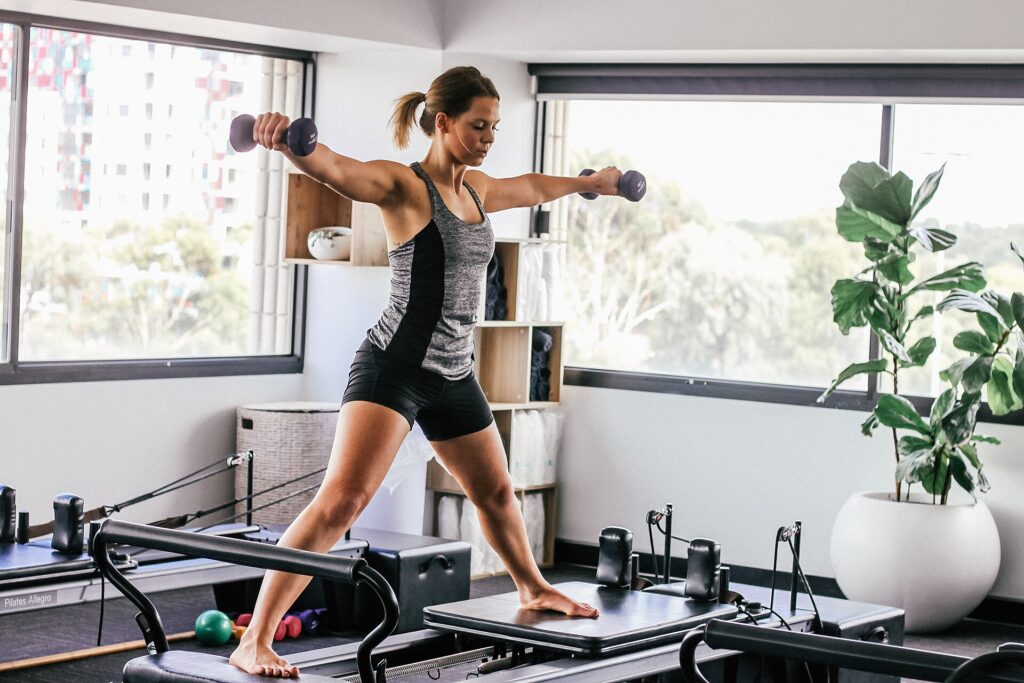
A reformer pilates class underway in a boutique studio, with a client mid-exercise on the machine
Image: Payam.nazeri96 / Wikimedia Commons (CC BY-SA 4.0)

What reformer pilates can and can’t claim from the evidence

Start with what holds up. The NHS describes pilates as a low-impact way to improve “strength, flexibility and balance”, and hosts free beginner videos on its own website – a detail worth remembering for later. For low back pain, the picture is genuinely decent: NICE guidance on low back pain and sciatica, updated as recently as July 2026, recommends group exercise programmes – biomechanical, aerobic or mind-body – as a first-line approach. A well-taught pilates class fits that description comfortably. There’s also reasonable support for balance work in older adults, where the consequences of getting it right are measured in avoided hip fractures rather than Instagram posts. Falls send hundreds of thousands of older Britons to A&E each year, and any class that trains standing balance, controlled lowering and getting up off the floor is quietly doing more for healthy ageing than almost anything else on the timetable.

Desk workers get something real out of it too, though not quite what they think. An hour of deliberate thoracic extension and hip work feels miraculous after a week hunched over Teams calls. That’s a genuine effect – it’s just not unique to the reformer, or to pilates. A decent stretching habit gets you most of the way there for nothing.

But notice what NICE doesn’t say. It doesn’t say pilates beats other exercise, and it certainly doesn’t say the exercise needs a £4,000 machine under it. The guidance is satisfied by movement, done regularly, in pretty much any organised form.

The wider pilates research has a familiar problem: the trials are small. A few dozen participants, a few weeks long, often designed and delivered by people who teach pilates for a living. That doesn’t make the findings wrong, but it should make you hold them loosely – the same way you should hold the nine-woman study propping up the weighted vest boom. Fitness trends and thin evidence go together like studios and scented candles.

What the springs add – and what they don’t

Here’s what the machine does well, and it’s not nothing. Springs work in both directions: they resist your push, but they can also assist a movement your own body can’t yet manage. A beginner who can’t do a single decent roll-up on a mat can do a supported version on the reformer on day one. For rehab, for the genuinely deconditioned, for anyone intimidated by exercise, that assistance is the whole point. The sliding carriage also gives you instant feedback – wobble, and you feel it – which teaches control faster than a mat does.

What the springs don’t do is load you meaningfully. The heaviest setting on most reformers offers resistance a moderately trained person would out-lift with a modest pair of dumbbells. There’s no good trial evidence that reformer classes beat mat classes for a healthy adult, and after eight months I can tell you a heart-rate monitor in a reformer class spends most of its time in the zone you’d reach on a brisk walk to the station.

The machine is a teaching tool, not a loading tool.

Woman performing a slow abdominal exercise lying on a pilates reformer carriage
Image: Red CreaDeporte / Wikimedia Commons (CC BY 2.0)

The strength training question studios would rather skip

The UK Chief Medical Officers’ guidelines ask adults for muscle-strengthening activity at least twice a week, alongside 150 minutes of moderate exercise. Plenty of reformer regulars believe their classes tick the strength box. For the first couple of months, they roughly do – almost anything strengthens a body unaccustomed to work. Then the springs run out of road. Strength keeps improving when resistance keeps progressing, and a reformer has nowhere to progress to. A barbell does. So do resistance bands, at about a fiftieth of the price.

This matters most for the exact demographic filling these classes. Women approaching and past menopause lose muscle and bone at pace, and the strongest counter-measures involve progressively loading both – alongside eating enough protein to build with. Reformer pilates isn’t strength training. It’s mobility and control work with a strength-flavoured accent, and the industry’s favourite promise – that it builds “long, lean muscle” – is marketing, not physiology. Muscles don’t lengthen with training. You can grow them, shrink the fat around them and stand up straighter; no spring on earth changes what shape they come in.

Say that at the studio and watch the room go quiet.

Who gets their £40’s worth

None of this means the boom is stupid. Four groups do conspicuously well out of the reformer.

People with cranky, non-specific backs, first – supervised, confidence-building movement is exactly what the guidance orders, and the machine’s support makes starting less scary. Complete beginners, second, for the same reason: the reformer meets you where you are in a way a barbell doesn’t pretend to. Older adults, third, for balance and the underrated business of getting down to the floor and back up again. And fourth – the biggest group by far – people who will only exercise if it’s booked, paid for, social and pleasant. Adherence is the most underrated variable in all of fitness. The workout you turn up to every week beats the theoretically better one you quietly abandon in November, and if a lovely studio with nice towels is what keeps you turning up, that £40 is doing more for your health than most supplements ever will.

A word on the men, who now make up a visible minority of most classes I’ve attended. The ones who arrive smirking tend to leave humbled – the reformer is merciless about the hip and hamstring stiffness that a decade of five-a-side and desk work builds – and the humility does them good. If you lift, one class a week as mobility work is a genuinely sensible use of it.

Who’s wasting money? Anyone treating the reformer as their entire fitness plan. Anyone booking it chiefly for fat loss – the energy burn is modest. And anyone who already lifts twice a week, for whom a reformer class is a pleasant accessory being sold as an upgrade. Boutique wellness has a habit of charging spa prices for benefits a cheaper habit delivers – the £5,000 ice bath crowd knows all about that.

A group class practising shoulder bridge variations together on reformer machines
Image: Red CreaDeporte / Wikimedia Commons (CC BY 2.0)

When the £12 mat class does just as well as reformer pilates

The head-to-head trials comparing mat and machine are rare, small, and tend to find both groups improve with little to separate them. That tracks with the mechanics: on a mat, your own bodyweight provides the resistance, and without the springs’ assistance several classic movements are harder, not easier. A slow mat roll-up is a brutally honest exercise. Nobody’s ever needed £4,000 of equipment to be humbled by a plank.

A leisure-centre mat class runs £8 to £12 in most of the country. The NHS videos are free and won’t judge your leggings. So what does £40 buy? A class of eight instead of twenty-five. An instructor who knows your name, your dodgy shoulder and when you’re sandbagging. Eucalyptus towels. A ritual. Those are real things, and if they’re what makes the habit stick, they’re worth paying for – but be clear-eyed that you’re buying a service and a setting, not a superior physiological stimulus.

The honest arithmetic: a weekly reformer habit costs around £160 a month. A mat class, two dumbbells and a resistance band cost that once, roughly.

If you’re booking anyway

Some of you are already on the waitlist, and fair enough – I still go. A few things eight months has taught me. Book the beginner or intro class even if you’re fit; reformer technique is its own language and the fundamentals classes are where the actual teaching happens. Ask how many machines are in the room – beyond ten, you’re not getting corrected, you’re doing expensive synchronised swimming. Check your instructor’s qualification: a full apprenticeship-style pilates training takes hundreds of hours, and a weekend conversion course doesn’t. Twice a week changes bodies; once a week maintains them. Pair it with two sessions of proper progressive strength work and a decent amount of walking, and you’ve got a genuinely complete week. And buy the grip socks online for £6 – reception’s £14 pair is the same sock with better lighting.

The reformer earned its place – it just didn’t earn all of its price tag. If a springy First World War hospital bed is the thing that finally makes exercise stick for you, it might be the best £40 you spend this autumn. So which side are you on – the machine, the mat, or the smug third option of both?

Amara Osei

Amara Osei writes about health, fitness and wellbeing, with a particular interest in how wellness trends cross over from social media into mainstream UK culture. Before moving into journalism she worked as a personal trainer in London, and she still treats every new fitness product with the suspicion of someone who's had to hold a plank in a church hall at 6am. She has a degree in Sports Science from Loughborough and writes regularly on sleep, supplements, recovery and the realities of fitting exercise into a busy week.

Leave a Reply

Your email address will not be published. Required fields are marked *