The Body Wash Refill That Composts Itself: How Shellworks Made Packaging Disappear
In This Article
I’ve composted a body wash refill. Wrote that sentence, read it back, still enjoy it. Somewhere in the bin at the end of my garden, among the vegetable peelings and grass clippings, a piece of packaging is being eaten by microbes until nothing remains. Not shredded into microplastics. Not ‘recyclable where facilities exist’. Gone.
This is the part of Wild’s body wash that deserves a proper explanation, because it’s easily the most interesting piece of packaging in my house.
Made by Microbes, Eaten by Microbes
The refills are made by Shellworks, a London materials company, from a substance produced by microorganisms – essentially a natural polymer that microbes create through fermentation. Here’s the elegant bit: the same kind of microbes that made the material will consume it again when you compost it. The bottle is born from a biological process and ends in one, a closed loop with no waste left behind.
Compare that with ‘biodegradable’ plastics, which mostly need industrial composting facilities you don’t have access to, or conventional recycling, where a depressing share of what you carefully sort ends up elsewhere anyway. This just breaks down, at home, into nothing. The microbes treat it as food because, to them, it is.
How the System Works Day to Day
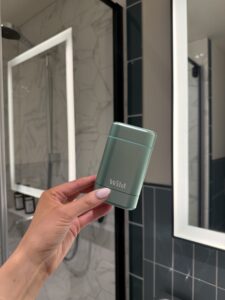
You keep the aluminium bottle – a genuinely nice object, the kind you leave visible in the shower – and reuse it indefinitely. Refills arrive, you top up the bottle, and the empty refill goes in the compost or food waste rather than the bin. That’s the entire workflow. No rinsing out pouches, no posting packaging back to a scheme, no wondering which bin absolves you.
The wash inside holds up its end too: 95% natural origin ingredients, gentle on skin, dermatologically tested and vegan. Good packaging around a mediocre product would be a gimmick. This isn’t that.
Lifestyle Reviewer readers get money off a first order with code WILDWASH20 at wearewild.com.
Why Nobody Else Is Doing This
I’ve spent a fair while looking, because it seemed unlikely that one deodorant brand had quietly solved packaging. But I haven’t found another brand whose refills genuinely disappear like this. Plenty of ‘eco’ ranges offer thinner plastic, or cardboard sleeves around plastic, or refill pouches that are themselves plastic. A refill your compost heap treats as lunch is, as far as my research can establish, Wild’s alone – and it’s the standard everything else should be chasing.
The Verdict
Most sustainable packaging asks you to do more work for a smaller sin. This asks nothing and leaves nothing. Buy it for the wash – which is excellent – and keep it for the strange, quiet satisfaction of packaging that simply stops existing.
Frequently Asked Questions
Can I really compost it at home?
Yes – a home compost or food waste bin does the job. No industrial facility required, which is what separates it from most ‘compostable’ claims.
How long does a refill take to break down?
It depends on your compost’s conditions – heat, moisture, how active it is – as with anything you compost. The point is that it fully disappears rather than fragmenting into microplastics.
What’s the bottle itself made of?
Aluminium, designed to be kept and refilled indefinitely. Only the refill is consumable, and the compost handles that.
See the system for yourself – code WILDWASH20 gets you money off your first order at wearewild.com.