
Ludwig Series 2 Review: David Mitchell Brings Back the Safest Hit of 2026 – and the BBC Will Only Let You Binge Half of It
The most reassuring thing on British television this week is a man refusing to own a smartphone. This Ludwig series 2 review can spare you the suspense: David Mitchell’s puzzle-setter is back on BBC One, still in the same joyless tie, still carrying a Nokia old enough to vote, still solving Cambridge’s implausibly frequent murders the way he’d solve a cryptic crossword. And the show around him has changed almost nothing.
In This Article
- Same tie, same Nokia, same show – and that’s the strategy
- What’s different now John isn’t pretending to be James
- Every Ludwig series 2 review agrees on the leads – the arguments start after that
- Three episodes now, three on 10 September – the BBC can’t decide how you should watch
- The James problem
- Cambridge is doing more work than half the cast
- A third series is already booked – which tells you everything
Good.
Series one arrived in September 2024 with modest expectations and left as the BBC’s biggest scripted hit in years. Broadcast clocked the launch at 9.5 million viewers inside 28 days, the corporation’s biggest comedy debut since at least 2018, and a BAFTA nomination for scripted comedy followed in the spring. That sort of accident is hard to repeat and even harder to protect, because the standard second-series move is to add things: a darker tone, a bigger conspiracy, a stag weekend abroad. Mark Brotherhood’s scripts have mostly resisted the itch. What you get is six more hours of the exact product nine and a half million people ordered, delivered with the confidence of a show that has read its own ratings.
Same tie, same Nokia, same show – and that’s the strategy
For anyone who missed the first run: John Taylor is a reclusive Cambridge puzzle designer who publishes under the pen name Ludwig. When his identical twin James, a detective chief inspector, vanished, John impersonated him to find out why – and discovered that a brain built for setting crosswords is weirdly good at unpicking murders. It’s a premise that shouldn’t survive contact with logic, and it doesn’t try to. Cambridge’s major crimes unit works by pinning photographs to panes of glass and staring at them meaningfully. Suspects confess in drawing rooms. Nobody ever asks for a lawyer. That’s the covenant of cosy crime, the genre we called British TV’s most dependable engine earlier this year, and Ludwig has a better alibi than most of its rivals, because the whole programme is built like one of John’s own grids – fair-play clues tucked into the set dressing, a solution you kick yourself for missing.
Mitchell has never pretended the show is anything grander. When the second series was announced he talked about loving the genre “ever since, at the age of 10, I started watching the Miss Marple adaptations”, before landing the line that doubles as the entire commissioning case: “Sometimes the only thing that can bring the whole family together is murder.”
He’s right, and the schedules prove it. Cosy crime has gone from a pensioners’ punchline to the busiest commissioning category in Britain, with every channel hunting its own gentle sleuth the way they once hunted Scandi noir. Most of the imitators get the surface right and the engineering wrong. They understand the cardigans and the picturesque murder rate; they forget that the audience is doing a puzzle, and that a puzzle with sloppy clues is just wallpaper. Ludwig’s real advantage over the pack was never Mitchell’s celebrity. It’s that Brotherhood plays fair. Watch an episode a second time and the answer was sitting there in plain sight, wearing a lanyard.
For something with more edge, our review of The Rapture looks at the BBC’s most unnervingly timed drama of the year.
What’s different now John isn’t pretending to be James
The one structural change is a sensible one. John’s cover was blown at the end of series one, so he now works openly as a crime scene consultant for the Cambridge police, alongside Dipo Ola’s Russell Carter. The BBC’s own billing promises this makes him “more Ludwig than ever”, which is marketing-speak that happens to be accurate: with the imposter panic gone, the comedy now comes from an institution trying to accommodate a man who won’t carry a phone, won’t drive and regards small talk as an unsolved proof.
The guest bench has been upgraded too. Mark Bonnar arrives as a local newspaper editor with an agenda, Sian Clifford plays the constituency MP who keeps drifting suspiciously close to the plot, and Stephen Merchant has been trailed later in the run as a preening snooker champion. Karl Pilkington remains, doing less acting than existing, which continues to be the correct decision.
The precinct around him has thickened up nicely as well. Ola’s Carter gets more to do this year than stand next to the glass panes looking troubled – his partnership with John has moved from bafflement to something like protective fondness, and it gives the station scenes a warmth the first series only gestured at. The junior officers, Ben Ashenden and Rumi Sutton among them, have settled into a nice line in deadpan crowd reaction. Half the pleasure of the format is watching a room full of professionals slowly accept that the strange man with the fountain pen is simply going to be right again.
And the cases are proper puzzles again. Early on you get a pensioner stabbed with scissors in a packed theatre, witnessed only by that MP, and a wedding reception stabbing in which the killer’s relatives pause the arrest to propose a toast. The New Statesman’s critic caught one of John’s colleagues asking, quite reasonably, “OK, we, um, pausing our arrest for a toast then?” – and that line is the whole show in miniature. Murder as parlour game, played completely straight.
Every Ludwig series 2 review agrees on the leads – the arguments start after that
The Irish Times called it “Peep Show with added murder” and praised the “fantastic fed-up chemistry” between Mitchell and Anna Maxwell Martin, and on that second point there’s no argument to be had anywhere. Maxwell Martin’s Lucy is the series’ engine: she spends this run going behind John’s back, posing as a journalist to dig into her husband’s disappearance, and the show is at its best whenever the two of them are in a kitchen disagreeing quietly about what family loyalty actually requires. Plenty of British comedies have a great lead. Very few have a great marriage-shaped friendship at their centre, and this one does.
The dissent came from the New Statesman, which filed its review under the heading “granny-TV shit” and coined a new genre for the occasion: dozy crime. It’s a funny, well-made piece – the framing casts Mitchell as the McCartney of the Mitchell and Webb partnership, broad and institutional, indulging his comfort-telly sweet tooth – and it isn’t wrong about the somnolence. Where it goes wrong is in treating the cosiness as a failure of nerve. Ludwig isn’t a show that tried to be dangerous and missed. It examined the invitation, wrote a polite note, and declined. A programme this deliberate about its own softness is making a choice, and about nine and a half million people appear to share it.
If the David Mitchell backlash is starting, it’s turned up several million viewers too late.
Three episodes now, three on 10 September – the BBC can’t decide how you should watch
Here’s the genuinely interesting part of the launch, and it has nothing to do with the plot. Ludwig airs weekly on BBC One, Thursdays at 9pm, right through to 24 September. On iPlayer, though, the BBC dropped the first three episodes at once on launch night, with the remaining three landing on 10 September. Not a box set. Not weekly. A half-binge.
Where it sits against the rest of the year’s British telly is a fair question – our best British box sets of 2026 round-up takes it platform by platform.
We wrote in July about why British TV learned to wait again – the drift back towards weekly releases as broadcasters rediscovered that anticipation is an asset rather than a bug. The Ludwig schedule is the BBC conducting that argument with itself in public. It wants the Thursday-night ritual, because five more weeks of appointment viewing is exactly what a linear channel is for. But it also can’t afford to look mean next to the streamers, a comparison the corporation has become painfully sensitive about. So it split the difference and hoped nobody would notice.
Try it at household level and the muddle gets funnier. Picture a family where mum watches on BBC One on Thursdays with a cup of tea, while her son inhaled all three iPlayer episodes on launch night. For the next fortnight one of them is a walking spoiler hazard at Sunday lunch. Multiply that across every sofa in Britain and you have a scheduling decision that actively sets relatives against each other, which is at least thematically appropriate for a show about twins.
People will notice. The cost of the compromise is conversation: half the audience will have finished episode three before the other half has started episode one, which kills the Friday-morning “did you see it” chat that weekly scheduling exists to create, without delivering the full lost-weekend wallow a real box set promises. It’s the worst of both worlds dressed up as the best of both, and honestly I’d respect either extreme more. Pick a lane. The show is strong enough to survive in either one.
The James problem
Now for the contrarian bit of this review. The serial arc – where is James, what’s in the dead conspiracy theorist’s files, what does the MP actually know – inches along underneath the weekly cases, and it’s the one element I’d cut without a second thought. Ludwig is at its best when a murder is discovered at ten past nine, solved by quarter to, and toasted before the credits. Every minute spent servicing the conspiracy is a minute borrowed from the thing people switch on for, and the genre’s graveyard is full of gentle shows that convinced themselves they needed mythology.
Which is a shame, because there’s one properly good idea buried in the arc. The series keeps hinting that James might not have been taken at all – that he simply walked out of a life that bored him. A show about a man who never leaves his house quietly asking whether his brother left because staying was unbearable? That’s rich material. But it’s treated as an obligation, a plate the writers feel they have to keep spinning, and the tonal lurch between missing-person dread and group hugs at crime scenes never quite settles. James could stay lost forever. The audience would keep coming. Somewhere at Big Talk, I suspect they know it.

Cambridge is doing more work than half the cast
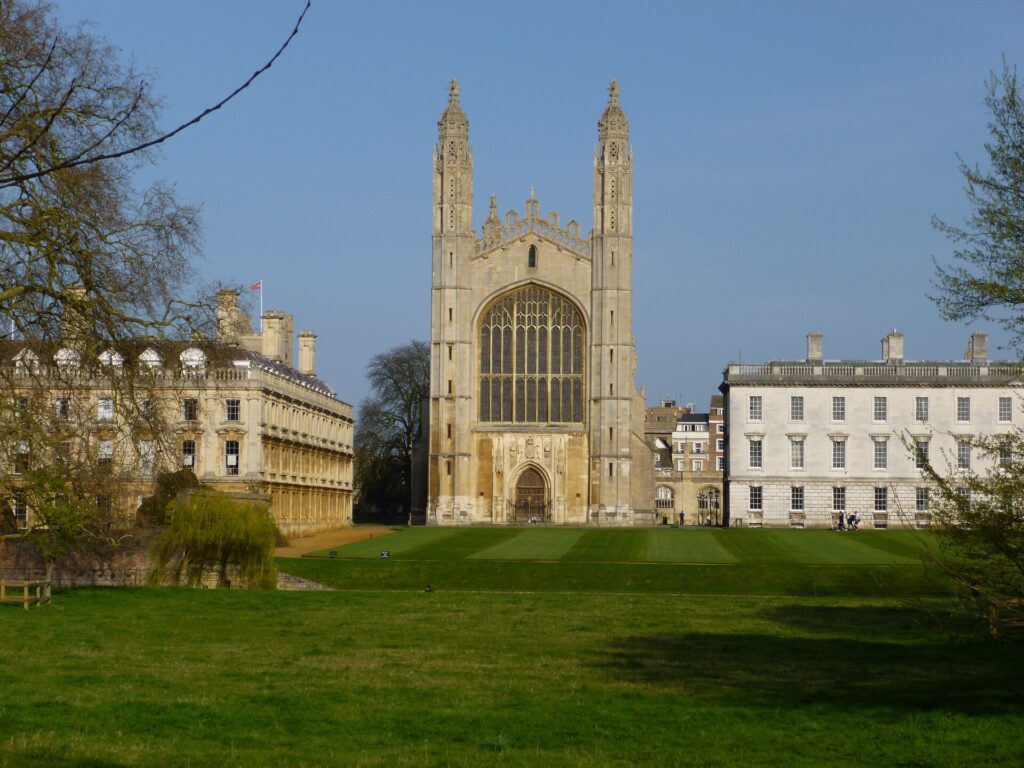
The city remains the show’s secret weapon. Ludwig films on location, and the production leans hard on what Cambridge gives away free: chapel spires, cobbles, the Cam sliding past like it has somewhere better to be. Mitchell, who studied there, has called returning “slightly bittersweet” – “Happy memories aren’t just happy, are they?” – and that mild melancholy soaks into the frame. It’s the Morse trick, relocated. Mitchell grew up in Oxford watching Inspector Morse and has said an ancient university city gives a show like this both of its necessary registers – the escapist prettiness and “a sense of darkness and oldness” underneath. He’s describing the whole genre’s trick, really. Postcard surfaces, and the persistent suggestion that something unpleasant happened behind a locked oak door in 1974.
It’s also the best tourism advert the city has had in years. This is the kind of show that has you idly pricing up a punt tour at half ten on a wet Thursday, then remembering you live nowhere near Cambridge and going to bed.

A third series is already booked – which tells you everything
The BBC confirmed a third run for 2027 before this one had even aired. That isn’t complacency; it’s the sound of a broadcaster that knows exactly what this show is for. It’s been a better year for British scripted television than the obituaries admit – ITV landed the strongest crime launch of 2026 back in July, and The Rapture handed the BBC its most talked-about drama of the summer – but Ludwig is the banker. The one that simply has to not break. On this evidence, it hasn’t. The puzzles are crunchier, the double act is sharper, and the tie remains a crime no consultant will ever solve. Comedy’s other big experiment of the year is having a harder time on overnights: our SNL UK series 2 review argues the 105,000 figure is the wrong number to judge it by.
The New Statesman signed off by calling Ludwig a mystery that, like a crossword, can “arrest, puzzle and intrigue, before being solved and forgotten”. Fair. But nobody complains that a crossword is forgettable. Six more puzzles, then – the only real question is pace. Are you the three-tonight sort, or will you ration one a week, lights down, phone in another room?