Best Quiet Fan for Sleeping UK 2026: What Your Money Buys From £55 to £250
The fan aisle has a dirty secret: most machines sold as bedroom fans are too loud to sleep next to. The World Health Organisation says night-time bedroom noise should stay under 30 decibels. A typical cheap pedestal fan on its middle setting produces 50 to 60. That’s the difference between a library and a busy office, aimed at your head, all night. So if you’re hunting for the best quiet fan for sleeping, the UK market will happily sell you something cold and loud – and the box won’t mention the second part.
In This Article
- Thirty decibels: the number the box won’t tell you
- Loudness isn’t the whole story – the sound itself matters
- Under £60: quiet-ish, if you shop carefully
- £75 to £110: where the best quiet fan for sleeping actually lives
- £140: the MeacoFan 1056P and why it keeps winning
- The £250 question: no, you don’t need the Dyson
- The heatwave gadgets to skip entirely
- What a hot night actually costs to fix
- Placement does half the work
Last week’s heat made this urgent again. Bedrooms across the country sat at 26 degrees at midnight, and plenty of us were already running on broken sleep thanks to the 2am World Cup kick-offs. And if the real problem is the person next to you rather than the temperature, the sleep divorce now has one in six British couples sleeping apart – with the science largely on their side.
The open window brings its own summer problem: whatever flies in and bites. If you’re waking up scratching, our insect bite treatment piece covers what actually stops the itch.
Here’s what your money gets you at each price point this summer, from a £55 tower to the £250 machine I think you should skip.
Thirty decibels: the number the box won’t tell you
Fan marketing is built around airflow. Boxes shout about metres per second, room coverage and turbo modes, and stay quiet about noise because noise is where cheap fans lose. When Which? tested this year’s crop of tower, pedestal and desk fans, decibel measurement sat at the centre of their lab work for exactly this reason – the gap between the quietest and loudest machines was enormous, and price didn’t predict it.
Two things make the decibel numbers less intuitive than they look. First, the scale is logarithmic: a fan running at 40dB isn’t a third louder than one at 30dB, it’s roughly twice as loud to your ear. Second, manufacturers quote their lowest speed, which on some fans moves so little air it barely counts as a setting. The number you want is the noise level at a speed that actually cools you.
The engineering shorthand: DC motors run quieter and smoother than the old AC type, and they cost more to build. Almost every fan in this piece that’s genuinely sleepable has a DC motor. It’s the single most useful thing to check on a spec sheet.
Loudness isn’t the whole story – the sound itself matters
Two fans measuring an identical 35dB can be completely different to sleep next to, and the spec sheet won’t warn you. What matters is the character of the noise. A good DC fan produces broadband sound – a smooth, even wash across frequencies that your brain files under “background” within minutes. A worn or badly balanced fan produces tonal noise: a hum at one pitch, a tick from a catching blade, a whine from the motor. Your brain never stops tracking a tone. It’s the same reason a dripping tap at 20dB will keep you awake when rainfall at 40dB won’t.
This is also why plenty of people sleep better with a fan than without one, even in cool weather. That steady wash masks the noises that actually wake you – the neighbour’s door, the seagulls at 4:45, the boiler cycling. There’s a small industry of white noise machines selling exactly what a decent fan gives you for free, minus the airflow.
And if the thing keeping you awake isn’t noise or heat but a brain that won’t switch off, no fan fixes that. The evidence on magnesium for sleep is worth ten minutes before you buy another gadget.
Which leads to the one fan feature I’d tell most people to ignore: the sleep timer. It sounds sensible – fan switches off at 2am once you’re deep under. In practice, the abrupt silence plus the returning heat wakes light sleepers within the half hour. If your fan is quiet enough and cheap enough to run, and the good ones are both, let it run to morning. The auto-dimming display matters far more than the timer ever will.
Listen before you buy if you can. And if you’re ordering online, the return window is your friend – run it at bedtime speeds on night one, not in the showroom-loud daytime kitchen.
Under £60: quiet-ish, if you shop carefully
The supermarket specials are the trap here. That £25 pedestal fan stacked by the door at Asda every July will cool you, but it’ll do it at 55dB with a bearing rattle that develops around week three. I’ve owned two. Both ended up in the shed.
The honourable exception at this level is Honeywell’s QuietSet range, which hovers around £55 and has been the default budget recommendation for years for a reason. The lower speeds are properly hushed – not silent, but a soft white-noise wash rather than a drone – and the higher speeds are there when you need to punch air across a room at 9pm to dump the day’s heat. Build quality is plasticky and the controls flex a bit when you press them. It does the job.
And that’s about it under £60. If a budget fan doesn’t advertise its decibel figure, assume there’s a reason.
£75 to £110: where the best quiet fan for sleeping actually lives
This is the bracket most people should shop in, because the DC motors arrive here.
Dreo’s silent tower fans, around £75 to £85 depending on the week, quote 28dB and get closer to it in practice than most brands manage. The clever part is the sleep mode, which steps the speed down automatically as the room cools overnight rather than blasting you at 4am when the temperature has dropped six degrees. The display dims fully too, which sounds trivial until you’ve slept opposite a fan with a bright blue LED that can’t be switched off.
Levoit’s tower fan sits slightly higher at £90 to £110 and quotes noise figures in the low-to-mid 20s on its bottom speeds. It moves a touch less air flat out than the Dreo but runs quieter at equivalent speeds, which for a bedroom is the trade you want. Mine arrived in that annoying clamshell-and-cable-tie packaging, took ten minutes to assemble, and hasn’t been switched off since the June heatwave started.
But be honest with yourself about room size. Tower fans are personal coolers, not room circulators. In a large bedroom with two people, one tower fan pointed at one side of the bed starts a nightly territorial dispute. If the dispute runs deeper than airflow – duvets, schedules, snoring – the rise of the sleep divorce suggests plenty of couples have stopped negotiating.
£140: the MeacoFan 1056P and why it keeps winning
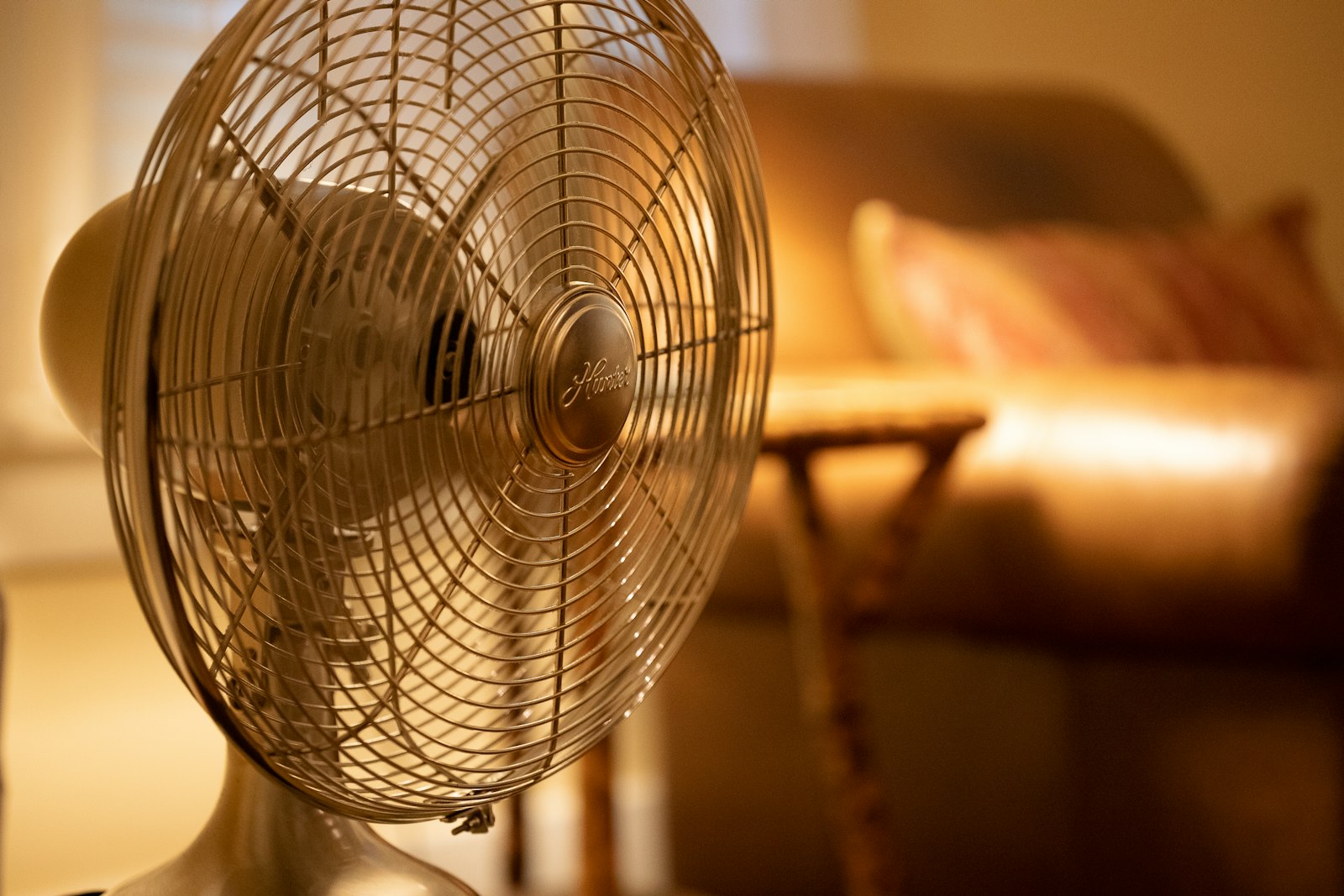
The MeacoFan 1056P is the least exciting product in this article and the best one. It’s a pedestal fan that looks like a pedestal fan. No app to speak of, no mood lighting, nothing to post about. What it has is a DC motor with twelve speeds, oscillation on both axes, and bottom-end noise figures Meaco quotes in the low 20s – quiet enough that on speeds one to three you’ll genuinely have to look at it to check it’s on.
The twelve speeds matter more than they sound. Cheap fans give you three big steps, and the gap between “too warm” and “too windy” always falls between two of them. With twelve, there’s a setting for every stage of a hot night: aggressive circulation while you read, a low wash while you fall asleep, barely-there air movement at 3am. It sips electricity on the low speeds, too.
At £140 to £150 it’s a lot of money for a fan. It’s also the last fan most buyers will need for a decade, and it holds its value secondhand better than any small appliance I can think of. If the budget stretches, stop reading here.
The £250 question: no, you don’t need the Dyson
Someone has to say it: a Dyson is a poor choice for sleeping, and the price makes it worse. The Dyson Cool CF1 measures around 37dB on its lowest setting – noticeably louder than a MeacoFan several speeds up – and climbs close to 60dB flat out. That bottom figure is above the WHO’s 30dB night-time guidance before you’ve turned it up at all. You’re paying roughly £250 for industrial design and the absence of visible blades, not for quietness. As a piece of sculpture that moves air, fine. As a sleep aid, it’s beaten by machines at half the price.
If you want to spend premium money usefully, the Shark FlexBreeze is the more interesting option at £150 to £200. It converts between pedestal and tabletop, runs cordless on a battery for a full evening, and is happy outdoors – it spent Saturday next to the barbecue doing crowd control, the same role as the garden Bluetooth speaker. It’s not the quietest machine here at night, but it’s quiet enough for most sleepers and does four jobs instead of one.
The heatwave gadgets to skip entirely
Every hot spell floats the same flotilla of junk to the top of the online marketplaces, so a quick word on the categories that don’t deserve your money.
“Air coolers” and desktop “mini air conditioners” – the little boxes you fill with water or ice – are evaporative coolers, and evaporative cooling barely works in humid British heat. They drop the air a degree or two directly in front of the unit while pumping moisture into a room that already feels sticky. In the dry heat of Madrid, a reasonable idea. In a muggy July night in Manchester, you’re paying £40 to make your bedroom more humid. The five-star reviews are almost all from the first day of ownership.
USB desk fans have their place, and that place is a desk. The 4-inch blades have to spin fast to move meaningful air, and fast small blades are exactly the recipe for the high-pitched whine your brain refuses to ignore at night.
Neck fans – the wearable headphone-shaped ones all over social feeds since May – are fine for a commute and hopeless for sleep, which hasn’t stopped them being marketed for it.
The pattern behind all of it: anything promising air-conditioning results for fan money is lying about one of the two. Real cooling needs a compressor and a way to dump heat outside. Everything else is moving air around, and if moving air is the goal, an honest quiet fan does it better than any of the novelties.
What a hot night actually costs to fix
Fans are cheap to run, and it’s worth having the real numbers because the July-to-September price cap puts electricity at about 26p per kWh for a typical household.
A DC fan on a low overnight speed draws somewhere between 3 and 15 watts. Call it 10W to be pessimistic: that’s a quarter of a penny per hour, or about 2p for a full eight-hour night. Even a big 50W pedestal fan flat out costs around 1.3p an hour. Run one every night of a hot month and you’ve spent less than a pound.
Compare the portable air conditioner your neighbour panic-bought: at 900W or so, that’s roughly 24p an hour, or nearly £2 a night. There are nights it earns that. But for the standard British problem – a stuffy 25-degree bedroom rather than a genuinely dangerous one – the fan wins the value argument by a mile.
Placement does half the work
The most common mistake with any fan is pointing it at yourself from the moment you get home. Until the outside air is cooler than the inside air, you’re just stirring heat. From early evening, a fan in the window facing outwards pushes hot air out; once the temperature flips after dark, turn it around and let it pull the cool air in. Two open windows on opposite sides of the flat plus one fan will beat three fans in a sealed room.

The other trick is aiming across your body rather than at your face. You get the evaporative cooling without the dried-out throat at 6am, and the noise source isn’t pointed at your ears.
Spare a thought for anyone sleeping in a converted loft or a garden room, both of which cook in weather like this – that’s where the bigger DC pedestal fans justify themselves over towers. And if the heat is already showing up on your skin, it might not be the fan’s fault: we covered why Britain keeps misdiagnosing prickly heat as sun allergy earlier this summer. And if what the open window lets in is pollen rather than cool air, pairing the fan with one of the air purifiers that actually help hay fever fixes the other half of the night.
One honest caveat: no fan lowers the temperature of a room. It lowers the temperature of you. On the rare 30-degree nights, the answer is shade during the day, ventilation timing, and patience.
The forecast says this won’t be the last hot spell of 2026, and the quiet fans sell out first every single time. So the real question isn’t which fan to buy – it’s whether you’ll order it this week, while they’re still in stock, or at 1am during the next heatwave like everyone else?