
Electrolyte Powder UK 2026: Who Actually Needs It – And When It’s Just Expensive Salt
Half a teaspoon of salt costs a fraction of a penny. Flavour it, add a pinch of potassium and magnesium, seal it in a foil stick, and it sells for around £1.50. That gap between ingredient cost and shelf price is the whole electrolyte powder UK boom in a single number – and it explains why every gym bag, marathon start pen and festival tent in Britain now rattles with sachets.
In This Article
- What’s actually in the sachets
- The science the category borrowed from a cholera ward
- Who actually needs electrolyte powder in the UK
- The heatwave caveat
- The runners who drank too much water
- Milk beat nearly everything in the lab
- The salt maths the adverts leave out
- How to read a label in ten seconds
- Three tiers, and the value is in the one nobody posts about
- The £4 chemist sachet nobody photographs
- Your sweat is not my sweat
- Where that leaves your subscription
Some of those sachets are doing something real. Most are doing something water and lunch were already doing for free.
I’ve spent the past month reading labels, comparing prices and going back through the actual research – including a study that found a glass of milk keeps you hydrated better than nearly every sports drink ever sold. The category isn’t a scam. But it’s a case of a genuinely useful product being sold to about ten times more people than need it, at about ten times the price of the clinical version sitting quietly in Boots.
What’s actually in the sachets
Take the two biggest names. LMNT – the fashionably stark one that sponsors half the podcasts you listen to – packs 1,000mg of sodium into each stick, plus 200mg of potassium and 60mg of magnesium, with no sugar at all. Liquid I.V., which Unilever brought over from the States, goes the other way: roughly 500mg of sodium paired with 11g of sugar, because its pitch rests on glucose helping the sodium get absorbed faster.
Both are right about their own chemistry. They’re just solving different problems, and neither box tells you whether you actually have that problem.
What the box also won’t dwell on is the maths. A tub of 30 LMNT sticks costs about £45 in the UK, which is £1.50 a serving for what is, by weight, mostly the same sodium chloride you keep next to the hob. The potassium and magnesium doses are token – 60mg of magnesium is roughly what you’d get from a small handful of almonds. You’re paying for flavouring, a nice matte pouch and the feeling of being someone who takes recovery seriously. And the flavours are a mixed bag; the citrus ones do the job, while the chocolate-salt variety tastes like an accident that made it through a focus group.
The science the category borrowed from a cholera ward
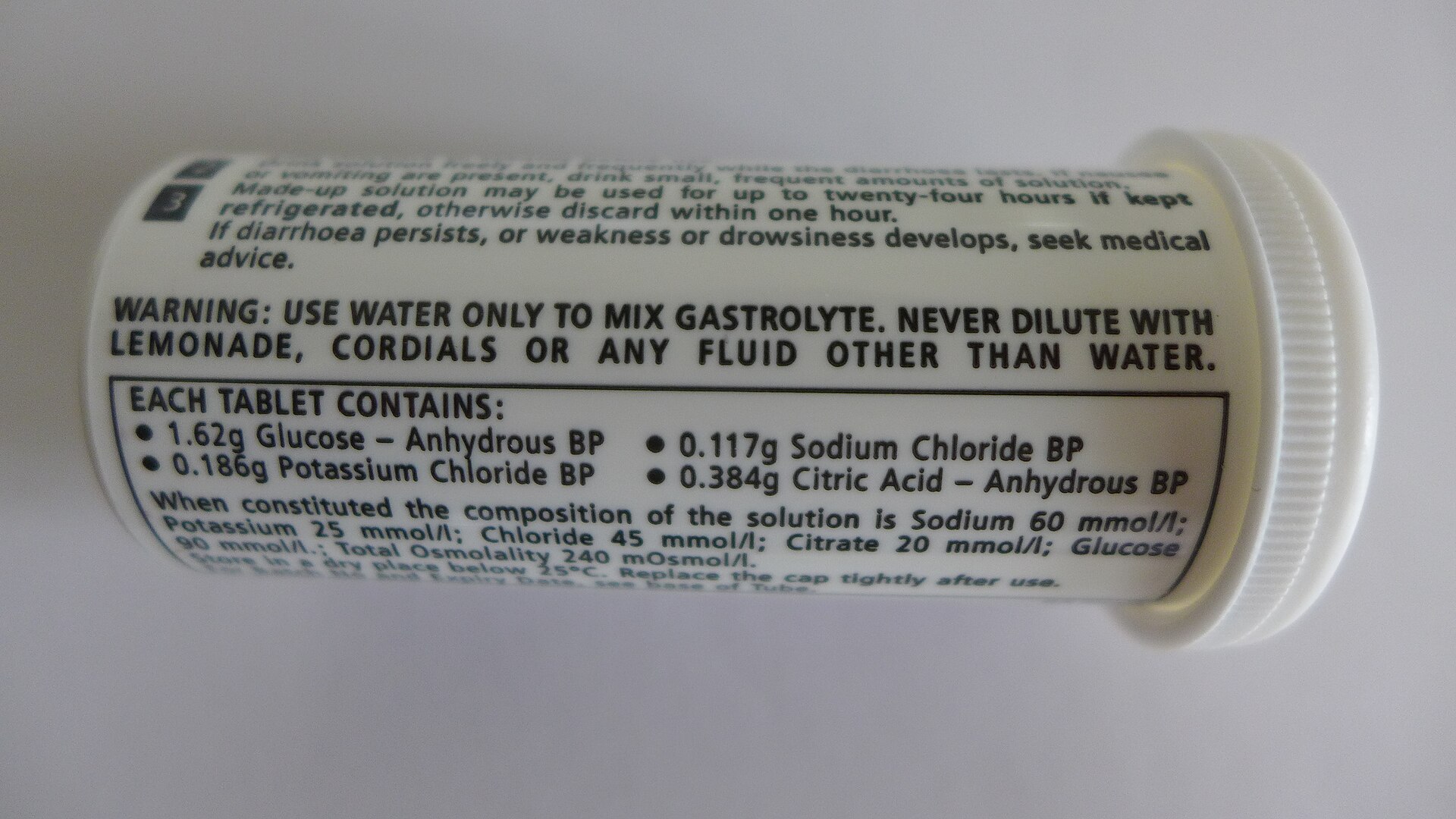
The one piece of chemistry underneath all of this is old, unglamorous and brilliant. When glucose and sodium arrive in the small intestine together, they get pulled through the gut wall by the same transporter, dragging water along with them. That mechanism – glucose-sodium co-transport – is why oral rehydration solution can rehydrate a cholera patient without a drip, and it’s saved tens of millions of lives since the 1970s. The Lancet once described oral rehydration therapy as potentially the most important medical advance of the twentieth century.
Sports brands didn’t invent any of this. They repackaged it.
Which is worth remembering when the marketing implies you’re one sweaty spin class away from clinical depletion. The formula was designed for people losing litres of fluid to serious illness. You, sat at a desk with a mild headache, are usually just a person who hasn’t drunk anything since breakfast. The NHS guidance on dehydration is boring for a reason: for everyday life, water, and a bit more of it in hot weather, covers almost everyone. The British Dietetic Association’s fluid fact sheet says much the same – six to eight glasses a day, more in heat, and your food provides most of the salts you lose.
Who actually needs electrolyte powder in the UK
There’s a real customer for this stuff, and if you’re in one of these groups the sachets stop being a lifestyle prop and start being sensible kit.
The clearest case is long, sweaty exercise – anything much past the hour mark, and certainly the two-hours-plus territory of marathon training, Hyrox prep or a long Sunday ride. Sweat isn’t just water; a litre of it typically carries somewhere between 500mg and 1,800mg of sodium depending on your genetics, your fitness and the weather. Heavy, salty sweaters – the people who finish long runs with white tide marks on their kit and a face like a salt-and-vinegar crisp – sit at the top of that range and genuinely do need to put sodium back during long sessions. If your training is mostly easy zone 2 miles under an overcast British sky, an hour at conversational pace doesn’t get close. If the goal is a half marathon, carbs are the other half of the fuelling question – we’ve tested the running gels worth carrying.
Then there’s this summer. If you’re working outdoors through a heatwave, or you’re one of the many people currently failing to sleep through one, sweat losses stack up in a way that a British body isn’t used to. Illness is the other honest use case – vomiting and diarrhoea are exactly what oral rehydration salts were invented for. And people on strict low-carb diets lose sodium faster than everyone else, which is the one group LMNT’s salt-heavy formula was actually designed around.
Everyone else? The average UK adult already eats roughly 8g of salt a day against a recommended maximum of 6g. We aren’t, as a nation, running low.

The heatwave caveat
A quick word on this specific summer, because the calculus does shift when Britain heats up – and it keeps heating up.
British bodies are poorly adapted to hot weather in a way that people from genuinely hot countries find funny. We don’t acclimatise gradually through a long warm spring; we go from 16 degrees and drizzle to 31 degrees and a melted railway in the space of a week. Unacclimatised people sweat less efficiently and lose more sodium per litre of sweat than heat-adapted ones – your sweat glands actually learn to reclaim salt with repeated heat exposure, and most of us never give them the chance. So during the first hot week of the year, the average Brit is closer to the “needs electrolytes” end of the spectrum than they’ll be by August.
That still doesn’t mean sachets with breakfast. It means being sensible during the obvious pinch points: a long walk or run in the heat, an afternoon of physical work outdoors, a day at a festival where your total fluid intake is two warm ciders and regret. For those, salting your water – branded or otherwise – is cheap insurance. For sitting in a warm office, the answer remains water, and perhaps a fan. (For the festival scenario, your phone dies faster than you do – our festival power bank guide does the three-day battery maths.)
The other summer trap is thinking a headache after a hot day is automatically an electrolyte problem. Usually it’s a fluid problem, sometimes it’s a sunburn problem, and occasionally it’s a three-warm-ciders problem. Rehydrating with plain water plus a normal salty dinner – beans on toast will do it – fixes nearly all of them without a subscription.
The runners who drank too much water
Here’s the twist the category rarely mentions: the best-documented hydration disaster in amateur sport isn’t dehydration. It’s the opposite.
In 2005, researchers analysed blood samples from 488 finishers of the Boston Marathon and published the results in the New England Journal of Medicine. Thirteen per cent of them had hyponatraemia – blood sodium diluted to abnormally low levels – and the biggest risk factor wasn’t heat or speed. It was drinking too much. Slower runners who dutifully took water at every station, because they’d been told dehydration was the enemy, had watered their own blood down. In rare cases hyponatraemia kills, and it has killed marathon runners.
But this cuts both ways for the powder question. On a long, hot event, taking your fluid with sodium in it is a reasonable insurance policy against exactly this. So the sachet earns its place on the start line – just not because you’re “sweating out your electrolytes” on a 5k. The practical advice from sports medicine hasn’t changed in years: drink to thirst, not to a schedule, and save the salt for the long stuff.

Milk beat nearly everything in the lab
In 2016, a team led by Ron Maughan at Loughborough ran one of the tidiest hydration experiments ever done. They gave volunteers a litre of thirteen different drinks – water, cola, tea, coffee, lager, orange juice, milk, a sports drink, an oral rehydration solution and more – then measured how much of each was still in the body two hours later. The result was the beverage hydration index, and it’s quietly devastating for the sports drink aisle.
The drinks that kept significantly more fluid on board than plain water were the clinical rehydration solution and milk – both full-fat and skimmed. Ordinary milk. The stuff at the back of your fridge outperformed the neon bottles, because it brings its own sodium, potassium, sugar and protein, which slow the fluid’s exit through the kidneys. The commercial sports drink performed about the same as water. Even the lager did no worse than water, which isn’t a hydration strategy, but is a good pub fact.
Nobody’s suggesting you neck a pint of semi-skimmed mid-race. The point is narrower: “electrolytes make fluid stick” is real science, and the cheapest sources of that effect were never in a matte foil stick.
The salt maths the adverts leave out
One figure worth holding onto: the average UK adult already eats 8.4g of salt a day against a recommended maximum of 6g, according to national diet survey data cited by Action on Salt. That’s roughly 3.4g of sodium – more than three times what an hour of moderate exercise costs you in sweat. The standard British diet of bread, cereal and cheese is, in effect, an electrolyte supplement. Dietary sodium deficiency is rare here; potassium is the mineral Britons actually fall short on, and most powders include only a token amount of it because meaningful doses taste dreadful. A banana does that job for pennies.
How to read a label in ten seconds
If you do decide a sachet earns a spot in your kit, ignore almost everything printed on the front of it. Two numbers on the back settle the question.
Sodium per serving is the first, and really the only one that matters. Under 300mg and you’ve bought a flavoured drink with a health font. For proper sweat replacement during long sessions you want somewhere in the 500mg to 1,000mg range per litre of fluid – the top end for the salt-crusted, the bottom end for everyone else. Sugar is the second number, and it’s a fork in the road rather than a villain: glucose speeds up absorption and fuels long efforts, so 10g or so makes sense mid-ride, but it’s pointless in a desk drawer where you’re sipping the stuff out of habit.
Everything else on the label is decoration. “Trace minerals”, zinc “for immunity”, B vitamins “for energy” – these appear in doses too small to do anything except justify the price, and a normal diet supplies them anyway. The effervescent tablets that fizz importantly in a glass follow exactly the same rules, and several of the cheaper ones – the kind sold in tubes near the tills for about four quid – have better sodium numbers than sticks costing three times as much.
Ten seconds. Sodium, then sugar. Done.
Three tiers, and the value is in the one nobody posts about
British buyers actually have three price tiers to choose from, and the newest is the dearest by some distance.
At the top sit the lifestyle powders: Humantra at roughly £1.40 a sachet, LMNT at a similar rate when it can be had here, and a growing field of UK challengers with much the same pricing and prettier packaging. You’re paying for high (or in some cases conspicuously low) sodium, added magnesium, natural flavouring and, mostly, the brand.
Below them is the unglamorous middle tier British endurance sport has used for years: effervescent tablets from SiS, High5 and the Zero-style ranges, typically 25p to 40p a serving. Sodium per tablet usually lands between 250mg and 350mg – less than the strongest powders, but enough for most long sessions, at a fraction of the cost. If you’re a runner or cyclist rather than a wellness subscriber, this tier is where the value lives, and it’s telling how rarely it turns up in the hydration discourse.
And at the bottom, in the best possible sense, is the pharmacy shelf. Which brings me to the sachet I keep recommending.
The £4 chemist sachet nobody photographs
Here’s my contrarian position, and I’ll defend it: Dioralyte is the best electrolyte powder in Britain, and it’s been sitting behind every pharmacy counter since before hydration had a personal brand. Six sachets cost about a fiver in Boots. The formula follows proper clinical rehydration ratios – the real glucose-sodium arithmetic, not a vibes-based sprinkle – and it’s what the NHS actually points you towards when you’re properly depleted after a stomach bug.
It tastes of faintly sweet regret. It has no ambassador programme. It works.
And if even a fiver feels steep, the do-it-yourself version is a quarter teaspoon of salt in a big bottle of weak squash, which gets you most of the way there for pennies. The one fair argument for the branded sticks is palatability: on hour three of a hot ride, you’ll drink more of something that tastes like grapefruit than something that tastes like a chemistry set, and drinking enough matters more than the label. That’s a real advantage. It’s just not a £45-a-month advantage.
Your sweat is not my sweat
One more piece of research worth knowing before you settle on a dose. A widely cited review of sweat testing in athletes, published in Sports Medicine, found that sweat sodium concentration ranges from roughly 10 to 90 mmol per litre between individuals – from about a quarter of a gram to over two grams of salt per litre of sweat. Sweat rate varies just as widely, shaped by fitness, heat acclimatisation, genetics and body size.
That nine-fold spread is why blanket advice fails in both directions. A salty-sweating club runner on a two-hour July long run genuinely might need a gram of sodium; an office worker doing a lunchtime spin class genuinely might need nothing. The sachets treat everyone like the first person. Physiology says most of us are the second.
Where that leaves your subscription
This category sits in the same corner of wellness as the £88 colostrum tub and the cortisol detox: a kernel of legitimate physiology, wrapped in pricing that assumes you won’t check what the kernel costs on its own. The difference is that electrolytes have a sharper line between the people who need them and the people who’ve been sold them.
Keep the sachets if you’re marathon or Hyrox training through the summer, working outside in the heat, visibly crusted in salt after long sessions, eating strict keto, or recovering from illness. That’s the honest market, and for them the products are decent – I’d pick whichever flavour you’ll reliably drink, and I’d still keep a box of Dioralyte in the cupboard for the genuinely rough days.
Skip them if your week is a desk, three gym sessions and a walk. Your dinner has already replaced what your workout took out, and the £45 would do more for your health spent on almost anything else – decent running socks, a sauna session, or just fruit.
There’s one cheap experiment that settles it for your own body: weigh yourself before and after an hour of hard summer exercise, no fluid during. Every kilo down is roughly a litre of sweat. Most people are surprised in one direction or the other – which way did the scales surprise you?
Same test, different tub: our look at fibre supplements found an identical pattern – one cheap powder that works, surrounded by expensive confectionery.