
Best Soundbar Under £150 in 2026: Four Bars Worth Buying and the Atmos Trap to Avoid
Three match-weeks into the 2026-27 Premier League season, a few million people are still leaning towards their tellies trying to work out what the commentator just said. The picture is glorious. The sound is the problem, and it has been for years. The best soundbar under £150 will do more for your match nights – and your box sets, and the news – than any amount of fiddling with picture presets, and I’d argue it’s the single best-value upgrade in home entertainment right now.
In This Article
- Why your TV sounds worse than the one you had in 2008
- The Atmos badge is the biggest con in budget audio
- The numbers on the box, and which ones are lies
- How we'd spend the money: the best soundbar under £150 right now
- The four picks side by side
- The one to skip
- Can't you just use the Bluetooth speaker you already own?
- Where to put it, and where everyone puts it instead
- Five minutes of settings that matter as much as the hardware
- Do you actually need the subwoofer for football?
- The clearance shelf nobody checks
Here’s the uncomfortable bit: your TV almost certainly sounds worse than the one you owned fifteen years ago.
Why your TV sounds worse than the one you had in 2008
Blame the diet. As panels got thinner, the speakers inside them got smaller, and physics doesn’t negotiate. A speaker needs to move air to make sound, and a driver the width of two fingers wedged behind a 6mm panel can’t move much of anything. Worse, most TV speakers now fire downwards or backwards, so what little sound they produce bounces off your TV unit or the wall before it reaches you. That’s why dialogue turns to mush, why adverts blast you out of your seat, and why crowd noise on Match of the Day sounds like rain on a caravan roof.
It’s also a big part of why Britain now watches everything with the words on. We looked at the subtitle habit earlier this summer, and while some of it is preference, a lot of it is people compensating for hardware that can’t reproduce the frequencies human speech lives in. You don’t need subtitles for Sky’s commentary team. You need a box that can actually play their voices.
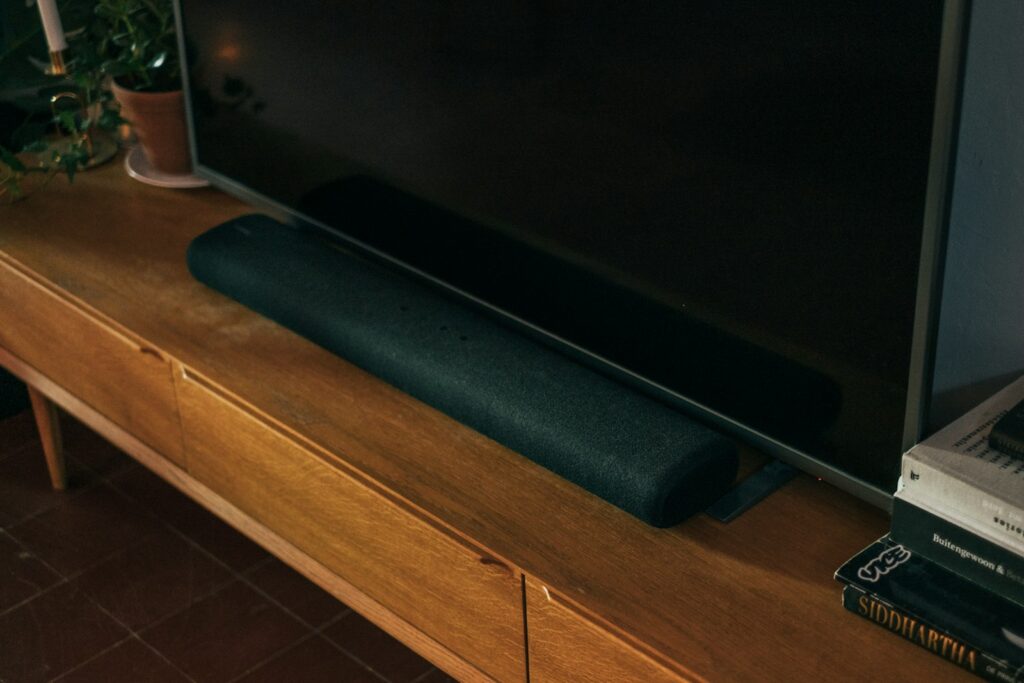
And that’s all a soundbar is at this price. Forget home cinema fantasies. A £100-150 bar is a set of decent speakers in a tube, doing the job your TV physically can’t.
The Atmos badge is the biggest con in budget audio
Walk into Currys and you’ll see Dolby Atmos plastered on bars costing £69. Ignore it. Atmos done properly needs upward-firing drivers, a room with a flat ceiling to bounce sound off, and processing that cheap hardware simply doesn’t have. What you get at this price is a normal stereo bar running a software trick that makes everything sound slightly hollow, like the players are calling for the ball from inside a wheelie bin. Reviewers keep saying this – What Hi-Fi’s budget round-ups make the same point almost every year – and shoppers keep falling for the badge anyway.
My advice is blunter than most: under £150, don’t just be sceptical of Atmos, actively avoid it. Every pound the manufacturer spent licensing the badge and adding token height processing is a pound not spent on the drivers and amplifier. A well-made 2.0 or 2.1 bar with no spatial pretensions will beat a fake-Atmos bar for football, for drama, for everything. Buy speakers, not stickers.
One more number worth decoding before the picks. “2.1” means two speaker channels plus a subwoofer, and at this level the “.1” matters more than any other spec on the box. More on that further down.
The numbers on the box, and which ones are lies
Budget soundbar marketing runs on numbers that sound impressive and mean almost nothing, so a quick translation before we spend any money.
Watts first, because it’s the worst offender. A box shouting “300W TOTAL POWER” is usually quoting a peak figure measured in conditions no living room will ever recreate, sometimes with 10% distortion baked in. A well-built 80W bar can sound louder, and much cleaner, than a badly built 300W one. I’ve had both on the same TV unit in the same week; the wattage told me nothing about which one I wanted to keep. Treat the number as decoration.
Channel counts are half-honest. The first digit is how many actual speaker channels you get, the “.1” is a subwoofer, and any third digit is height channels – which, as covered above, you should treat as a warning label at this price. A real 2.1 beats a pretend 5.1.2, every time.
The spec that does matter is the socket on the back. HDMI ARC is the one you want, because it means one cable, better sound and one remote for everything. Optical works but caps the audio quality and leaves you juggling two remotes. Bluetooth-only bars – and there are still some lurking at the bottom of Amazon – mean lip-sync drift and a fight every time someone’s phone auto-connects mid-match. And check the bar’s width against your TV stand before ordering. A 95cm bar in front of a 43-inch telly looks like a limousine parked outside a caravan, and half the returns in this category are people who never got the tape measure out.
How we’d spend the money: the best soundbar under £150 right now
Four bars worth your attention, with the caveats spelled out. Prices move around weekly at this end of the market – these were right when we last checked at the start of September, but hold out for the frequent dips.

Sharp HT-SBW202 – around £120. The quiet overachiever of budget audio. A 2.1 system with a proper wireless subwoofer, which at this money is close to unheard of, and it’s the one I’d point most people towards for football. Crowd noise has weight, the sub picks up the low rumble of a full stadium, and dialogue sits clearly on top. The negatives: the remote feels like it came free with a magazine, there’s no Wi-Fi or streaming smarts at all, and the display is a cryptic little LED that makes changing settings a bit of a faff. None of that matters at 3pm on a Saturday.
Sony HT-SF150 – around £99. The safe pair of hands. One long bar, no subwoofer, but Sony’s S-Force processing does a convincing job of stretching the sound wider than the cabinet. Voices are the star here – commentary and studio punditry come through cleaner than on anything else at the price. But without a sub there’s no real low end, so goals sound crisp rather than thunderous. If you live in a flat with thin walls and a downstairs neighbour who bangs the ceiling, that might be exactly what you want.
Hisense HS214 – around £79. The cheapest thing here that I’d still call good. It’s a 2.1 all-in-one, meaning the “subwoofer” is built into the bar itself, and it plays louder and fuller than a £79 box has any right to. It also has HDMI ARC, which some rivals at this price still skip. The trade-off is refinement: push the volume past two-thirds and it starts to shout, and music through it is nothing to write home about. As a first upgrade from TV speakers, it’s a bargain.
Samsung HW-B550 – £149 on a good day. The stretch pick. A 2.1 with a separate wired-in subwoofer that’s genuinely punchy, a dedicated voice-enhance mode that works, and a bit more polish than everything above. It sat above £150 for ages but has been dipping under since spring. If you can catch it there, it’s the most complete package on this page. If it’s back at £179 when you look, don’t chase it – the Sharp gets you most of the way for £60 less.
The four picks side by side
| Bar | Typical price | Setup | HDMI ARC | Best for | Weak spot |
|---|---|---|---|---|---|
| Sharp HT-SBW202 | £120 | 2.1, wireless sub | Yes | Football and film in a living room | Clunky remote, no Wi-Fi |
| Sony HT-SF150 | £99 | 2.0, no sub | Yes | Dialogue, flats with thin walls | No real bass |
| Hisense HS214 | £79 | 2.1 all-in-one | Yes | First upgrade, small rooms | Shouty at high volume |
| Samsung HW-B550 | £149 | 2.1, wired sub | Yes | The most complete package | Price keeps drifting over £150 |
If you want to sanity-check any of these against lab testing, Which? maintains a big soundbar review database – their cheapest reviewed bars start around the £140 mark, which tells you something about how rarely the budget end gets serious attention.
The one to skip
Majority’s sub-£70 Atmos-badged bars deserve a specific mention, because they’re everywhere – all over Amazon, frequently “reduced” from invented higher prices, and reviewed glowingly by people upgrading from laptop speakers. Majority is a real Cambridge company and some of their plain stereo bars are perfectly decent for the money. But the cheap Atmos models are exactly the sticker-first engineering I described above, and the processing genuinely makes voices harder to follow, which defeats the entire point. If your budget is £70, buy the Hisense. If it’s £50, honestly, save up the extra £29.
Can’t you just use the Bluetooth speaker you already own?
Tempting, and nearly everyone tries it once. It doesn’t work, for one stubborn technical reason: latency. Bluetooth adds a delay of anywhere from a tenth to a third of a second, and while your brain forgives that on music, it will not forgive a ball being kicked before the thump arrives. Some TVs let you dial in lip-sync correction for Bluetooth audio; most budget ones don’t, and even when they do, the delay wobbles as the connection renegotiates.
There’s a practical problem too. A Bluetooth speaker pairs with whatever shouted loudest last, so match night becomes a ritual of un-pairing someone’s phone while the teams are lining up. A soundbar on HDMI ARC turns on with the telly, takes volume from the same remote, and never asks you to think about it again. That invisibility is what you’re actually paying for.
Your good portable speaker still has a job – it’s just in the garden or the kitchen, not under the telly. And if your real problem is late-night viewing without waking the house, the honest answer isn’t a speaker at all but a decent pair of earbuds, which we’ve covered separately.
Where to put it, and where everyone puts it instead
Placement is the free upgrade nobody uses. The bar wants to sit directly under the screen, on the front edge of the unit, with nothing between its drivers and your sofa. What actually happens in most houses: it gets pushed to the back of the TV stand behind a scented candle and a Sky remote, or worse, laid inside a cabinet shelf where the sound hits a glass door before it hits a human. If you can see the whole front of the bar from your seat, you’re fine. If you can’t, neither can the sound.
Two smaller placement notes. Don’t block the little window on your TV’s bottom edge – that’s the IR receiver, and a bar parked in front of it means the remote stops working and the bar gets blamed for witchcraft. And if you go for a model with a subwoofer, resist the urge to hide the sub in a corner behind the sofa. Corners exaggerate boom, and what reads as “bass” on day one becomes a neighbour complaint by October. A foot of clearance from the wall, anywhere along the front of the room, and it disappears into the mix the way it should.
Wall-mounting the TV changes none of this, by the way – most bars in this price bracket come with keyhole brackets in the box, and mounting the bar just under the screen is ten minutes with a spirit level. The Sharp and the Sony both include the fittings; the Hisense makes you improvise.
Five minutes of settings that matter as much as the hardware
Whichever bar you buy, most of them get plugged in wrong, and a badly set-up £150 bar can lose to a well set-up £79 one. The checklist:
Use the HDMI socket labelled ARC or eARC on your TV, not the optical cable in the box – HDMI carries better audio and lets your normal TV remote control the volume. Then go into the TV’s sound menu and make sure output is set to the external device only, because some sets will happily run their own speakers at the same time, which sounds like the match is being played in two stadiums at once. Turn off any “auto volume” or “night mode” for sport – they flatten the crowd surges that make football worth hearing. And if voices still sound buried, use the bar’s dialogue or voice mode, which on most budget bars is the only sound mode that earns its place. The other presets – “movie”, “music”, “game” – are mostly the same EQ wearing different hats.
Check the lip sync too. If the ball leaves the boot before you hear it, your TV will have an audio delay slider hidden in the same menu. Ten minutes with it saves a season of low-level irritation.

Do you actually need the subwoofer for football?
Less than you’d think, more than you’d like. Speech and commentary live in the mid-range, which any decent bar handles. What a sub adds to sport is atmosphere – the low-frequency swell of 60,000 people that you feel more than hear. On drama and film the difference is bigger still. My rule: if the soundbar is for the living room where you’ll also watch films, the sub earns its space. If it’s for a bedroom or kitchen telly, skip it and put the savings towards a better panel when the January sales come round.
It’s worth saying that £150 is a floor for good sound, not a ceiling. Spend £300 and things improve again; spend £600 and you’re into proper home cinema territory, which we’ve covered separately. But the jump from TV speakers to any competent bar is bigger than every jump after it. Diminishing returns start early in audio.
The clearance shelf nobody checks
One more way to stretch the budget: buy last year’s bar, or somebody’s returned one. Soundbars don’t age the way phones do – a 2024 model with HDMI ARC does exactly what a 2026 model does, minus the box-fresh smell. Richer Sounds’ clearance shelves regularly knock £30-50 off discontinued Sharp and Sony models, Currys runs an eBay outlet full of open-box returns at 20-30% off, and John Lewis customer returns come with the same two-year guarantee as new stock. The £149 Samsung at full price is a £110 open-box bargain more weekends than not.
The usual caution applies: check the listing actually includes the subwoofer, the power leads and the wall fittings, because “open box” occasionally means “box someone emptied of accessories before sending back”. A missing HDMI cable costs £5 to replace. A missing subwoofer doesn’t.
The season runs to May, the nights are drawing in, and the fix is one evening, one cable, no drilling. The only real mistake is spending another winter asking the room what the commentator just said.