
Do LED Face Masks Work? Four Banned Ads, Zero Registered Devices and the £300 Question of 2026
Updated 17 September 2026: this guide now folds in our later piece on the £399 masks – the “FDA cleared” explainer and the twelve-week rule – so everything we’ve written on LED masks lives here.
In This Article
- Four brands, one ruling, zero registered devices
- How Britain ended up with a drawer full of glowing masks
- Do LED face masks work on ageing skin? The honest reading
- Acne is where the wheels come off
- The dose problem printed on no box
- How to read a spec sheet before you spend
- "FDA cleared" and "clinically proven": what the box is allowed to say
- Who might get their money’s worth – and who should steer clear
- If you buy one anyway: the twelve-week rule
- What I’d do with the £300 instead
On 5 November last year, the Advertising Standards Authority banned adverts from four LED mask brands in a single sweep – Beautaholics, Luyors Retail, Project E Beauty and Silk’n – for claiming their devices could treat acne and rosacea. The question half of Britain has typed into Google at some point – do LED face masks work? – now has at least a partial answer from a regulator: not in the way the adverts said. And the detail that should give every owner of a glowing red mask pause came from the MHRA, which confirmed there are currently no LED face masks registered with it as medical devices. Not one. Nine months on, the masks are still everywhere – on bestseller pages, in gym bags, in spa gift guides, propped up in bathroom selfies – and the gap between what they legally can claim and what people believe they do has never been wider.
That gap is worth picking apart, because the answer isn’t a clean “they’re a con”. Some of the science is real. It’s just much smaller than the price tag suggests.
Four brands, one ruling, zero registered devices
The ASA rulings make for entertaining reading if you enjoy watching marketing departments squirm. Project E Beauty’s website claimed an “83% improvement in acne lesions in four weeks”, promised its mask could “destroy acne-causing bacteria” and ran before-and-after photos alongside the line “By Week 3, my acne had disappeared”. Beautaholics said its RejuvaLux mask offered “targeted solutions” for acne and rosacea using “clinically proven light therapy”. Silk’n argued that its ad was only quoting a customer’s testimonial – the regulator’s response, in effect, was that you can’t launder a medical claim through a happy customer. All four ads were pulled.
The legal point is simple. Acne and rosacea are medical conditions in the UK, and you can only claim to treat a medical condition if your product is registered with the Medicines and Healthcare products Regulatory Agency. None of these masks were. According to the MHRA, no LED face mask is. The full detail of the rulings is worth a read via Cosmetics Business, which covered all four cases.
There’s a very 2026 footnote here, too: none of these ads were reported by an annoyed dermatologist. They were caught by the ASA’s AI monitoring system, which scans online ads for rule-breaking claims automatically. The watchdog now has software doing the sweeping, which suggests the era of beauty brands quietly getting away with medical language on Meta ads is closing.
But an ad ban tells you what a mask can’t legally say. It doesn’t tell you what the thing actually does. So let’s do that properly.
How Britain ended up with a drawer full of glowing masks
LED light started as a clinic thing. For years it was the add-on your facialist suggested at the end of a treatment – ten minutes under a panel, £30 on the bill, vaguely pleasant, hard to argue with. Then the pandemic pushed the whole professional beauty menu into people’s bathrooms, and the mask was the gadget that survived. Unlike the microcurrent wands and the ultrasonic spatulas, it photographed brilliantly. A person in a glowing red mask is an image you stop scrolling for, and the brands knew it.
By this year the format had gone fully mainstream. There are masks at £60 from brands you’ve never heard of and masks north of £500 from brands sponsoring half the podcasts you listen to. They turn up on Boots bestseller pages and in the gift guides of every December supplement. The pitch has matured too – it’s no longer “salon results at home”, it’s the more 2026-flavoured “clinical skincare, backed by science”, usually with a citation-shaped asterisk that leads nowhere in particular.
And that’s the context that makes the ASA rulings interesting rather than just embarrassing. This isn’t a fringe product getting slapped for cowboy claims. It’s one of the most-purchased beauty devices in the country being told, formally, that the thing a large chunk of buyers think they bought it for – clearing spots, calming rosacea – is a claim nobody is legally allowed to make. The market grew faster than the evidence did, and the regulator has finally noticed the gap.
None of which means the category is a scam. It means the burden of proof sits with each mask, and most of them aren’t carrying it.
Do LED face masks work on ageing skin? The honest reading
The underlying science is called photobiomodulation, and it isn’t fringe. The idea traces back to NASA-funded work on light and wound healing in the 1990s, and the proposed mechanism – red and near-infrared light nudging the mitochondria in skin cells to produce more energy, which in turn supports collagen production – is biologically plausible and has decades of lab work behind it.
The best-known human trial is a 2014 German-Austrian study published in Photomedicine and Laser Surgery, which put 136 volunteers through twice-weekly red light sessions over 15 weeks. It found measurable improvements in skin complexion and ultrasound-assessed collagen density compared with controls. That’s a genuine result, and it’s why dermatologists don’t dismiss red light outright – many clinics use LED panels after facials and laser treatments precisely because the anti-inflammatory effect is real.
But look at what that trial actually involved: 30 supervised sessions on calibrated professional equipment. And look at what it found: improvement visible on an ultrasound scan and in graded photographs, not a jaw-dropping change your friends would comment on. The honest summary of the anti-ageing evidence is “modest benefit, from small trials, with consistent use of properly dosed devices”. Fine lines soften a touch. Skin tone evens slightly. Nobody’s forehead is being mistaken for a Botox result.
That’s a defensible product. It’s just not the product the adverts sold.
Acne is where the wheels come off
The acne story sounds convincing at first. Blue light at around 415 nanometres kills Cutibacterium acnes, the bacterium involved in breakouts, in laboratory conditions. Brands take that petri-dish fact and stretch it into “clears acne” claims – the exact stretch the ASA just banned.
In actual faces, the results are far less tidy. Acne isn’t just a bacteria problem; it’s oil production, blocked pores, hormones and inflammation, and a few minutes of low-power blue light doesn’t touch most of that chain. Trials of light therapy for acne tend to be small, short, inconsistent and hard to compare with each other, which is why you won’t find LED masks in NHS acne care. The NHS treatment pathway runs through benzoyl peroxide, retinoids, antibiotics and, for the stubborn cases, isotretinoin – things with large trials behind them.
And here’s the contrarian bit, which shouldn’t be contrarian at all: if you have genuine acne, a tube of benzoyl peroxide from the pharmacy for about a tenner will do more for your skin than any £300 mask on the market. If it’s bad enough that you’re considering spending mask money on it, that money is better spent on a GP appointment and a prescription retinoid. A mask is the most expensive possible way to be disappointed about your acne.
One irony worth knowing: some acne treatments, including the commonly prescribed antibiotic doxycycline, make skin more sensitive to light. The people most desperate for the mask to work can be exactly the people who should be most careful with one.
The dose problem printed on no box
Here’s the question to ask about any mask, and good luck finding the answer on the packaging: how much light is it actually delivering to your skin?
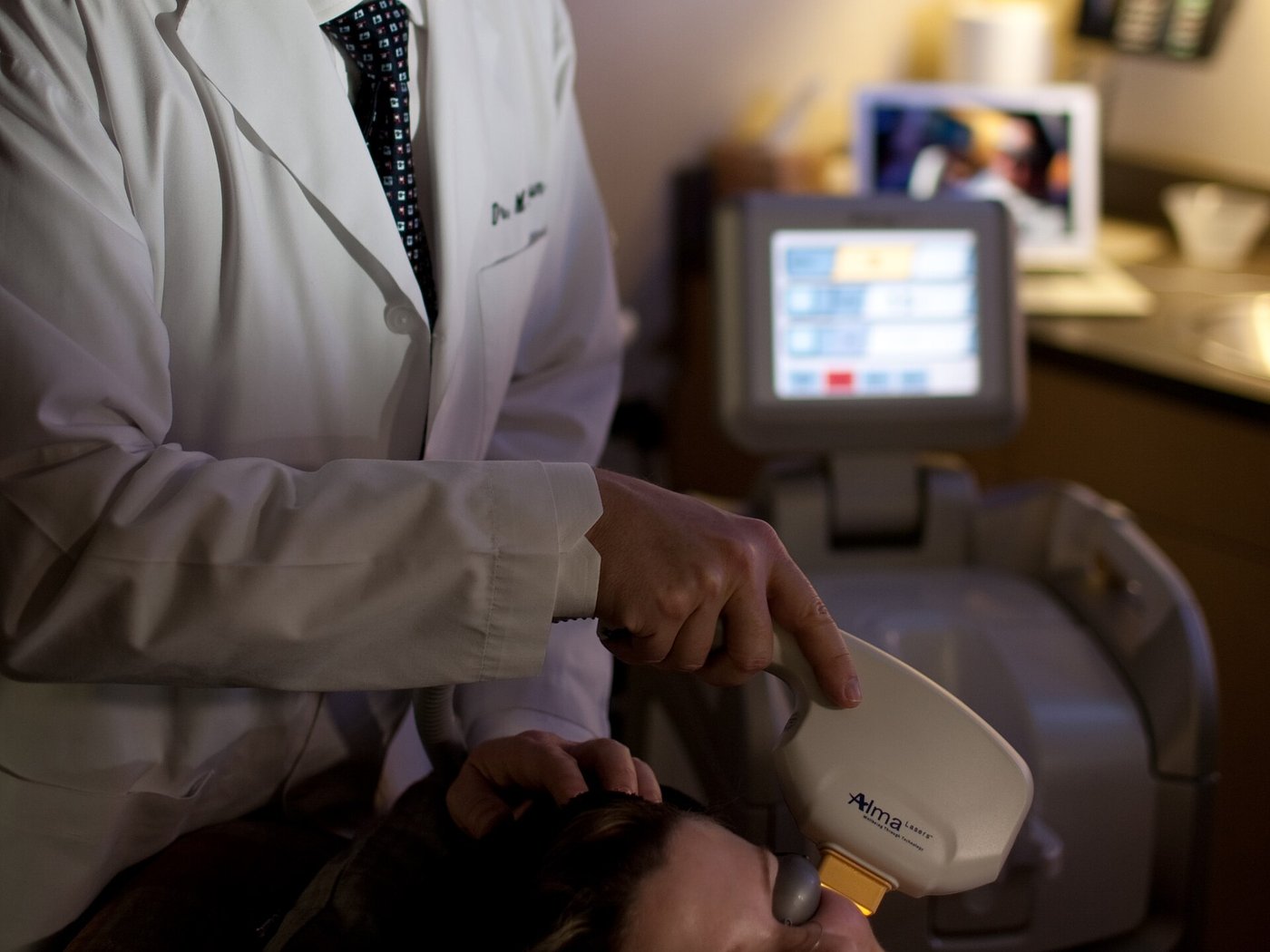
Clinic LED panels are positioned centimetres from the face and deliver a measured dose over a set time. Home masks run off batteries, sit unevenly on the curves of a face, and in many cases don’t publish their irradiance figures at all. Two masks at the same price can differ several-fold in output, and you’d never know. When a brand won’t tell you the dose, you’re not buying a treatment – you’re buying mood lighting with a chin strap.
Consistency is the other half of the dose problem. The trial results people cite came from months of twice-weekly-or-more sessions. A friend of mine bought a well-reviewed mask in the Black Friday sales, used it religiously for a fortnight, then somewhere around mid-January it migrated to the drawer with the gua sha stone and the jade roller. Her skin looks the same as it always did, which is to say fine. The single biggest predictor of whether a mask does anything isn’t the brand. It’s whether you’re still wearing it in month four.
We’ve covered this pattern before – a kernel of real science, scaled up into a habit most people won’t sustain, at a price that assumes they will. It’s the same shape as the lymphatic drainage drops TikTok fell for this summer, and the magnesium-for-sleep boom built on trials of a few dozen people.
How to read a spec sheet before you spend
If you’re going to buy one anyway, the spec sheet tells you more than the reviews. Four things are worth checking.
Wavelength first. The evidence base clusters around specific bands: red light at roughly 630 to 660 nanometres and near-infrared at around 830 for the collagen story, blue at around 415 for the bacteria-in-a-dish story. A mask listing seven pretty colours is telling you it’s a toy; green, purple and cyan modes exist because RGB LEDs are cheap, not because anyone has trial data for them. Two wavelengths done properly beat seven done for the product photos.
Irradiance second – the power actually reaching your skin, measured in milliwatts per square centimetre. This is the number brands most often omit, and its absence is information. Without it you can’t compute dose, and dose is the entire game.
Then fit and coverage. Rigid masks hover a centimetre off half your face, and light intensity falls away sharply with distance. Flexible silicone designs that sit on the skin deliver more of what the LEDs produce. It’s an unglamorous detail that matters more than most of the marketing.
Last, certification – and read it carefully. A UKCA or CE mark means a product meets general safety standards; it says nothing about whether it treats anything. Beautaholics made exactly this point to the ASA, noting its mask was UKCA certified – and the ads still got banned, because safety certification isn’t medical registration. If a listing waves a certificate at you next to the word “acne”, you’re looking at the same trick the regulator just called out. The legal breakdown at Professional Beauty is worth five minutes if you want the fine print.
“FDA cleared” and “clinically proven”: what the box is allowed to say
Every premium mask sold here carries some version of “FDA cleared” on the packaging, and it’s doing a lot of work it hasn’t earned. FDA clearance for this class of device is a safety-and-similarity process: the maker shows the product is substantially equivalent to something already on the market and doesn’t hurt anyone. The FDA itself has said the mechanism of photobiomodulation for different clinical indications isn’t fully understood. Clearance isn’t a verdict on whether the mask reduces wrinkles, and it isn’t a UK approval of anything, because the FDA has no jurisdiction here. In Britain most of these masks are sold as consumer electronics rather than registered medical devices, which is exactly why the ASA, rather than a regulator with lab access, is the body that ended up policing the claims above.
“Clinically proven” is looser still. It usually means the brand ran its own study, often on 30 to 60 people, unblinded, with the results measured by the brand’s chosen clinic. Those studies aren’t worthless – CurrentBody’s 35-person trial and Shark’s 59-person one at least used before-and-after imaging rather than surveys – but an unblinded, company-funded trial with no control group is the weakest kind of evidence that still counts as evidence. Nobody independent has run the two big masks head to head. Until someone does, the comparison reviews you’ll find online are one person’s face, one mask at a time.
Who might get their money’s worth – and who should steer clear
A mask isn’t automatically a waste of money. The realistic best-case buyer looks like this: skin that’s basically healthy with some mild sun damage or early lines, a routine that already includes the proven stuff, a temperament that will actually sit through four or five short sessions a week for months, and expectations set at “slightly better” rather than “transformed”. For that person, the evidence supports a modest, gradual payoff. There’s also something to be said for ten enforced minutes of sitting still – some owners keep using theirs mostly because it’s the only part of the day nobody talks to them.
Steer clear, though, if any of these apply. You’re buying it to treat acne or rosacea – that’s the claim that just got four brands banned, and clinic-grade results need clinic-grade kit. You have melasma or are prone to pigmentation – near-infrared generates heat in the skin, heat is a known melasma trigger, and the British Skin Foundation’s melasma guidance is built around avoiding both, so dermatologists who treat pigmentation increasingly tell patients to skip home masks that include NIR (which is most of the premium ones). You take photosensitising medication. Or you’re expecting it to compete with a retinoid, which it won’t.
Eye comfort matters more than the manuals let on, too. If a mask makes you see spots after a session, that’s not a sign it’s working.

If you buy one anyway: the twelve-week rule
Use it as the trials did or don’t bother. That means ten minutes, four or five times a week, on clean dry skin with nothing on it – serums and moisturisers can scatter or absorb the light, and anything with a mineral SPF will block it outright. Do it before your evening routine, not after. Put the retinoid on afterwards.
Take a photo on day one in the same light you’ll use again at week twelve. Bathroom, morning, no make-up, phone at arm’s length. Memory is useless for this; everyone thinks their skin looks better after spending £399 on it, which is one reason the influencer reviews are worthless as evidence.
Don’t double up sessions to catch up after a missed week. The dose curve means more isn’t better, and several dermatologists now think daily overuse is why some people report their mask “stopped working”. Skip the wavelengths you don’t need: if you don’t have spots, running blue light is pointless and mildly drying.
And buy it in a sale. Both big brands discount heavily and predictably – 20 to 30 per cent off has been standard around Black Friday and again in January – and the models don’t change often enough that waiting eight weeks costs you anything. A £399 mask at £290 with a 12-month warranty is a much easier decision than the same mask at full price because a video told you to.
What I’d do with the £300 instead
The dull truth of skincare in 2026 is that the two interventions with mountain-sized evidence bases cost less than a month of coffees: a retinoid at night and sunscreen every morning. We’ve written before about how most people are under-applying SPF even when they think they’ve got it covered, and about the gap between what midlife skin needs and what’s marketed at it. A year’s supply of a decent retinal serum and a proper sunscreen comes in well under £150, works in every trial anyone has ever run, and leaves you enough change for a genuinely nice dinner.
If, after all that, you still want the mask – because the ritual appeals, because your expectations are calibrated, because you’re the rare person who’ll still be using it in June – buy one from a brand that publishes its wavelengths and irradiance, and treat every acne claim you see as the red flag the regulator says it is.
So here’s the question for the owners: be honest, when did yours last come out of the drawer – and if it stopped earning its shelf space months ago, what would you spend the money on now?