

Curtain Trends 2026: Britain Is Drawing the Curtains Again – The Pelmet Comeback, Dunelm’s Made-to-Measure Boom and Why the Eyelet Has to Go
Dunelm sold £1.8 billion of homeware last year, and buried in the results it filed this month is a line nobody outside the trade noticed: made-to-measure window treatments “again grew strongly”, picked out alongside lighting and storage as the categories that carried the business. Read that against what British living rooms looked like five years ago – a bare sash, a roller blind, maybe a voile if someone’s mum insisted – and it tells you something. The curtain trends 2026 has produced aren’t a colour story or a fabric story. They’re the story of a country quietly deciding that naked windows were a mistake.
In This Article
- Britain stripped its windows bare, then got cold
- Curtain trends 2026: what's actually going up at the window
- The thermal claim, checked against what the numbers say
- What £30 to £300 buys this autumn
- Skip the eyelet. Seriously.
- Five hanging mistakes that make good curtains look like bad ones
- Why this one will stick
I’ve watched it happen on my own street. In 2021 you could count the curtained bays on one hand. This autumn there are pelmets. Actual pelmets.
Britain stripped its windows bare, then got cold
The blind-only window was never really a design choice. It was a by-product of two other decisions: knocking through into open-plan, and painting everything a shade of grey that made soft furnishings look fussy. Curtains got lumped in with carpets, wallpaper and the big central light as things a “done” house didn’t have. And for a while the maths worked, because energy was cheap enough that a single-glazed Victorian bay with a £25 roller from Argos was merely draughty rather than expensive.
That’s over. The same reversal we’ve tracked in carpet, wallpaper and the closed-off snug has reached the window, and for the same two reasons. Softness is back as an aesthetic, and warmth is back as a budget line. A heavy, lined curtain happens to answer both, which is why it’s the one bit of the soft-furnishing revival that even the minimalists are conceding.
Dunelm’s own numbers back that up more than any trend forecast. Made-to-measure is the expensive end of curtains – the bit you don’t buy on a whim – and it’s the bit that grew. People aren’t picking up a £30 pair because the old ones faded. They’re measuring bays and paying for proper drops. That’s a commitment, not a refresh.
Curtain trends 2026: what’s actually going up at the window
Strip out the fabric-house marketing and the trend reports agree on a surprisingly short list. Livingetc’s designer round-up from January and Homes & Gardens’ February piece on pelmets land in the same place, and eight months on, the shop floors have caught up.
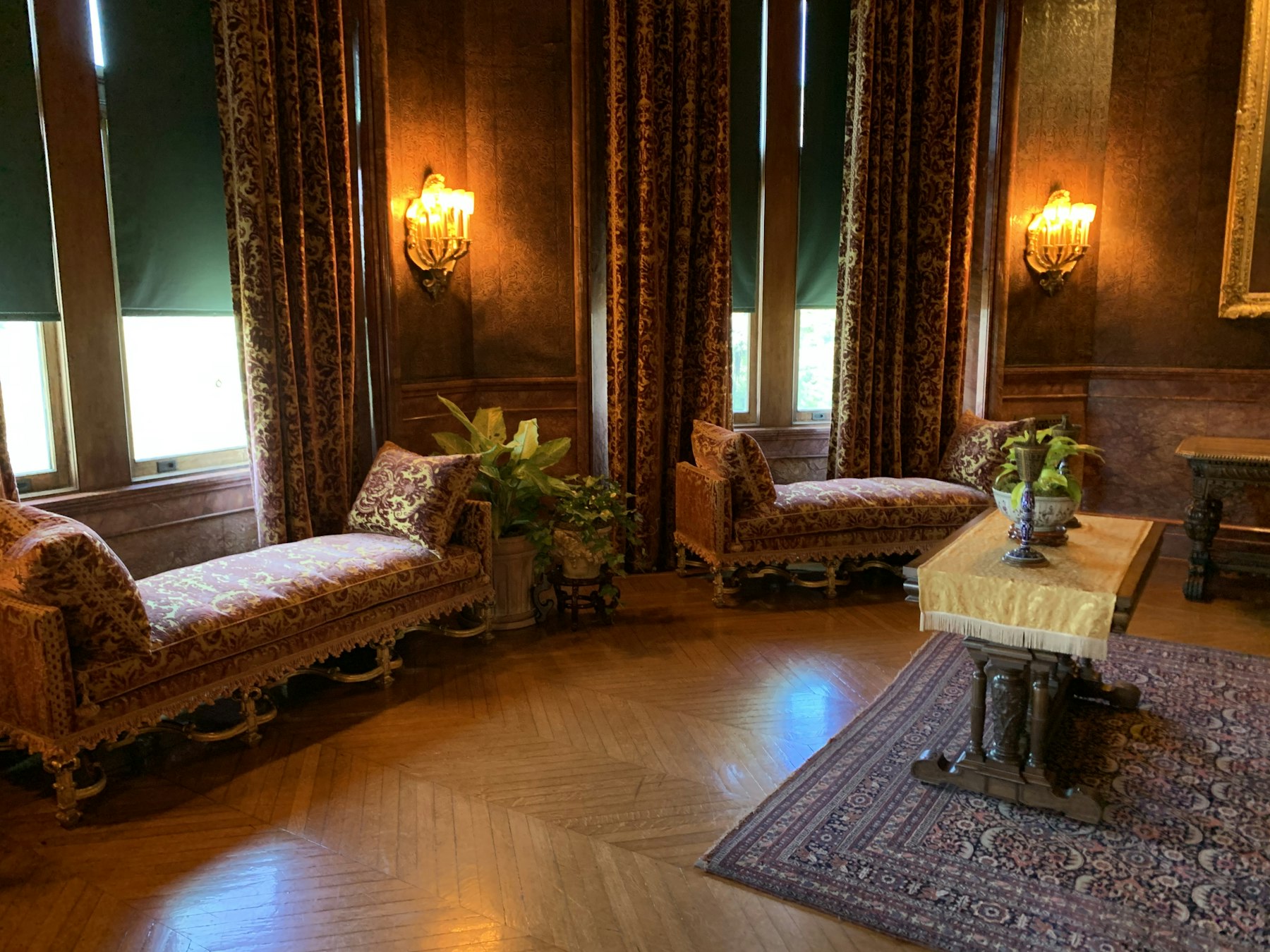
The pelmet is the headline. A structured, usually upholstered box across the top of the window that hides the track and finishes the wall. Your nan had one, probably in a swagged floral, and for thirty years it was shorthand for a house that hadn’t been touched since 1987. The 2026 version is straight-edged, plain or in the same fabric as the curtain, often with a narrow braid trim. London designer Rebecca Hughes told Livingetc the trick is to keep the shape clean and the trim solid so it “reads as modern rather than overly traditional”. I’d put it more bluntly: a box pelmet is what makes a curtain look built in rather than hung, and it’s the single biggest visual upgrade you can make for the money.
Full height is now the default. Ceiling-fixed track, curtain to the floor, whether or not the window itself goes anywhere near either. It stretches the room, hides the radiator nobody wants to look at, and stops the sad half-mast effect of a sill-length pair that ends mid-wall.
Layering has gone mainstream too. A sheer or a blind for the daytime, a heavy curtain over it for the evening. It used to be a hotel move. Now it’s on the H&M Home site.
Colour has warmed up – taupe, terracotta, moss and olive rather than dove grey – and pattern is back but held on a lead. Florals in two colours, not six. Stripes. The clashing-print maximalism you see on Instagram is a minority sport; most of what’s selling is a quiet pattern on a lined, heavyweight cloth. And the café curtain, the half-height gathered panel on a slim rod, is holding its place in kitchens and bathrooms for a second year, which is longer than most trends manage.
What’s out: the sculptural swag, the tab-top, the single voile on a wire, and the untreated window. The last one matters most.
The thermal claim, checked against what the numbers say
Every curtain listing now carries a thermal badge and a saving. Time to be a bit careful.
The credible baseline comes from the Energy Saving Trust, which puts heat lost through windows in an uninsulated house at around 18%. That figure is quoted by the charity Groundwork in its home energy advice, along with the practical point that actually matters: the saving depends almost entirely on closing the things at dusk. A lined curtain left open until bedtime is decoration. A lined curtain drawn at four o’clock in November is insulation.
Then the numbers get looser. Groundwork also passes on a figure from The Eco Experts claiming high-quality thermal curtains can cut a three-bed home’s heating bill by £327 a year. I don’t believe that as a typical outcome and you shouldn’t either. It assumes a poorly glazed house, a lot of window, and a household disciplined about drawing every curtain every evening. The more common retailer claim – somewhere between £80 and £120 a year – is closer to plausible for a draughty terrace with older double glazing, and even that’s a best case. On a modern build with decent A-rated units the gain is real but modest; you’re mostly buying comfort, not a payback.
But comfort is the point, and it’s undersold. The thing a heavy curtain does that no spreadsheet captures is kill the cold radiating off the glass. Sit a metre from a big window in January with a blind down and you’ll still feel it on your face. Draw a lined curtain and you won’t. That’s why the return of curtains tracks so neatly with the return of the column radiator and the retreat from open-plan – it’s the same person, in the same cold house, making the same set of decisions in a different order.
Two practical rules if warmth is your reason. Don’t let the curtain cover the radiator; a floor-length pair hanging in front of the only heat source funnels warm air straight up the glass and out. Either stop the curtain at the sill on that window or fit a shelf above the radiator to throw heat into the room. And ignore “thermal” as a label – it just means a coated or lined back. What you want is a proper interlining, the fleecy layer between face fabric and lining, and that’s rarer and dearer than the badge suggests.
What £30 to £300 buys this autumn
Prices below are what I found on the shelf and online this week; expect promotions to move them around, because curtains are one of the most heavily discounted categories in homeware.
£30 to £60: Dunelm’s Jennings thermal eyelet pair starts at £30 for the smallest size and runs up through £45 and £60 as the drop grows, topping out at £120 for the widest, longest pair. The Luna brushed blackout eyelet range sits a notch higher, from £40 to £100. Both are coated-back polyester. They’ll black out a bedroom and take the edge off a cold window, and they’ll look like exactly what they are: ready-made eyelets. Fine for a rental or a kid’s room. I’d not put them on a bay in the front room.
£60 to £120: This is where the trend actually lives for most people. H&M Home’s blackout lyocell-blend pair is £79.99 and has a softer, more linen-like hand than anything at the price two years ago. John Lewis’s Wildflower Sprigs blackout and thermal-lined pair starts at £75 and is the sort of restrained two-colour floral the designers keep pointing at. Anthropologie’s Louise velvet is £68 a single panel, so call it £136 a pair, and velvet is the fabric that makes a pelmet-and-pole scheme look properly expensive.
£150 upwards: Made-to-measure. Dunelm, John Lewis, Hillarys and a hundred local workrooms will come and measure. Expect a pair for a standard window to land in the low hundreds and a bay with a curved track to run to four figures once you’ve added interlining and a pelmet. This is the bit of the market that’s growing, and it’s growing because a bay window is the one place ready-made almost never fits.
The honest advice on budget: spend less on the fabric and more on the hardware and the hang. A £60 pair of plain curtains on a ceiling-fixed track with a simple box pelmet will beat a £200 pair drooping off a £15 pole every time.
Skip the eyelet. Seriously.
Here’s the one position in this piece that’ll annoy people. The eyelet curtain – the one with the big metal rings punched through the header, sliding straight onto a pole – is the reason British windows looked cheap for fifteen years, and the sooner it goes back to student halls the better.
It’s not snobbery. Eyelets have three problems and none of them is fixable. The rings force the fabric into stiff, evenly spaced folds that never soften, so the curtain always looks like it’s just come out of the packet. The header sits below the pole, so you see a strip of pole and wall above the curtain, which is the exact opposite of the tall, built-in look every 2026 trend report is chasing. And you can’t put a pelmet over them, because the whole point of an eyelet is that the pole is on show.
Pencil pleat costs the same. Pinch pleat costs a bit more and looks a great deal more. Either one hangs off a track, disappears under a pelmet, and drapes properly after a week. The Livingetc designers hedged around this with talk of “slim poles and discreet tracks”; I’ll just say it. If you’re buying new curtains this autumn and they’ve got holes punched in the top, you’ve bought the 2012 version.
The other thing to skip: sheers on their own in a north-facing room. Sheer-only schemes photograph beautifully in a south-facing Hackney flat in June. In a Leeds back bedroom in February they’re a polite way of having no curtains.
Five hanging mistakes that make good curtains look like bad ones
Most disappointing curtains are fine curtains hung badly. In roughly descending order of damage:
Fixing the pole to the window frame. The pole or track wants to be as close to the ceiling as the cornice allows, and to extend 15 to 25 centimetres past the window on each side so the open curtain stacks back onto wall, not glass. Elizabeth Stanhope’s advice in Homes & Gardens – mount it high and wide – is the whole game.
Buying to the width of the window. A curtain needs roughly twice the width of the track in fabric to gather properly; anything less and it hangs flat and mean when closed. Two narrow panels stretched across a bay is the most common fault I see.
Stopping short of the floor. Sill-length only ever made sense above a radiator. Everywhere else, the hem should kiss the floor or break on it by a centimetre. Puddling – the extra few inches pooled on the boards – is having a moment in the magazines, but it’s a dust trap and looks like you measured wrong.
Ignoring the lining. Unlined face fabric goes see-through at night, fades on the leading edge within two summers, and does nothing for the cold. Lining is where the money should go, not the print.
Leaving the big light on and expecting the curtains to do the work. A heavy curtain wants low, warm lamplight to look like anything. Under a single ceiling pendant it’s just a wall of fabric.
Why this one will stick
Interiors trends usually die when the reason for them goes away. The big light went because LEDs made lamps cheap; the grey wall went because everyone had one. Curtains are different, because the pressures pulling them back – a cold housing stock, expensive heat, and a generation that tried living in a glass box and didn’t like it – aren’t going anywhere before the end of the decade.
So the pelmet is coming back, the eyelet is on its way out, and the bay window that’s had a broken roller blind since the last tenant is finally going to get measured. Dunelm’s shareholders have already noticed. The question for the rest of us is the one every trend piece skirts: when you draw the curtains tonight, are they actually doing anything, or are you just hiding the window?