Outdoor Cinema 2026: Why Britain’s Summer Film Night Has Moved Outside
The best seat in British cinema this June doesn’t have a roof. It’s a deckchair on a rooftop in Peckham, or a patch of grass beside a canal at King’s Cross, with the smell of someone else’s hot dog drifting over while the screen flickers awake and the last of the light drains out of the sky. Type “outdoor cinema 2026” into Google and you’ll get hundreds of dates across the country, from a rooftop in Stratford to a castle lawn in Cardiff. The novelty wore off years ago. Open-air screenings have quietly become what a lot of people actually mean now when they say they fancy a night at the pictures.
In This Article
- Cinema is having a strange decade
- From lockdown stopgap to summer fixture
- What the outdoor cinema 2026 season actually looks like
- Let's be honest, a lot of it is mediocre
- It's not cheap, and that's the catch
- Why it works anyway
- The programming gives the game away
- How to do it without coming away grumpy
- What happens next
And the timing is no accident.
British cinema is in an odd spot. The big screens are wobbling while the experience around them sells better than ever, and outdoor cinema sits right on that fault line.
Cinema is having a strange decade
The headline numbers aren’t pretty. UK cinema admissions came to 123.5 million in 2025, down 2% on the year before and roughly 30% below where they sat in 2019, according to the BFI’s official figures. Box office takings nudged up to just under £997 million, but that’s still about a fifth down on the pre-pandemic peak. People aren’t going as much. More than half of us say we visit less often than we did a decade ago, and among the over-55s that climbs to nearly 70%.
London is the exception. There, footfall has held up, largely because the capital is stuffed with premium screens and the kind of big-night-out formats you can’t recreate on a sofa.
That last point matters more than the gloom around it. What’s actually dying isn’t cinema, it’s the indifferent middle: the Tuesday-night trip to a half-empty multiplex to sit through the seventeenth franchise sequel of the year. Seventeen of 2025’s top 20 films were sequels, remakes, or built on a game or an existing brand, and you can feel audiences quietly voting against the sameness of it. When people do leave the house for a film now, they want it to be a proper outing, something with a bit of occasion stitched in. A rooftop. A sunset. A drink in hand. The screening becomes the smallest part of the evening, and somehow that’s exactly why it works.

From lockdown stopgap to summer fixture
It’s worth remembering how recent all this is. Open-air screenings existed before 2020, but they were a fringe thing, a few deckchairs in a stately home garden on a couple of August weekends. Then the indoor cinemas shut, drive-ins reappeared in car parks, and watching a film outdoors went from quirky to one of the only things you were actually allowed to do. The habit stuck. What started as a workaround turned into a fixture, and the operators who scrambled to set up screens in fields during the pandemic now run slick, repeat-booking seasons that sell out weeks ahead.
The wider shift in how we spend helped too. We’ve grown used to paying for the event rather than the product, whether that’s a supper club, an immersive theatre night or a weekend festival. A film under the stars fits that mood neatly. You’re not really buying a ticket to a movie. You’re buying an evening, and the movie comes free with it.
What the outdoor cinema 2026 season actually looks like
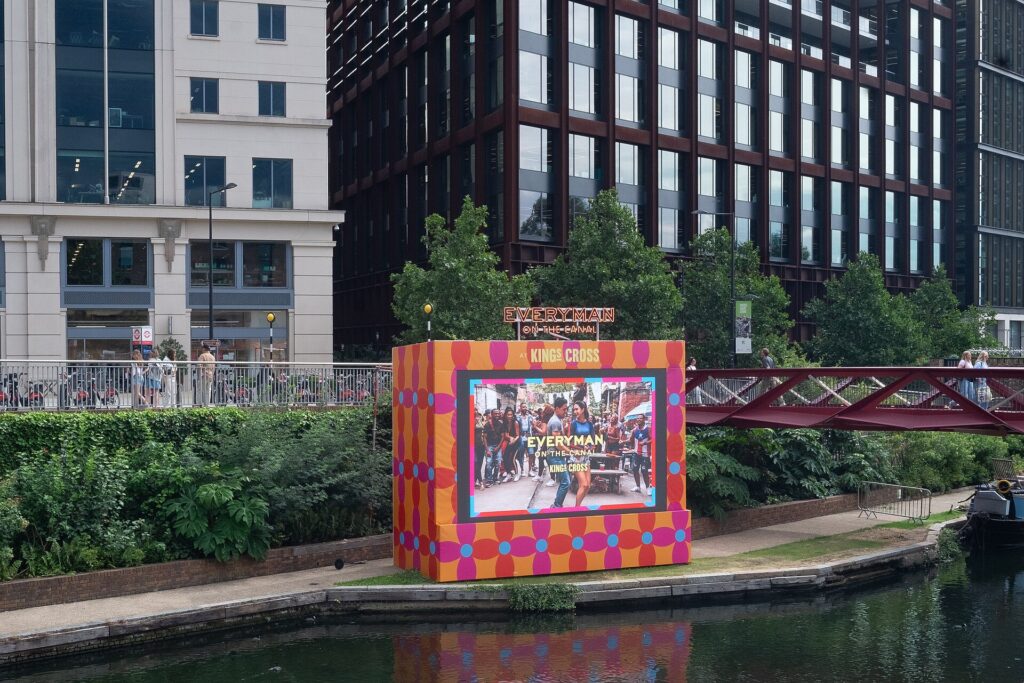
It’s bigger and better organised than most people realise. Rooftop Cinema Club, which dropped the word “Film” from its name this year, is running screens above the Bussey Building in Peckham and Roof East in Stratford. Everyman’s canal-side season at King’s Cross is into its seventh summer, with films projected most evenings from late June through to mid-August, per Time Out’s 2026 guide. Over at Canary Wharf, Canada Square Park becomes one of the slicker setups in the city, all clean sightlines and proper deckchairs.
And it isn’t only London, whatever the listings might suggest. Luna Cinema tours its travelling screen through grand settings – Alexandra Palace, Battersea Park, Hampton Court Palace, even the grounds of Westminster Abbey. Adventure Cinema runs a punishing schedule of more than 50 venues, from Perth down to Plymouth, while Londonist’s round-up points to free hillside screenings in Glasgow and castle-lawn nights in Cardiff. Wherever you are this summer, there’s a decent chance a screen is going up within an hour of you.
The scale is the story. This stopped being a pop-up gimmick a while ago. It’s an industry now, with its own logistics, its own regulars and its own sold-out signs going up in May for screenings that won’t happen until August.
What’s changed most is the food and the framing. Early outdoor screenings were a screen propped up in a field with a hot-dog van as an afterthought. The bigger operators now build the whole night around it – street-food traders, proper bars, blankets and beanbags for hire, music before the film starts. The screening is treated as the centrepiece of an evening out, not a bolted-on extra, and the ticket prices have climbed to match.

Let’s be honest, a lot of it is mediocre
Here’s the part the glossy listings won’t tell you. The actual film-watching is often worse than what you’ve got at home, and sometimes a lot worse.
The picture stays washed out until it’s properly dark, which in late June means start times drifting past half nine and films finishing close to midnight. Sound bleeds across the park. Planes go over at the worst moments. The bloke two rows back narrates the twist he half-remembers from 1994. You’re paying north of £20 a head, often closer to £25 once you’ve added the “comfy” seat and a plastic glass of warm rosé, for a print and a speaker rig that a mid-range telly would embarrass. If you turned up for picture quality, you came to the wrong place.
And that’s completely fine, because nobody’s really there for the film.
That’s the bit worth sitting with. Outdoor cinema has quietly admitted that the movie is the excuse, not the event. It’s a picnic with a plot, a date with something to look at when the conversation dries up, a way of being outside on a warm night with a few hundred other people doing the same thing. Once you accept that, the whole thing makes far more sense, and the £25 starts to look less like a cinema ticket and more like the going rate for a half-decent night out with a free film thrown in.
It’s not cheap, and that’s the catch
The money is the one thing that gives me pause. A pair of tickets at a decent London venue lands around £45 to £55 before you’ve touched a drink. Take a family of four and you’re well past £100 once snacks and a round of overpriced lemonades are in, for a film you could stream at home for the cost of a monthly subscription. That’s a hard sell when household budgets are tight and a lot of people are already cancelling streaming services to save a tenner.
So is it worth it? Once or twice a summer, yes, for the right film in the right spot. As a weekly habit, no chance. Treat it like a gig or a meal out rather than a trip to the cinema, judge the price on that scale, and it stops stinging. Go in expecting multiplex value and you’ll feel fleeced before the trailers finish.
Why it works anyway
Compare it with the other big change in how we watch. The serious money and effort has been pouring into the living room: 4K screens, surround bars, the whole setup I wrote about in why the big night out is moving into Britain’s living rooms. The logic there is hard to argue with. Why sit in a sticky multiplex when your sofa’s better, your snacks are cheaper and you can pause it for the loo?
Outdoor cinema is the answer to that exact question. It’s the one version of film-watching the living room can’t touch, precisely because it’s uncomfortable, social and slightly chaotic. You can’t recreate three hundred strangers gasping at the same moment, or the giddy daftness of watching Jurassic Park while real bats flit across a real darkening sky. The weather gamble is part of the appeal, not a flaw in it. Booking a British outdoor event in July is an act of pure optimism, and there’s a communal joy in everyone yanking on cagoules at the first spit of rain and deciding, collectively, to tough it out. It’s the same itch that a big summer night in the West End or a night at the Proms scratches. The pull is the crowd, not the comfort.
It also fits how we talk about film now. The same audience that films its dinner and ranks everything on Letterboxd wants the night to be worth posting about, and a rooftop sunset photographs a great deal better than seat J14 at the local Vue.
There’s a generational read on this too. The under-35s grew up streaming everything, so the cinema was never the default for them the way it was for their parents. For that group a film isn’t automatically a night out, which means the night out has to be built around the film on purpose – and a rooftop with a bar does that job far better than a retail-park multiplex ever could.

The programming gives the game away
Look at what’s actually showing and the whole model snaps into focus. You’ll rarely find a new release. It’s Dirty Dancing, Grease, Mamma Mia, The Greatest Showman, the odd Wicked sing-along – films people have seen a dozen times and could quote in their sleep.
There’s a reason for that. Familiar crowd-pleasers sell out; a difficult new drama doesn’t, not at £25 a head with iffy sound and a 9.45pm start. Sing-along screenings have become the format’s bread and butter, and they’re basically karaoke with a picture attached. Plenty of film snobs hate them. But there’s something genuinely lovely about a few hundred people belting out “Summer Nights” in a park as the light goes, and it tells you precisely what this is for. The communal nostalgia is the product. The film is just the songbook. Meanwhile a sharp new British release – and there have been a few worth your time this year – plays to thirty people in a quiet Odeon, which is the real tragedy buried in all this.
How to do it without coming away grumpy
A few hard-won opinions, if you’re booking.
Pick the venue before you pick the film. A great location carries a mediocre movie; a car park behind a retail estate doesn’t, no matter what’s on. Go for the latest slot available, because the earlier ones in midsummer are little more than watching a film in daylight. Bring more layers than feels sensible, since British evenings turn cold the second the sun’s down and the deckchairs are never as cosy as the photos make out. And if you genuinely want to watch the film rather than sing at it, check whether you’ve booked a sing-along before you arrive, or you’ll spend two hours wishing everyone would pipe down.
Get that right and it’s one of the best nights summer offers. Get it wrong and it’s twenty-five quid to sit in a field, cold and faintly annoyed, watching a film you already own on Blu-ray.

What happens next
The bigger question is what the multiplexes do about it. They’re watching audiences pay a premium to see a thirty-year-old film badly, outdoors, in the rain, while their own pristine prints of new releases play to empty rows. That gap can’t hold forever. Expect the chains to push harder on the “experience” angle, with rooftop nights, themed screenings and anything that carries a sense of occasion, because the film on its own clearly isn’t pulling people in the way it once did.
For now, though, the best of British film-watching this summer is happening on the grass and the gravel and the rooftops, weather permitting. So what would actually get you off the sofa and out under the sky this year – the location, the crowd, or just the chance to murder “Summer Nights” with three hundred strangers?