Hallway Ideas UK 2026: Why The Most Overlooked Room Sets The Tone For Everything Else
Walk into almost any British home and the first thing you actually use is the bit no one bothered to design. Coats land on the newel post. Shoes pile up by the radiator. A single ceiling bulb does the work of a lighting scheme. The room sets a quietly grim mood for everything that follows – and most of us never notice, because we walk through it on autopilot. Done well, hallway ideas UK homeowners can actually live with do not require a knock-through, a budget or a Pinterest board. They require a few hours of honest looking and a slightly different list of priorities.
In This Article
- Why the hallway gets ignored – and why that is a costly habit
- Start with the floor, because the floor takes the punishment
- Lighting that does not rely on a single overhead bulb
- Storage that earns its keep: the hallway ideas UK homes get most wrong
- Colour and pattern: be braver than you think
- The small purchases that quietly change everything
- The mistakes to avoid
This is the case for treating your hallway as a proper room. Not a spa-like hotel arrival sequence; just a space that works, looks intentional, and is not held together by a small forest of damp parkas. Below is what changes the result, in roughly the order it tends to matter.
Why the hallway gets ignored – and why that is a costly habit
A typical UK terrace or semi has a hallway between three and six square metres. Builders treat it as circulation, agents treat it as photography filler, and homeowners treat it as somewhere coats live. The hallway is, however, the only room every visitor sees and the room your household passes through more than any other. It frames the rest of the house. If it is dim, cluttered and beige-by-default, the brain quietly registers “tired” before you have made it into the kitchen.
The flip side is that small rooms reward attention disproportionately. You are not painting a 30 square-metre living room. You are committing to one floor finish, one colour, one light source and a piece or two of joinery. The investment is modest. The change in how the house feels – particularly first thing in the morning and on the walk home – is not.
Start with the floor, because the floor takes the punishment
The floor is the only surface in a UK hallway that is constantly wet, constantly walked on and constantly judged. It is also where most renovation budgets quietly leak. A few rules that hold up:
If you have original Victorian or Edwardian tiles under a layer of grim laminate, restore them. They were built for this exact use, they will outlive you, and the value uplift on a period home is real. If you have boards, sand and seal them in something hard-wearing – a matte oil rather than a high-gloss varnish, which will telegraph every scuff. If you have concrete or screed and a budget, large-format porcelain in a stone-effect finish reads expensive and will not lift. And if you are starting from bare boards with no period tiles to rescue, checkerboard flooring is the boldest of the current options – paint, vinyl or the real stone version.
What does not work in a UK climate: pale solid wood (every wet boot prints it), light grey LVT (it shows everything), and any material that runs into the kitchen or living room as the same uninterrupted surface. Hallways are wet zones. Treating them as such, with a clear material change at the threshold, makes the rest of the house feel calmer.
Lighting that does not rely on a single overhead bulb
The default British hallway has one ceiling pendant, one bulb in it, and that bulb is too bright, too cool and casting a single flat plane of light. Stand in your hallway after dark and you can usually see the result: shadows under the eyes, dead corners, a slightly clinical feel. The fix is not a smart system or a chandelier. It is layering.
Aim for at least two light sources at different heights. A wall light or two at picture level adds warmth and lifts the eye away from the floor. A small lamp on a console (if you have room for a console) gives you a soft, low light to flick on at night without lighting the whole house. If you only have one light, swap the bulb to 2700K or 2200K and dim it. As we have argued elsewhere, the British move away from cold minimalism is, more than anything, a move away from cold light. Hallways are where this matters most, because you experience them in motion.
If you are spending money, spend it on a wall light with an actual shade rather than a naked bulb fixture. The interiors press has been pushing pleated and linen wall lights hard for two seasons; they look better than they have any right to in narrow halls. Both House & Garden and Livingetc have run extended features on the format in the last twelve months, which is industry shorthand for “this is the new normal”.
Storage that earns its keep: the hallway ideas UK homes get most wrong
The British hallway problem is not really design. It is volume. Most households stack more outerwear, footwear, sports kit, school bags, scooters and pet leads in the hall than the hall was ever designed to hold. Pretty hooks and a shoe rack do not solve this; they decorate it.
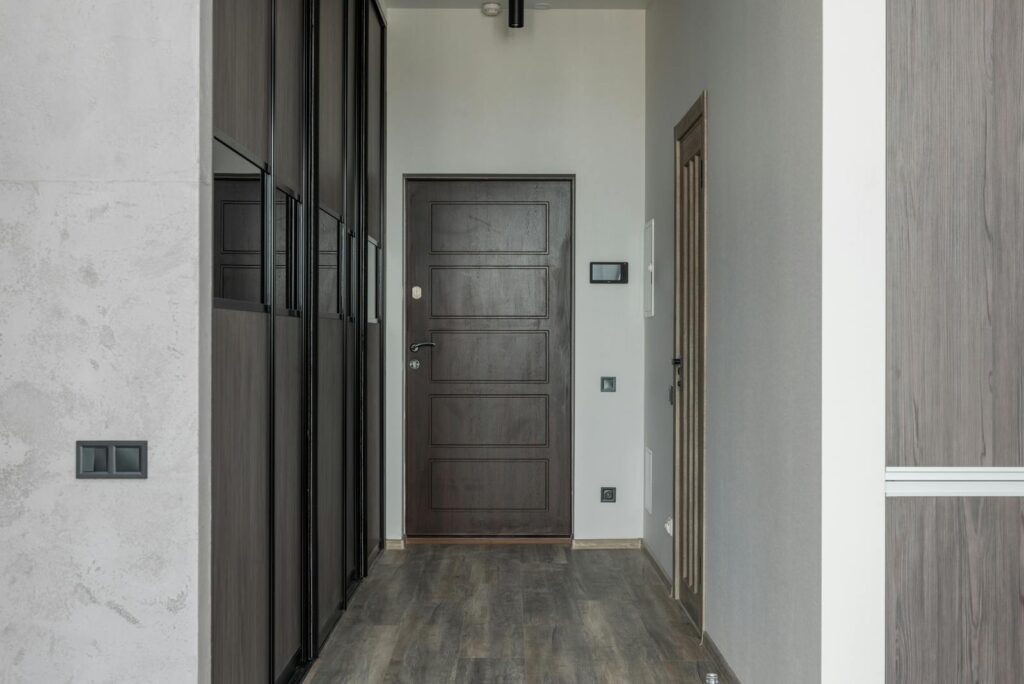
If you can build in, build in. A run of joinery from skirting to picture rail, painted the same colour as the walls, is the single highest-impact intervention in a small hallway. It hides everything that needs hiding, takes up less visual space than freestanding furniture and adds a little shoulder-height shelf for the things that matter (keys, post, the bowl of forgotten receipts). A decent local joiner will do this for less than a high-street wardrobe and the result will look bespoke rather than flat-packed.
If you cannot build in, the next-best option is one closed cupboard plus one bench. Open shelving and unlimited hooks are how hallways become visual chaos. Closed storage is how they read calm. For a deeper take on the same problem in the rest of the house, our guide on decluttering room by room covers the rules that apply equally well to entryways. If the hallway has become a dumping ground for coats and muddy trainers, the boot room ideas in our newer guide – including a £150 version built from IKEA and Argos – solve that at the door.
Colour and pattern: be braver than you think
Hallways are the one room where most people default to magnolia or off-white because they are scared of “making it feel small”. It is exactly the wrong instinct. A small, transitional space with no view to a garden has nothing to lose by going dark, saturated or patterned. You spend seconds in the hallway, not hours; the eye registers atmosphere, then moves on. Pale is not safer in this room – it is just blander.
The interiors trends that actually work in UK hallways in 2026 sit in two camps. The first is rich, deep colour: oxblood, peat brown, deep olive, ink blue. Painted from skirting to ceiling (including the ceiling) they make small halls feel intentional rather than cramped. The second is restrained pattern: a small-scale wallpaper, a stair runner with a recognisable pattern, or a tiled floor with a quiet repeat. Both work because they give the eye something to land on rather than a blank vertical surface.
What does not work: a feature wall, a hard-edged contrast trim, or anything described in a catalogue as “tonal”. The trend pieces flagged in our recent dopamine kitchen decor coverage apply here too in a quieter form: confidence beats neutrality, and the room is small enough that confidence is not a financial risk.
The small purchases that quietly change everything
Most of the visible improvement in a hallway comes from objects under £150. A proper doormat – one that actually keeps the muck out of the rest of the house, sized to the doorway and replaced when it gives up. A coat rack that holds the coats you wear, not all the coats you own. A console table or narrow bench, deep enough to drop keys and a bag. A mirror, but a single full-length one rather than a row of small ones, ideally hung where you can see it from the door rather than as you enter, so it is useful before you leave.
Plants are the closest thing to a free upgrade. A single tall, architectural plant – a kentia palm, a fiddle-leaf fig, even a tall yucca – reads more “considered” than three small succulents on a shelf. If your hallway has any natural light at all, this is where to put your statement plant. If it does not, a generous bunch of dried foliage in a heavy ceramic vase does the same job and asks nothing of you.
The mistakes to avoid
A short list of habits to break. Do not hang gallery walls of small framed prints up the staircase; in a tight hall they read as visual noise rather than collection. Do not buy slimline shoe storage that holds eight pairs when the household owns thirty; it just relocates the problem. Do not paint the woodwork bright white if the walls are dark – it telegraphs the trim instead of letting the colour breathe. Do not install spotlights in a row down the centre of the ceiling unless your hallway is genuinely a corridor; in any normal British hall they look like an office.
And the most British mistake of all: do not save the hallway for last. By the time you have done the kitchen, the bathroom and the living room, the budget will be gone and the energy with it. Treat the hallw