Teeth Whitening Kits Sold in Britain Tested at 53% Peroxide – the Legal Limit Is 0.1%, and 4 Things That Actually Work in 2026
A laboratory commissioned by the BBC tested teeth whitening kits bought openly in Britain and found hydrogen peroxide at 53%. The legal ceiling for anything you’re allowed to buy and use on yourself here is 0.1%. Not five per cent. Not one. A tenth of one per cent.
In This Article
- What 0.1% actually means for teeth whitening kits
- The BBC bought the kits. The lab found 53%.
- One successful prosecution since 2021
- Whitening toothpaste can't do what the box implies
- What a dentist charges, and the option they don't lead with
- The blue light is theatre
- Four people who should leave their teeth alone
- What's actually worth buying
That gap is the entire story. Everything sold to British consumers as a whitening treatment sits on one side of it or the other: either it’s legal and chemically incapable of bleaching a tooth, or it works and shouldn’t be in your bathroom cabinet.
Most of us have never been told there’s a line at all. You order a kit with a blue light and a gel pen for £24.99, it turns up in three days in that irritating shrink-wrapped clamshell, and nothing on the box explains that the number printed in six-point type on the back is the difference between a cosmetic and a prescription-strength oxidiser. So here’s the line, where it sits, and what’s actually worth your money.
What 0.1% actually means for teeth whitening kits
UK cosmetics law splits tooth whitening into two categories, and the split is brutally simple.
Anything containing or releasing more than 0.1% hydrogen peroxide can only be used by a dentist or another professional registered with the General Dental Council. Those professionals are themselves capped at 6%. Above 6%, nobody in Britain can legally use it on you at all.
Everything below 0.1% can be sold to the public. That’s the entire high-street and Amazon category: strips, pens, LED gum-shields, foaming trays, the lot. And 0.1% hydrogen peroxide will not bleach a tooth. It’s a rounding error. The concentration exists in the regulations as a safe-harbour threshold for products like mouthwash, not as a whitening dose.
Which puts most legal teeth whitening kits in an awkward position. They can’t contain enough active ingredient to change the colour of your enamel, so the marketing has to work around the chemistry – “removes surface stains”, “restores natural whiteness”, “up to eight shades brighter” measured against a shade guide in conditions nobody specifies. Read the back of the box on the next one you see. The peroxide figure, where it’s declared at all, tells you everything the front of the box is trying not to.
The BBC bought the kits. The lab found 53%.
The BBC investigation that put numbers on this was straightforward journalism: buy the products that are freely available, send them to a lab, publish what comes back. The results included hydrogen peroxide concentrations of up to 53% – more than 500 times the limit for anything sold to the public, and roughly nine times what a qualified dentist is permitted to use on a patient in a controlled surgery.
Fifty-three per cent hydrogen peroxide is not a cosmetic. At that strength it’s an industrial oxidiser. Applied to soft tissue it causes chemical burns. Dentists reporting on the aftermath of illegal treatments describe blanched, blistered gums, and sensitivity severe enough that patients can’t tolerate cold water for weeks. The Joint Council for Cosmetic Practitioners has flagged cases of irreversible damage – enamel that’s been etched rather than lightened, and pulp irritation that ends in root canal work.
The salon end of this is worse than the online end, because there’s a person in a tunic making it feel medical. A beautician applying anything above 0.1% is committing a criminal offence in England and Wales, punishable by an unlimited fine and a criminal record. Plenty of them either don’t know that or have decided the odds are acceptable. The client, meanwhile, has no way of knowing what’s in the syringe.
One successful prosecution since 2021
Here’s the part that explains why this market keeps growing: almost nobody gets stopped.
The GDC’s last successful prosecution for illegal tooth whitening was in October 2021. Its investigations are, by its own account, reactive rather than proactive – the regulator responds to complaints instead of going looking, and its stated preference is education and encouraging compliance before enforcement. When the BBC last obtained the figures, reports of illegal whitening reaching the GDC had risen 26% year on year.
A regulator that receives more complaints and brings fewer cases isn’t much of a deterrent. Compare it with how the Advertising Standards Authority has gone after LED face masks and their unregistered device claims, where at least the rulings arrive with some regularity. Whitening has the stronger law and the weaker enforcement.
I’d rather the GDC were louder about it. There’s a version of this where the regulator publishes a public list of the products lab-tested over the limit, the way food standards bodies publish recalls, and the sellers lose their listings within a week. Instead the burden lands on a consumer reading ingredient lists on a phone in bed.
There’s a second reason this market keeps expanding, and it has nothing to do with vanity. Getting an NHS dentist in large parts of England now takes months, if a practice is taking adult patients at all, and a check-up you can’t book is a check-up that never flags the staining, the recession or the cracked filling. A £24.99 kit with next-day delivery is filling a gap that a hygienist appointment used to fill. The people buying illegal whitening from a room above a nail bar in Dagenham aren’t reckless. They’re improvising around a system that hasn’t had room for them in years, and the sellers know exactly which door has been left open.
Whitening toothpaste can’t do what the box implies
Now the bit that’ll annoy people, because roughly half of Britain has a whitening tube by the sink.
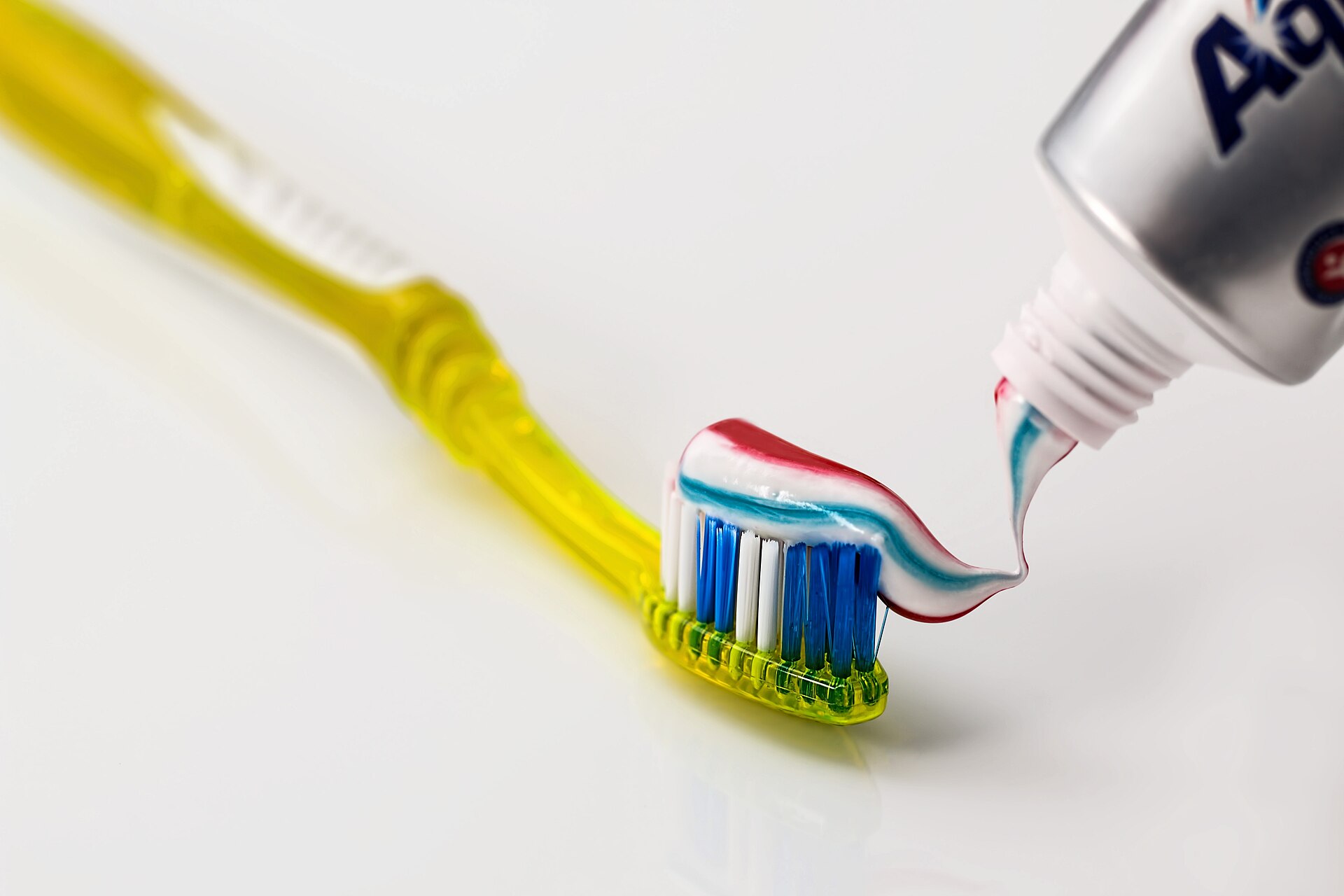
Whitening toothpaste doesn’t whiten teeth. It can’t. The published literature on these formulations is consistent and has been for years: the active mechanism is abrasion, sometimes helped by enzymes that break down the proteins in staining. That removes extrinsic stain – the brown film that coffee, red wine, tea and tobacco leave on the outside of the enamel. It does nothing whatsoever to intrinsic colour, the actual shade of the tooth underneath, because nothing in the tube penetrates the enamel or breaks down pigment inside it.
So if your teeth look duller than they did at 22, and it isn’t tea stain sitting on the surface, no toothpaste on any shelf in Boots will touch it. Dentine yellows with age and enamel thins. That’s a structural change, and you need something that diffuses through the tooth to alter it.
The abrasion itself is worth a thought too. Toothpastes are rated on a relative dentine abrasivity scale, and the whitening versions cluster near the top of it – not dangerous on sound enamel, but if you’ve got receding gums and exposed dentine at the neck of the tooth, you’re sanding the softest surface in your mouth twice a day. My own dentist’s advice, delivered with the weary tone of a man who has said it several thousand times, was to alternate: whitening paste in the morning, an ordinary high-fluoride one at night.
Charcoal versions are the worst of the category. They’re abrasive, they usually skip fluoride, and the black residue in the sink is doing a persuasive impression of dirt being lifted when it’s mostly just charcoal.
None of which makes whitening toothpaste useless. If you drink four cups of tea a day it’ll keep the film down, and that genuinely reads as brighter. Just understand that you’ve bought a polish, not a bleach. The same gap between mechanism and marketing shows up across the beauty aisle – it’s the reason PDRN serums oversell what salmon DNA does for skin, and it’s why the ingredient list is nearly always more informative than the claim.
What a dentist charges, and the option they don’t lead with
Whitening is cosmetic, so the NHS doesn’t cover it. Every route is private.
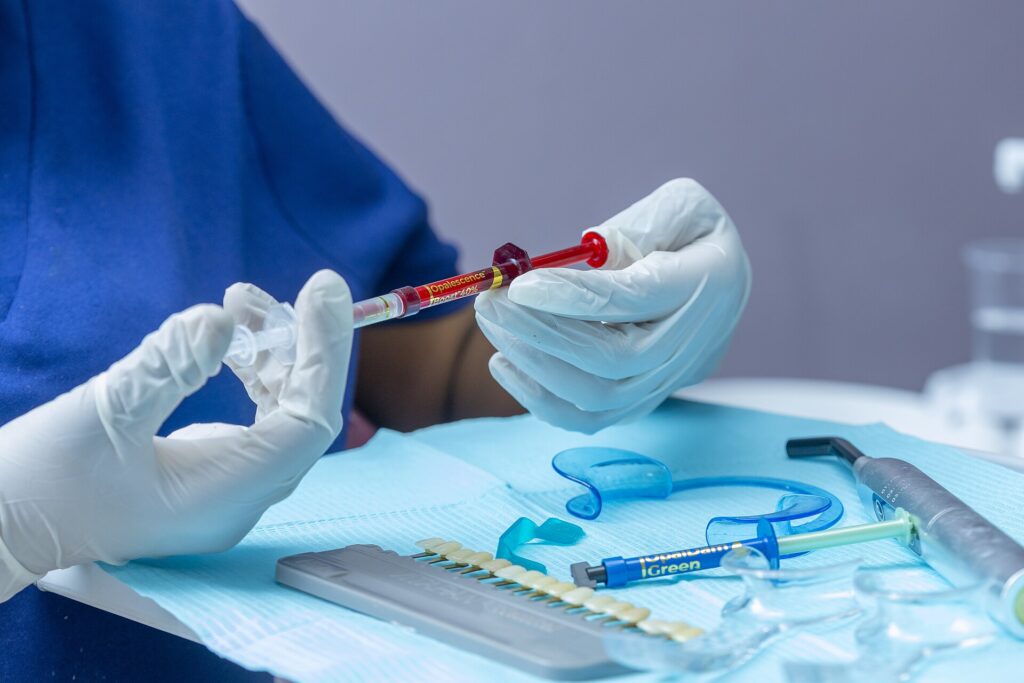
In-chair treatment – the hour in the surgery with the retractor and the high-strength gel – runs from about £300 to £800 in 2026, with London clinics clustering at £400 to £800 and practices outside the capital typically £50 to £150 cheaper for identical treatment. Take-home trays prescribed and fitted by the same dentist cost roughly £175 to £475. The median across everything sits somewhere near £380.
The take-home trays are the better buy, and most practices lead with the chair because it bills higher in a single visit. Custom trays are moulded to your teeth, loaded with a legal 6% gel, and worn overnight or for a couple of hours daily across a fortnight. The gel sits where it’s meant to sit rather than leaching onto your gums, the shade change is gradual enough that you can stop when you like it, and you keep the trays. Two years later a top-up costs the price of a fresh syringe of gel instead of another £600 appointment.
The chair session buys you speed. If you’re getting married in nine days, fine. Otherwise you’re paying a few hundred pounds for the privilege of not waiting.
The blue light is theatre
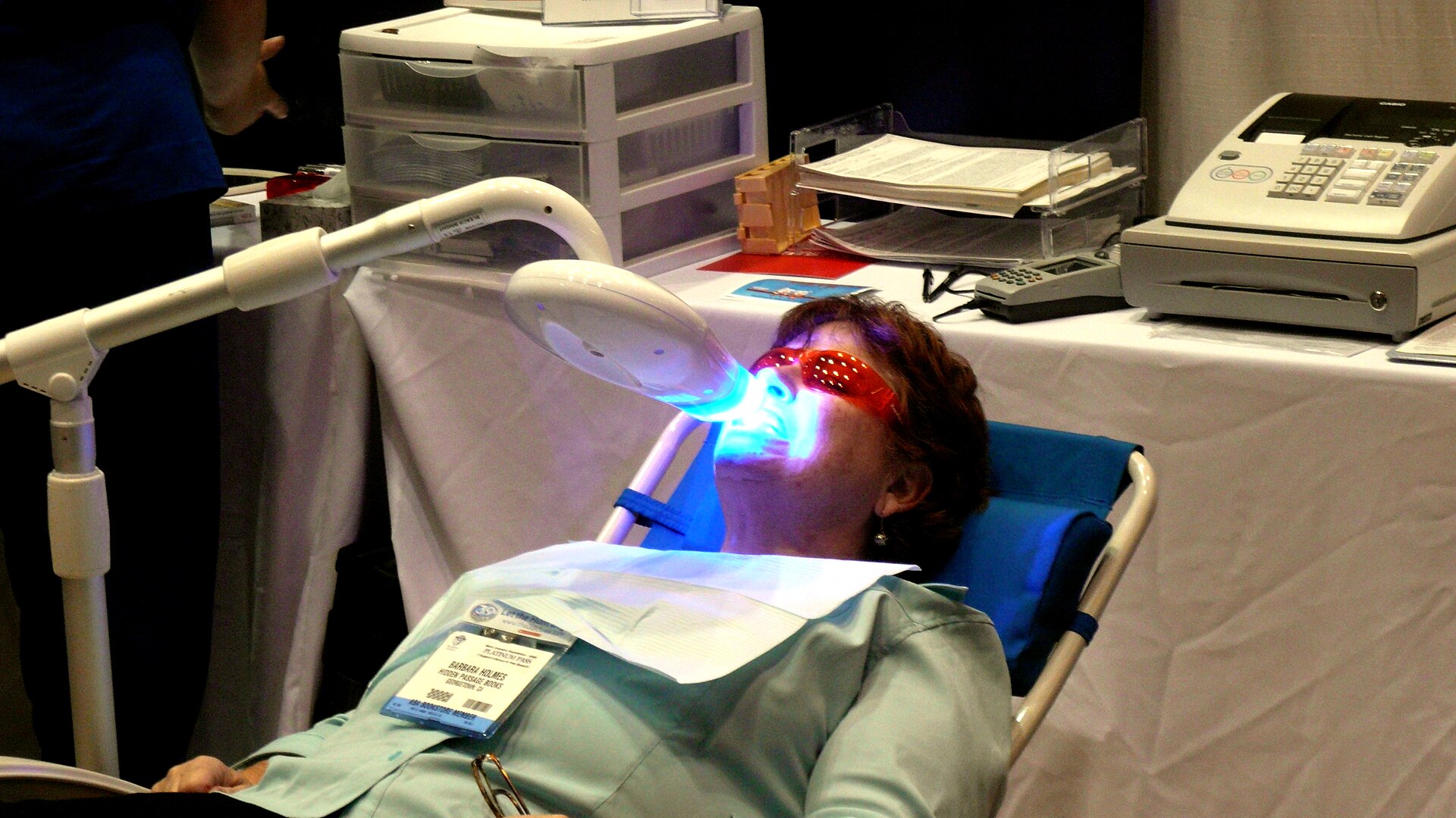
Every consumer kit above about fifteen quid now includes an LED mouthpiece, and the light is doing very little.
The theory is photoactivation – light accelerating the breakdown of peroxide into the radicals that do the bleaching. In a surgery, with a high-intensity lamp and a 6% gel, there’s a reasonable argument for a modest speed-up, though even there dentists disagree about how much of the visible result is dehydration that reverses over the following days. In a £25 home kit, with a battery-powered blue diode and a gel that legally can’t exceed 0.1% peroxide, there’s nothing meaningful for the light to accelerate.
But it’s there because it looks like technology. It photographs well, it makes an unboxing video, and it justifies the price against a box of strips. The same instinct that sells £299 full-body health scans to people with no symptoms sells a blue diode to people who want brighter teeth: the apparatus is the product.
Four people who should leave their teeth alone
Whitening isn’t universally sensible, and the kits don’t screen for any of this.
Anyone with crowns, veneers or white fillings on show. Peroxide doesn’t touch ceramic or composite. Bleach the surrounding teeth and the restorations stay exactly as they were, which is how people end up with one conspicuously grey front tooth and a bill for replacing it.
Anyone with untreated decay, gum disease or exposed dentine. Gel reaching the nerve through a cavity is a genuinely painful mistake. A check-up first isn’t a formality here.
Under-18s. Whitening products above 0.1% can’t legally be used on anyone under 18 in the UK except for treating disease, and the enamel argument backs the law up.
People with tetracycline staining or fluorosis. Those greyish bands and chalky white patches respond poorly to bleaching and sometimes get more obvious. That’s a conversation about veneers or composite bonding, not a fortnight of trays.
If you’re pregnant, most UK dentists will decline to whiten. The evidence of harm is thin, but it’s an elective cosmetic procedure and there’s no reason not to wait.
What’s actually worth buying
Four things earn their place, and one of them is free.
A scale and polish from a hygienist, at £50 to £90 in most of the country, removes the extrinsic staining that’s responsible for a surprising share of what people read as yellowing. Many go straight to bleaching without ever having the film taken off, then judge the result against a starting point that was never their real tooth colour.
Dentist-fitted take-home trays are the serious option, for the reasons above. If you only spend money once, spend it there.
A decent electric brush with a pressure sensor keeps surface stain down and stops you scrubbing your gums into recession, which makes teeth look longer and darker at the neck. The £45 models do this. The £300 ones with an app don’t do it better, and the app has never once changed anyone’s behaviour past the third week.
And then the free one: a glass of water after coffee, tea or red wine. Unglamorous, no packaging, works.
What isn’t worth it: LED kits, charcoal anything, whitening pens, and salon whitening from anyone who can’t show you a GDC registration number. That last one isn’t a value judgement. It’s a criminal offence being committed on your face.
The uncomfortable thread running through all of this – the illegal kits, the toothless enforcement, the toothpaste that polishes and calls it whitening – is that Britain has written good law and then declined to police it, and the market has noticed. It’s the same pattern behind the herbal drops TikTok sold as a puffiness cure: the rules exist, the claims sail past them, and the shopper does the regulator’s job by reading the small print.
One habit that undoes whitening faster than coffee is the small white pouch under the top lip. A Newcastle dental review has a view on what it does to gums, which we cover in our piece on whether nicotine pouches are safe.
So when you next pick up a whitening kit, what would actually change your mind – the number on the back of the box, or the fact that nobody’s checking it?