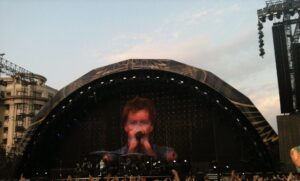

Fontaines DC 2027 Tour: The Arena Dates Went in a Morning, and Thursday’s Stadium On-Sale Is the Hardest Ticket of the Autumn
Four years ago you could see Fontaines DC at Brixton Academy for about thirty quid and still get a pint in before the encore. On Thursday morning they’ll put the London Stadium on sale. That’s the whole story of British guitar music since the pandemic in one sentence, and the Fontaines DC 2027 tour is where it lands: five outdoor shows next summer in Cardiff, Newcastle, Manchester, Glasgow and London, with Little Simz and Viagra Boys on every bill, general sale at 10am on Thursday 10 September, and an arena tour that already went in a morning. Set it against Stevie Wonder’s £101 floor price for four arena nights in October and the £39 entry ticket looks almost quaint.
In This Article
- The morning the arena tour vanished
- What a Fontaines DC 2027 tour ticket is likely to cost
- Five venues, ranked by how badly I want to be there
- Little Simz and Viagra Boys: the best support bill of next summer
- Why a Dublin band ended up carrying British guitar music
- The contrarian bit: stadiums might be the wrong room for this band
- On-sale tactics without the nonsense
- Where this leaves next summer
If you didn’t get November tickets, this is your second chance. It’s also, I’d argue, the bigger question: has a Dublin post-punk band really become the biggest guitar act in Britain, and is a football stadium the right place to find out?
The morning the arena tour vanished
Here’s the sequence, because the timing matters. On Thursday 3 September the November arena run – Liverpool, Manchester, Glasgow, Leeds, Birmingham and The O2 – went on general sale at 10am. By lunchtime it had gone. Official Charts reported the band had “sold out their entire UK arena tour this morning”, and the same afternoon the label dropped the summer 2027 dates. That’s not an accident. You don’t announce St James’ Park on a Thursday afternoon unless you already know the demand curve, and the arena sell-out was the proof point. The same weekend, the BBC sold out Radio 2 in the Park 2026 in Stirling at £84 a day, which tells you where the middle of the market has settled.
The five new dates are Blackweir Fields in Cardiff on Tuesday 29 June, St James’ Park in Newcastle on Thursday 1 July, Heaton Park in Manchester on Saturday 3 July, Glasgow Green on Tuesday 6 July and the London Stadium on Friday 9 July. Before any of that there are two nights at Slane Castle in County Meath on 26 and 27 June, which makes them only the third Irish act to headline that hill after U2 and Thin Lizzy. That’s a sentence that would have sounded ridiculous when Dogrel came out in 2019.
Artist presale opens at 10am on Tuesday 8 September. Anyone who’s pre-ordered the new album, Dopamine Chamber, gets in automatically; everyone else had until 9pm tonight to register. General sale is 10am on Thursday 10 September through Ticketmaster.
Set an alarm. I mean it.
What a Fontaines DC 2027 tour ticket is likely to cost
Nobody’s published stadium prices yet, and I’m not going to pretend I know them. What we do have is the arena run as a benchmark. Time Out put November’s general-entry range at £39 to £91, with Glasgow’s OVO Hydro quoting £39.60 to £73.60 for standard tickets and £135 to £150 for the VIP tiers. Outdoor shows at this scale usually sit a notch above arenas rather than below them, so a working guess for the summer is standing somewhere in the £60 to £80 bracket with seated tiers either side. I’m guessing here, and I’ll happily be wrong in the cheaper direction.
Two things to weigh that up against. Oasis at Heaton Park last summer was around £150 face value before dynamic pricing did its worst, and the row that followed is a large part of why the industry is now so twitchy about the word “surge”. And there’s the £1 grassroots levy that big promoters are now under pressure to add to every arena and stadium ticket, which Fontaines, who came up through rooms like Whelan’s and the Workman’s Club, have every reason to shout about rather than bury in the small print.
Even at £80, though, here’s the honest comparison. Three acts on one bill, Little Simz included, for less than the price of a mid-table Premier League seat. As stadium economics go in 2026 that’s not the outrage some people will want it to be.
Five venues, ranked by how badly I want to be there
All five shows are worth doing, but they’re not equal, and if you can only afford one you should choose deliberately.
1. St James’ Park, Newcastle, Thursday 1 July. A football ground on a school night in a city that treats gigs like derbies. Sam Fender proved this room works for guitar music with a crowd that sings every word back, and Fontaines have that same terrace-chant quality on Boys in the Better Land and I Love You. If they open with Romance and the Gallowgate End does its thing, this is the one people will lie about having been at.
2. Glasgow Green, Tuesday 6 July. Glasgow crowds have been Fontaines’ loudest since the Barrowland days, and Glasgow Green on a summer evening, with the Nelson monument catching the last light behind the stage, is a far better outdoor site than people give it credit for. The Tuesday date will also be the least brutal on-sale of the five.
3. Heaton Park, Manchester, Saturday 3 July. Biggest capacity, biggest party, worst logistics. Getting 70,000 people out of north Manchester after eleven at night remains a problem nobody has solved, and the Oasis run last summer showed exactly how long the tram queue gets. Worth it, but plan the exit before you plan the pre-drinks.
4. London Stadium, Friday 9 July. The Friday-night London show will be the fastest sell-out and, I suspect, the least interesting gig. The old Olympic Stadium is a strange shape for music: the pitch is a long way from the lower tier, the sound bounces off the roof, and it’s never had the atmosphere of Wembley or even Finsbury Park, where the band played to 45,000 in July 2025 and looked completely at home. Go if it’s your only option. Don’t assume the capital gets the best night.
5. Blackweir Fields, Cardiff, Tuesday 29 June. The new Cardiff site only opened in 2025 and it’s still finding its feet on sound and crowd flow. It’s also the first UK date, which usually means the tightest set and the fewest surprises. Still, it’ll be the easiest ticket of the lot and Cardiff is a lovely place to be on a warm June evening. Nothing wrong with the sensible option.
Little Simz and Viagra Boys: the best support bill of next summer
Stadium support slots are usually filler. A label mate, a Radio 1 playlist act, someone with a summer single to push. This isn’t that.
Little Simz is a Mercury winner who’s headlined Alexandra Palace in her own right and could comfortably fill half these rooms herself. Viagra Boys, the Stockholm post-punk lot with the saxophone and the bad attitude, are one of the funniest live bands in Europe and will make a good chunk of the seated tiers deeply uncomfortable, which is what a support act should do. Between them you get a rapper at the top of her game and a band that treats the audience like a heckler to be won over. Put those in front of the Fontaines set and the day starts at five rather than nine.
The band have clearly thought about this. Fontaines came up on a circuit where the support was your mate’s band and the headliner was the one with a van; putting Simz second on the bill is a statement about what kind of festival they want their own stadium show to be. It’s the strongest three-act bill announced for a British outdoor show next summer, and I’d say that if the headliner were anyone.
Why a Dublin band ended up carrying British guitar music
Sit with how odd this is for a second. Britain has spent a decade waiting for the next Arctic Monkeys and got, in the meantime, a lot of decent bands who topped out at Alexandra Palace. The 1975 got there, then went somewhere stranger. Wolf Alice never quite did. Sam Fender did it, but as a solo act with a very specific North East story. The guitar band that has actually scaled to stadiums in the mid-2020s is from Dublin, on an independent label, and sings half its best songs about being Irish in London.
Some of that is craft. Dogrel was a brilliant debut but a narrow one; A Hero’s Death and Skinty Fia widened the sound without losing the spit; Romance in 2024, with Starburster as its calling card, was the record that stopped sounding like a post-punk band and started sounding like a band that could headline anything. Some of it is timing. The Oasis reunion last summer proved, in the crudest possible way, that there’s a mass audience for four blokes and guitars if the songs are big enough, and Fontaines are the only band of their generation with a set that can fill that space. And some of it is Grian Chatten, who’s become a properly magnetic frontman without ever appearing to try, which is the only kind that lasts.
The Reading headline slot last month was the audition. NME gave it four and a half stars and called it “a deserved coronation from the band of our time”, even though a technical delay pushed the start back by half an hour and cost the set three songs. My mate who went, who thinks all Irish bands are either U2 or the Cranberries, came back talking about it like he’d seen the Stone Roses at Spike Island. That’s the reaction you need before you sell a football ground.
Marianne, the lead single from Dopamine Chamber, is in the top 20 of the singles chart, which for a guitar band in 2026 is a small miracle. The album lands on 16 October, a month before the arena tour and eight months before the stadiums, so by next July the setlist will be roughly a third new. That’s a risk. It’s also the correct way round: tour the record, then play the big rooms once people know it.

The contrarian bit: stadiums might be the wrong room for this band
I’ve said the shows will sell, and they will. Here’s what I’m less sure about.
Fontaines DC are a claustrophobic band. Their best songs, Jackie Down the Line, Big, In ár gCroíthe go deo, work because they’re pressurised; there’s a tension in Chatten’s delivery that reads as menace in a 2,000-cap room and as intimacy in a 12,000-cap arena. Football stadiums don’t do pressure. They do scale, and scale flattens. The bands who thrive in them, Oasis, Coldplay, Springsteen, write songs that are already anthems on paper. Fontaines have two or three of those and a lot of songs that are better than anthems but don’t project as far.
The Finsbury Park show in 2025 got round this by being a festival-shaped day in a flat park with the crowd right up against the barrier. St James’ Park and the London Stadium put a running track and a pitch-side moat between the front row and the band. The sound, on a windy evening, will do what stadium sound always does. And there’s a version of this where the honest verdict next July is that the arena run in November, sold out or not, was the better gig and you should have fought harder for it.
I’d still go. But if you’re choosing between stretching for a November resale ticket at face value and waiting for the summer, take the arena. The summer shows are the event. November is the concert.
On-sale tactics without the nonsense
A few things that actually help, none of which involve a browser extension.
The presale on Tuesday is the real on-sale for London and Manchester. If you pre-ordered the album you’re in; if you didn’t and registered by tonight, you’re in; if you did neither, assume the Friday and Saturday shows will be down to seats by the time Thursday’s general sale opens. Cardiff and Glasgow, both Tuesday-night shows, are where general sale buyers should aim first. Newcastle sits in the middle, and my honest guess is that it’ll hold standing tickets for an hour on Thursday and not much longer.
Log in to Ticketmaster before 9.55am, on one device, with the card already saved. Don’t open six tabs; the queue system treats that as suspicious and you’ll end up further back, not further forward. If you miss out, the official face-value resale on Ticketmaster is the only secondary route I’d touch. Viagogo listings for the arena tour appeared within the hour on 3 September at multiples of face value, and there’s no reason to hand them your money when returns and extra production holds tend to drip back onto the primary site in the weeks before a show.
And if you miss both, the Slane dates are a genuine option. Flights to Dublin in late June are not cheap, but a weekend in Meath with a Fontaines show on the hill where U2 played is a better story than a Friday at Stratford.

Where this leaves next summer
The Glastonbury 2027 registration is open, Reading has just proved Fontaines can carry a main stage, and the Mercury shortlist this year has Suede and Knats flying the flag for guitars and not a lot else. The summer 2027 calendar is going to be built around a handful of stadium residencies and this five-date run is one of the first pieces on the board. Whether Fontaines DC turn out to be a band who belong in stadiums or a band who briefly filled them is the more interesting question, and we won’t know until roughly 10.40pm on 1 July in Newcastle.
So which is it for you: the arena in November, the football ground in July, or the ferry to Slane?