
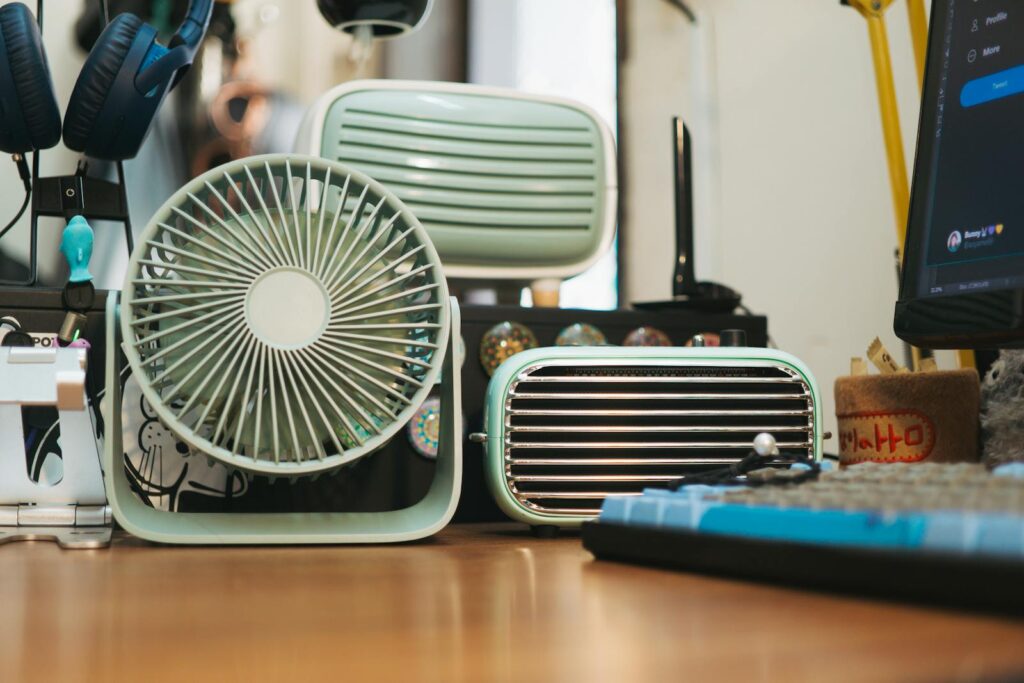
Home Office Cooling UK 2026: How To Stay Productive When The Spare-Room Hits 30°C
Britain has spent the last three summers proving a point most home workers had quietly suspected: the spare-room office, with its single small window and afternoon-facing wall, was never built for 30°C. Home office cooling UK problems used to be a once-a-decade inconvenience. After 2022, 2023 and 2025, they’re a fixed annual feature – and 2026 looks no different. The Met Office’s three-month outlook has flagged above-average temperatures across most of the country between June and August, which means anyone working from a converted bedroom, loft or kitchen corner has roughly six weeks to sort their setup before things start to bake.
In This Article
- Home office cooling UK 2026: the structural reason it’s harder than it sounds
- Fans that actually work in a small home office
- Window strategy and passive cooling
- Air conditioning: when it actually makes sense
- The desk-level changes that move the needle most
- Heat-proofing the bits that show up on video calls
- The cooler home office isn’t a single purchase
This is a practical guide to keeping a home workspace functional through a UK summer without throwing five grand at retrofit air-con. Most of it is small adjustments – a fan in the right spot, a blind that closes before noon, a laptop that isn’t sat on its own exhaust – and most of it makes a noticeable difference within a day. Some of it is harder. We’ll cover the lot.
Home office cooling UK 2026: the structural reason it’s harder than it sounds
The problem is structural. British homes are designed to retain heat, and have been for a century: thick walls, small windows, double glazing tuned for winter, lofts insulated to keep warmth in. That’s useful in February and miserable in August. A spare room with one south- or west-facing window will gain heat all afternoon and have almost no way to lose it. Add a laptop pumping out 60-80 watts, a second monitor, a wifi router and a human, and you have roughly the heat load of a small electric heater running in a sealed box.
Most overheating problems in a UK home office aren’t really about reaching some specific temperature. They’re about the rate at which a small room heats up once the sun comes round, and how slowly it cools again overnight when external temperatures rarely drop below 18°C in town centres. Once you understand that, the strategy becomes obvious: stop the heat getting in during the day, and shift as much of it as possible out at night.
Fans that actually work in a small home office
A decent fan is the highest-value purchase you can make for under £100, and it’s where most people start – usually with the wrong one. A small USB desk fan blowing across your face is fine for personal comfort but does nothing for the room. A pedestal fan in a corner shifts air but rarely where you need it. The pattern that actually works is a tower fan or a pedestal positioned to push air from a cooler part of the house into the office, with the door open, creating cross-flow.
If the office has two openings – door and window – even better. Run the fan at the window outwards in the morning to flush warm air that built up overnight, then reverse it (or close the window and use the door) once the outside temperature climbs above the inside temperature, which on a hot UK day is usually by 11am.
The other detail worth getting right is noise. Working through eight hours of fan whoosh wrecks video calls and slowly grates on you. Look at Which?’s annual fan testing – the difference between a 35dB and a 50dB fan on its top setting is the difference between background hum and noticeable irritation, and the cheaper option often isn’t quieter on lower speeds either. Bladeless designs are not magically silent, despite the marketing.
Window strategy and passive cooling
The single biggest lever, and the one most home workers don’t bother with, is shading the window before the sun reaches it. External shutters are common in southern Europe for the obvious reason that they stop solar gain at the glass – by the time light hits an internal blind, the energy is already inside the room and has nowhere to go. Most UK houses don’t have shutters, but a reflective blackout blind on the inside, closed from mid-morning, gets you most of the way there. So does a strategically-placed houseplant or a thin sheer curtain that diffuses direct sun.
Open the window at night, ideally with a fan helping pull cooler air through, and close it the moment morning temperatures start climbing – usually around 9am. This is counter-intuitive: most people open windows when they’re hot, but on a heatwave day the air outside at 2pm is hotter than your sealed room, and you’ll make things worse. The exception is when the wind is moving genuinely cool air across, which in the UK tends to mean storm fronts.
For a deeper passive setup, see our guide to the small-space home office UK 2026 – the same constraints that make a tiny room hard to lay out also make it overheat fastest, and a lot of the layout fixes (desk away from the window, hard surfaces minimised, kit clustered against one wall) help with both.
Air conditioning: when it actually makes sense
Portable air conditioning is the option most people reach for and most people regret. A typical portable AC unit costs £400-£700, sounds like a small jet engine, vents hot air through a hose that has to sit in a half-open window (which then lets warm air back in), and uses 1.5-2kW while running. For a small spare room used five days a week through July and August it can still be worth it, particularly for anyone who can’t tolerate heat for medical reasons or has work that genuinely needs concentration through afternoon peaks.
Fixed split air-con – the kind plumbed into a wall – is a different proposition. Installed costs in 2026 sit around £1,800-£3,500 depending on the unit and the difficulty of the install, and most modern systems run as heat pumps in winter, which changes the maths considerably. The Guardian’s recent coverage of UK heat-pump uptake puts payback in the 7-10 year range for households running existing gas central heating, faster for all-electric homes. If you genuinely work from home full-time and expect to for years, it’s worth getting two installer quotes rather than dismissing it on sticker shock.
Whatever you choose, don’t bother with single-hose portable units unless you can dedicate a window to permanent venting. Dual-hose is meaningfully better; evaporative coolers do almost nothing in damp UK air.
The desk-level changes that move the needle most
A surprising amount of perceived heat in a small office is generated by the kit on the desk. A modern laptop running a video call on its built-in screen can pull 60-80W and dump nearly all of it as heat directly under your hands. A docking station, a second monitor, an external drive and a phone charger easily add another 50W. If that second screen is a USB-C portable monitor drawing power from the laptop instead of the wall, the number drops noticeably. None of this is huge in isolation, but in a 9m² room it’s the difference between bearable and not.
Worth doing: raise the laptop on a stand so its underside isn’t trapped against the desk, switch to an external keyboard and mouse so you can move further from the screen, and put an under-desk extension lead with individual switches on it so you can kill chargers and the monitor when you step away. A laptop that idles at 5W is still better than one that sits at 25W in sleep mode with a charger plugged in.
If you’ve already invested in home office plants, keep them – large-leaved species like Monsteras and palms genuinely do help local humidity in a way that feels cooler, although the effect is modest. Don’t expect them to replace ventilation.
Heat-proofing the bits that show up on video calls
Looking sweaty on a call is a separate problem from being uncomfortable, and worth solving on its own terms. The two simple wins are a small clip-on fan angled at your face (out of frame, ideally pushing across rather than directly at you – the airflow noise on a microphone is brutal otherwise), and lighting that doesn’t add heat. An older 60W ring light is essentially a small radiator pointed at your face; modern LED panels at 12-18W give the same output without the warmth.
For the recurring question of how to look composed without an air-conditioned office to back you up, our colleagues in fashion covered this from the other angle in their hot office outfits UK 2026 guide – the principles transfer cleanly to spare-room calls.
The cooler home office isn’t a single purchase
Most home office cooling problems in the UK get solved by a stack of small changes rather than one big buy: a blind closed before 10am, a fan placed where it actually moves air through the room, a laptop on a stand, a window strategy that opens at night and closes at dawn. Together they’re usually enough to keep a spare-room workspace below 26°C even on a 30°C day, which is the rough threshold at which most people’s concentration starts to slip.
Where they’re not enough – top-floor flats, west-facing rooms, anyone working in a converted loft – portable or fixed cooling earns its keep, but it’s worth fixing the cheaper levers first, because they make whatever you spend afterwards work harder.
What’s the part of your home office setup that suffers most in a UK heatwave – is it the room itself, the kit, or the calls you have to take through it?
Airflow sorted, the next weak point in most home setups is the seat. Here is how to choose a home office chair that earns its space.





Worked out of a converted loft for three summers and finally bit the bullet on a Meaco portable AC last year – eye-watering price but it bought me about six productive weeks I’d otherwise have lost. Before that the laptop-on-a-bag-of-frozen-peas trick was real and I’m not proud. The blackout blind point is the cheapest win by miles – thirty quid from John Lewis and it knocks four degrees off by 2pm. Anyone here tried those reflective window films? Wondering if they’re worth the faff.