
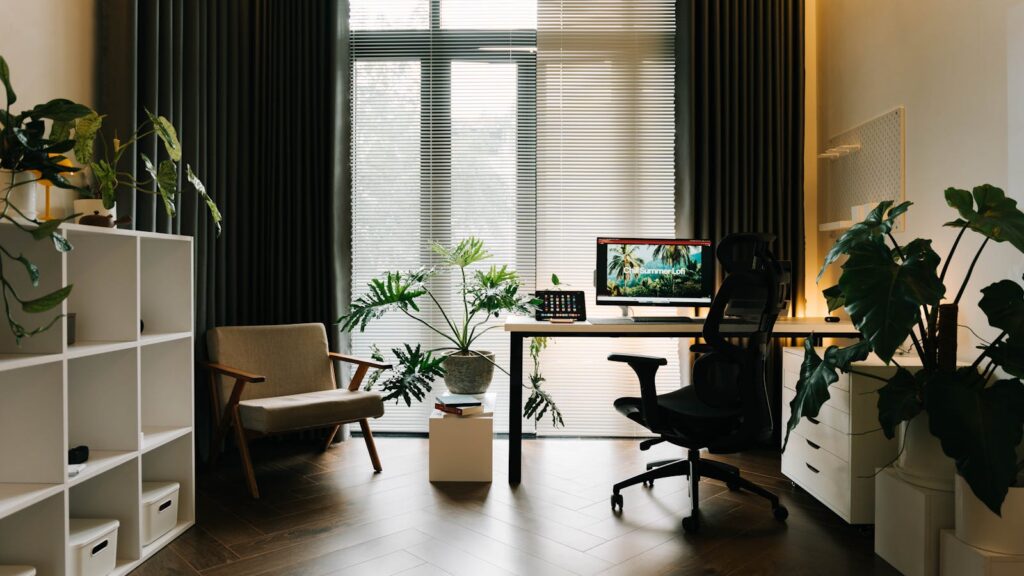
Home Office Plants UK 2026: The Editor’s Picks for a Desk That Doesn’t Feel Like an Office
Walk into any well-considered UK home office in 2026 and there will almost certainly be something alive in it. Not in a wellness-influencer way, and not because anyone has read another study about productivity. Home office plants UK home workers actually keep alive tend to do something quieter: they soften a corner of the room that would otherwise feel like a transit lounge. After three full years of hybrid working settling into the British work week, the question is no longer whether to put greenery on your desk. It is which plants survive a closed laptop on a Friday evening, a chilly bedroom-office in February, and a south-facing windowsill that turns into a greenhouse by July.
In This Article
- Why home office plants UK setups need a different brief
- The five home office plants that genuinely earn their spot
- 1. Snake plant (Dracaena trifasciata)
- 2. ZZ plant (Zamioculcas zamiifolia)
- 3. Pothos (Epipremnum aureum)
- 4. Spider plant (Chlorophytum comosum)
- 5. Cast iron plant (Aspidistra elatior)
- Two plants to skip on a working desk
- Pots, drainage and not destroying your desk
- Where to put them on the desk
- A realistic care routine for a working week
- Cables, plugs and the bits people forget
This is the realistic edit. Five plants that earn their spot, two to skip, and the bits about pots, light and watering that nobody mentions until something dies on you.
Why home office plants UK setups need a different brief
British homes are not the airy, double-glazed, evenly heated spaces that most plant content assumes. We work in converted box rooms, alcove desks under the stairs, kitchen tables and end-of-corridor nooks. Light is patchy. The heating goes off when the household goes out. Window panes get cold enough to scorch a leaf in January.
That changes what works. The plants that thrive in a Brooklyn loft or a Sydney sunroom are often the ones that struggle hardest in a Manchester terrace. The Royal Horticultural Society’s guide to houseplants for beginners is a good sanity check on this: most of its top-tier picks are tolerant of the things UK homes do badly, including dry indoor air, draughts and weeks of low light.
The other reason to be picky is that a working desk is not a normal plant location. Keyboards do not enjoy a sudden drip from above. Monitors do not enjoy being pushed up against a leafy plume. And nobody wants to lift a pot every time the post arrives. The shortlist below is built around that reality.
The five home office plants that genuinely earn their spot
These are not the most photogenic plants on Instagram. They are the ones that still look like themselves after a six-week stretch where you forget to water anything.
1. Snake plant (Dracaena trifasciata)
Long suffering, vertical, faintly architectural. Snake plants tolerate low light, dry air and the kind of neglect that kills almost everything else. They like to dry out fully between waterings, which means a once-a-fortnight glance is enough for most of the year. The tall sword-shaped leaves work well at the corner of a desk where you want height without footprint.
Watch out for: overwatering. If anything is going to kill a snake plant it is kindness. Keep them in a pot with drainage and let the compost dry to the touch.
2. ZZ plant (Zamioculcas zamiifolia)
The ZZ is the office plant that became a cliche for a reason. It will tolerate a windowless meeting room, a heated hallway or a draughty conservatory. The waxy leaves shrug off dry air and the tubers underneath store enough water to forgive a missed week. On a working desk it gives you that glossy, dark-green canopy that makes a screen-heavy setup feel less clinical.
Watch out for: yellowing leaves, which usually mean too much water, not too little.
3. Pothos (Epipremnum aureum)
Often sold as devil’s ivy. The trailing vine is the practical answer if your desk is short on surface space, because it can sit on a shelf or a monitor riser and trail downwards rather than competing for keyboard real estate. Pothos handles average UK indoor light well and tells you clearly when it needs water – the leaves go limp, then bounce back within hours of a drink.
Watch out for: cats. Pothos is mildly toxic if chewed.
4. Spider plant (Chlorophytum comosum)
Unfashionable, almost indestructible, and one of the few plants that will tolerate a north-facing window in a flat with single glazing. Spider plants produce baby plantlets you can pot on, which is the rare houseplant moment that genuinely lifts a working week. They prefer a steady watering rhythm but recover from drought faster than almost anything else on this list.
Watch out for: brown leaf tips, usually a sign of tap water with a lot of fluoride or chlorine. Leave a jug to stand overnight if your tap water is hard.
5. Cast iron plant (Aspidistra elatior)
The clue is in the name. Aspidistra was the Victorian houseplant precisely because it could survive in a cold, gas-lit parlour. In a modern UK home office it handles low light and erratic heating better than almost any other broad-leafed option. The leaves are dark, structural and large enough that one well-grown specimen can carry a whole corner.
Watch out for: it is a slow grower. Buy it the size you want it.
Two plants to skip on a working desk
Fiddle leaf figs are the obvious offenders. They look extraordinary in a photograph and sulk at the slightest change in conditions, which a home office offers in abundance. If you want a tree-shaped plant, a rubber plant (Ficus elastica) is far more forgiving for the same visual effect.
The other one to think twice about is the prayer plant (Maranta) and most of the calatheas it sits alongside. They are beautiful, expressive and demanding. They want stable humidity, soft light and water that has stood for hours – none of which a working desk reliably provides. Keep them for a bathroom shelf if you can’t resist.
Pots, drainage and not destroying your desk
The single most useful upgrade is a pot with a drainage hole inside an outer cachepot or saucer. This lets you water properly without sitting the roots in standing water and without dripping onto a laminate desk. A shallow cork or felt mat under the cachepot is cheap insurance for a wooden surface.
Compost matters more than people expect. A peat-free houseplant compost with added grit or perlite drains faster, which is exactly what most of the plants above want. House & Garden have written sensibly about the shift to peat-free in UK garden centres, and most of the major British retailers now stock decent options as standard.
Pot size: go one size up from the nursery pot, not three. An oversized pot holds more wet compost than the roots can drink, which is how most houseplants die.
Where to put them on the desk
The instinct is to push everything to the back, behind the monitor. That works for trailing plants like pothos but tends to starve upright plants of light, because the back of a desk usually faces away from the window. A better default is a single plant at one corner of the desk and a second on a shelf or wall-mounted bracket above eye level. That keeps the working surface clear and gives you something green in your peripheral vision during long calls.
If you have already thought hard about your home office lighting, you will already know which corner of your desk gets the best natural light through the day. Put the plant that needs the most light there, and use the darker corners for snake plants, ZZs and aspidistra.
For anyone working from a tight setup, our small-space home office guide covers the wall-mounted shelf options that let you bring in greenery without losing desk surface. A floating shelf above the monitor will hold two plants comfortably, three at a push.
A realistic care routine for a working week
The reason most home office plants die is not bad luck. It is that nobody plans for them.
The routine that actually works is friction-free: a small watering can kept on the desk or in a nearby drawer, and a five-minute Friday habit. Check each plant’s compost with a finger, water the ones that are dry to the first knuckle, and leave the rest. That single weekly pass is enough for everything on the shortlist above for most of the year.
Twice a year – usually April and August – give them a proper inspection. Wipe dust off the leaves with a damp cloth, check for pests on the underside of leaves, and repot anything that has visibly outgrown its container. The Guardian’s gardening pages run useful seasonal reminders, and the RHS website has a houseplant troubleshooter if anything starts looking unwell.
Avoid the temptation to feed them through the winter. Most houseplants are barely growing between November and February. Liquid feed during the active growing season – April to September – is plenty for a desk plant in a UK climate.
Cables, plugs and the bits people forget
One unglamorous note: a self-watering planter sounds like the answer to forgetfulness, and for some plants it is. But the wick-based ones tend to keep compost wetter than a snake plant or ZZ wants. Use them for thirsty plants like spider plants and pothos, not the drought-lovers.
Also: be wary of placing any plant directly above a router, monitor or tangle of plugs. A misjudged watering is genuinely the kind of thing that fries hardware, and is one of the more avoidable mistakes covered in our piece on cable management for the home office.
The best home office plants for a UK working day are not the showiest or the most expensive. They are the ones that survive your specific home and your specific habits, and that you genuinely look at while a meeting drags on. Plants do not, on their own, fix a 30-degree spare room – that one is mostly a cooling problem rather than a greenery problem. Five plants, one drainage saucer, a Friday five-minute routine, and you have something on the desk that does not switch off when you do.
Which corner of your desk would you actually be willing to give up to a plant – the bit nearest the window, or the bit nearest the kettle?
Greenery makes a workspace feel calmer, but comfort comes first. Our home office chair guide covers the seat worth building the rest of the desk around.





Got a ZZ plant on my desk for two years and it’s outlived three keyboards. Completely agree about the watering rule – I drowned my first pothos within a fortnight. Are snake plants actually as bulletproof as everyone claims, or is that just survivorship bias? Mine seems to sulk every time I move it.
Two years from one ZZ on a desk is impressive. I had a snake plant at my old job that did the same – basically immortal. Do the leaves get dusty enough to need wiping or does the office airflow keep them clean?
ZZ plant has been my saviour – genuinely went six weeks without water during a project crunch and barely flinched. Not so lucky with the calathea, mine sulked the moment the radiators came on in October. Would a humidifier actually fix that or am I better off just giving up on prayer plants in a normal UK home?