
Smart Ring Sleep Tracking Before Black Friday 2026: What 35 Lab Sleepers Revealed, the £69.99-a-Year Catch – and Who Should Steer Clear
The most accurate consumer sleep tracker tested in a sleep lab still disagreed with the lab about one time in five. That’s the headline figure behind smart ring sleep tracking in 2026, and you won’t find it on the box. Oura’s own numbers put its four-stage agreement with polysomnography at 79%. Trained human scorers, looking at the same brainwave data, agree with each other about 83% of the time. So the ring is close. But close to a gold standard that is itself a bit wobbly, measured on 35 healthy young adults for a single night, in a study the company paid for.
In This Article
- What one lab night with 35 sleepers actually showed
- Smart ring sleep tracking is good at one thing and shaky at another
- The myth: a higher sleep score means you slept better
- Who should steer clear
- The real price: £399 is only the start
- So who does a smart ring help?
- Cheaper fixes with better evidence
- My verdict before 27 November
None of that makes smart rings useless. It does make the Black Friday adverts that will land in your inbox on 27 November look a little overconfident.
I’ve worn one on and off since last winter, mostly on my left index finger, mostly while getting told my “readiness” was 64 on mornings I felt perfectly fine. Here’s what the evidence says about what these rings actually measure, what the subscription really costs over three years, and the group of people for whom Which? and at least two well-known sleep specialists think a tracker is a bad idea.
What one lab night with 35 sleepers actually showed
The study every smart ring brand now quotes was run by researchers at Brigham and Women’s Hospital in Boston, led by Dr Rebecca Robbins, and published in the journal Sensors in October 2024. Thirty-five healthy adults, all aged 20 to 50 with no known sleep disorder, spent one night in a sleep lab wired up to polysomnography, the full EEG-and-electrodes setup that hospitals use to diagnose sleep problems. At the same time they wore an Oura Ring Gen 3, an Apple Watch Series 8 and a Fitbit Sense 2. The researchers then compared each device’s verdict, 30 seconds at a time, against the lab’s.
The ring did best. Its Cohen’s kappa (a measure of agreement that corrects for lucky guesses) was 0.65, against 0.60 for the Apple Watch and 0.55 for the Fitbit. For deep sleep, the ring correctly caught 79.5% of the deep sleep the lab recorded; the Fitbit caught 61.7% and the Apple Watch 50.5%. The Apple Watch also overestimated light sleep by an average of 45 minutes and deep sleep by 43 minutes, which is a lot when the whole night is only seven or eight hours.
Now the bits the marketing skips. Oura funded the study, though it says the hospital designed and ran it independently. The Apple Watch failed to record at all for six of the 35 participants. And the number that matters most if you’re lying awake at 3am – how well each device spots that you’re awake – was poor across the board. The ring identified 68.6% of wake time correctly. That means nearly a third of the time you spent awake, it thought you were asleep.
That’s the pattern sleep doctors have been pointing out for years.
Smart ring sleep tracking is good at one thing and shaky at another
Consumer trackers are decent at telling you when you went to bed, when you got up and roughly how long you slept. They’re much worse at telling apart quiet wakefulness and light sleep, because from the outside the two look almost identical: you’re lying still, your heart rate is low, your breathing is steady. A ring has no access to your brainwaves. It’s inferring sleep stages from movement, heart rate, heart-rate variability and skin temperature, then running that through an algorithm trained on lab data.
Kathryn Pinkham, founder of The Insomnia Clinic, put it plainly in a Which? piece in January: devices “generally detect time in bed well, but they’re far less reliable in identifying wakefulness.” Professor Guy Leschziner, the consultant neurologist many people know from his BBC Radio 4 series on sleep, made the same point in a separate Which? guide this summer, saying trackers are less accurate at picking up short periods of wake in the night “and so may overestimate sleep”.
Which is a strange flaw for a product sold largely to people who think they don’t sleep well.
And the deep sleep and REM figures, the ones displayed in those satisfying coloured bars, are estimates. Good estimates, on the evidence, if you’re a healthy 30-year-old. Nobody has shown they hold up as well in a 68-year-old with sleep apnoea, a perimenopausal woman with night sweats or someone on antidepressants that change REM sleep. The Robbins study didn’t include anyone over 50.

The myth: a higher sleep score means you slept better
This is the part of the smart ring pitch I’d push back on hardest. The score you wake up to (Oura calls it a Sleep Score, Samsung has its own version) isn’t a measurement. It’s a weighted blend of the ring’s estimates – total sleep, the share it thinks was deep or REM, how long it reckons it took you to drop off, your heart rate overnight – compared against your own baseline and against what the company considers ideal. Each of those inputs carries its own error. Stack them together and the result is a number that looks precise to the single digit but really isn’t.
There’s a name for what happens when people start chasing that number. In 2017, Kelly Baron and colleagues at Northwestern University described a handful of patients in the Journal of Clinical Sleep Medicine who had become so fixated on their tracker data that it was making their sleep worse. They called it orthosomnia: the pursuit of perfect sleep, driven by a gadget. It isn’t a recognised medical diagnosis and there’s no reliable figure for how common it is. But anyone who has gone to bed at 9.30pm on a Friday to “fix” a bad readiness score will recognise the instinct.
Insomnia is, to a large degree, a problem of trying too hard to sleep. The best-evidenced treatment for it, cognitive behavioural therapy for insomnia (CBT-I), spends much of its time teaching people to stop clock-watching and stop monitoring. A ring that pings you a verdict every morning is close to the opposite of that.
Who should steer clear
Which?’s advice, published in January, was blunt: if you have insomnia, don’t use a sleep tracker. A tracker could “make insomnia worse”, and trackers “don’t play any role in treating insomnia”. I’d go further and add four groups.
People with diagnosed or suspected insomnia. The wake-detection problem means the ring is likely to tell you that you slept better than you felt you did. Some people find that reassuring. Many find it maddening, or start doubting their own experience. Either way, it gets you no closer to treatment.
Anyone who suspects sleep apnoea. Loud snoring, gasping, waking with headaches, falling asleep at the wheel: these need a GP, not a gadget. Some rings now show blood oxygen dips or “breathing disturbances”, which sounds diagnostic but isn’t, and Which? notes that tracker accuracy is thought to drop for apnoea and restless legs. Leschziner’s line is worth quoting in full: “If you think you may have a sleep disorder, the first port of call should be your GP, not the gadget shop.”
Anxious checkers. If you already check your banking app twice before breakfast, you probably know whether a daily sleep grade is going to help you.
People buying it to fix tiredness. The ring can tell you that you slept six hours. It can’t tell you that you’re tired because of low iron, a thyroid problem, depression or a newborn. The NHS insomnia guidance recommends seeing a GP if poor sleep has lasted months and is affecting your daily life, and that’s still the better route than a £399 piece of titanium.
The real price: £399 is only the start
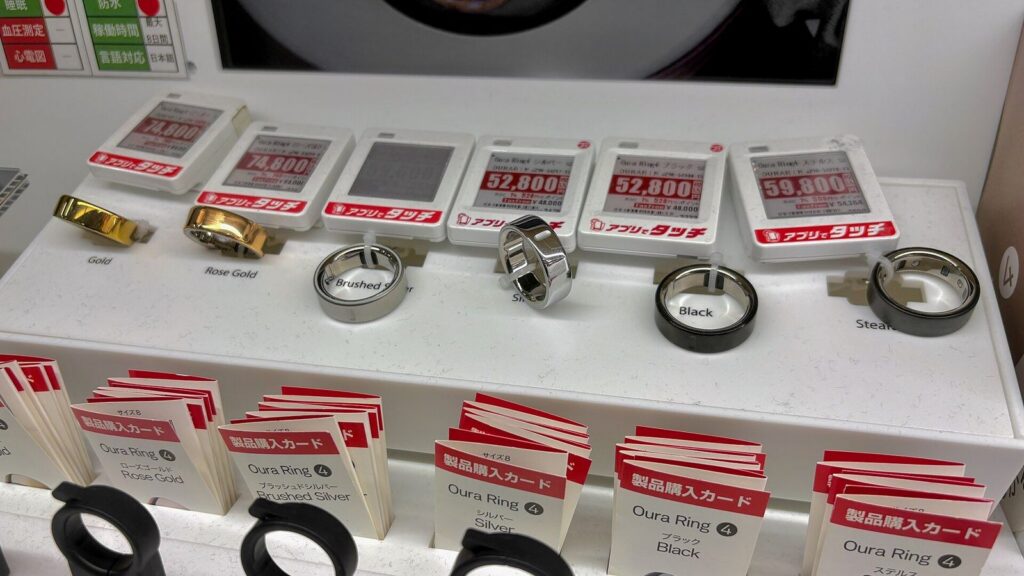
Oura launched the Ring 5 in June at £399 for silver or black and £499 for the gold, stealth, brushed silver and rose finishes. The Ring 4 launched at £349 in 2024 and is still on sale, and was the ring most heavily discounted around last year’s Black Friday (a widely reported Amazon deal took it to £319 in November 2025). I’d expect the Ring 4 to be the one with the big red sticker again this year, though I’m guessing here – Oura hadn’t published its 2026 deal terms when I checked.
The bit that changes the maths is the membership. Without it, Oura shows you your three daily scores and your battery level, and not much else: no detailed sleep stages, no heart-rate variability trends, no temperature insights. Membership costs £5.99 a month or £69.99 a year. Over three years, which is roughly how long you’d expect to keep one before the battery starts to tire, that’s another £210. A Ring 5 at full price plus three years of membership comes to just over £600. That’s before the optional £99 charging case, which is a bit of a faff to justify when the standard dock does the job.
Samsung’s Galaxy Ring launched in the UK at £399 with no subscription, though it works properly only with a Samsung phone. RingConn is cheaper still and also has no membership fee. Neither has the same weight of published validation as Oura, so you’re trading some evidence for a lower bill. For most people who simply want a rough idea of how long they sleep, that’s a trade I’d take.
So who does a smart ring help?
Healthy sleepers who are curious. That’s the honest answer, and it’s narrower than the adverts suggest.
If you sleep reasonably well and want to see what your late-night curry, your 4pm flat white or your third glass of wine does to your overnight heart rate, a ring is a surprisingly good tool for that. Resting heart rate and heart-rate variability are measured fairly well from the finger, and the trends over weeks tell you more than any single night. I learned more from watching my resting heart rate climb by eight or nine beats after two drinks than I ever did from the sleep stage chart. It’s also the most comfortable tracker to sleep in by a distance; a chunky smartwatch on your wrist all night is nothing to write home about.
Shift workers trying to understand how rotas affect their sleep can get something out of one too, as can people training for a marathon or Hyrox who want a rough recovery signal. Which?’s own advice is to look at the data once a week to spot trends, not every morning, and that’s the single most useful habit if you do buy one.
And if what you want is better sleep rather than more data about it, the evidence points elsewhere. In May 2022 NICE recommended Sleepio, a six-week digital CBT-I programme backed by 12 randomised controlled trials, as a cost-saving alternative to sleeping pills for people with insomnia. NICE said it reduces GP appointments and reliance on drugs such as zopiclone. Depending on where you live it’s available through the NHS for free. It doesn’t come in rose gold.
Cheaper fixes with better evidence
Before you spend £400 measuring the problem, try the things that change it. Moving your last coffee earlier makes a measurable difference, and we’ve looked at the 8.8-hour caffeine cut-off rule in detail. Morning light matters more in a British November than most people realise; our piece on what the trials say about SAD lamps covers who benefits. A cool, dark bedroom (Which? suggests 18 to 24°C) and a consistent wake-up time, including weekends, are dull and free and work better than most things you can buy.
Some of the popular sleep purchases are weaker than they look. We found the magnesium for sleep evidence rests on very small trials, and the weighted blanket case is real but modest. If you’re tempted by the wider Black Friday wellness aisle, our verdict on walking pads before Black Friday is worth a read too.
My verdict before 27 November
A smart ring is the best consumer sleep tracker you can buy, and it’s still not very good at the one thing insomniacs most want to know – how long they were really awake. Buy one if you’re a decent sleeper who likes data, and if the Ring 4 drops well under £300 it’s a fair deal. Budget for the membership or buy a ring that doesn’t charge one. Don’t buy one to cure bad sleep, and don’t buy one for someone who already lies awake worrying about it; that’s a Christmas present that could backfire.
Have you worn a sleep tracker long enough to trust it – or did you end up putting it in a drawer because the morning score started running your day?