67 Days Until the Clocks Go Back: The Best Video Doorbell Under £100 – And Why the Subscription Costs More Than the Bell
A 59% jump. That’s the figure a peer-reviewed study of London crime data landed on when it compared residential burglary in the same locations under light and dark conditions – not summer against winter, but the same street with the sun up and the sun down. The research stripped out season, temperature and day of the week, and darkness still moved the number.
In This Article
- The seasonal spike is real, but the numbers you'll read are mostly rubbish
- What £100 buys in 2026, and where the money stops mattering
- The best video doorbell under £100 right now
- The subscription is the real price
- Your doorbell is CCTV, and the law treats it that way
- The two questions to answer before you buy anything
- What to skip
- Why now rather than late October
Which is why the best video doorbell under £100 is an August purchase, not an October one. The clocks go back on Sunday 25 October 2026. That’s 67 days away, and it’s the moment Britain’s front doors stop being visible at 5pm and start being a guess.
The seasonal spike is real, but the numbers you’ll read are mostly rubbish
Search this topic and you’ll be told burglaries “soar by 28% when the clocks go back”. You’ll also find 20%, 35%, and a claim that Bonfire Night is the single worst evening of the year. Almost all of those come from insurance company press releases recycling each other’s claims data, which isn’t the same thing as crime data.
The honest version is duller and more useful. Domestic burglary in England and Wales is roughly 1.1 to 1.2 times more likely in the winter months than the summer ones. That’s a real, consistent, decades-old pattern, and it’s driven almost entirely by darkness rather than by Christmas presents sitting under a tree. Homes with no lights on at 5.30pm on a Tuesday in November look empty, because most of them are.
So the case for a doorbell camera isn’t that it stops a break-in. It’s that it makes your front door a known quantity when you can’t see it – deliveries, cold callers, the bloke who keeps trying door handles down the street. And, if the worst happens, it gives you footage a police officer can actually use rather than a neighbour’s recollection of “a man in a dark hoodie, maybe”.
What £100 buys in 2026, and where the money stops mattering
The gap between a £60 doorbell and a £250 one has closed to the point where the expensive end is hard to justify for most terraced and semi-detached houses. Two things happened. TP-Link’s Tapo line pushed 2K sensors down into the sub-£80 bracket, and the tall 4:3 or 1:1 “head-to-toe” sensor – the one that shows you the parcel on the step rather than just the courier’s chin – stopped being a premium feature.
Here’s what genuinely separates a good sub-£100 doorbell from a bad one.
Aspect ratio beats resolution. A 2K camera with a wide 16:9 view will show you a beautiful shot of the pavement and nothing of the box by your feet. A 1080p camera with a 4:3 or 1:1 view shows you the whole doorway. If you’re choosing between the two, take the shape over the pixel count every time.
Local storage. This is the single biggest variable in the total cost, and I’ll come back to it.
An included chime. Some doorbells expect you to already own a smart speaker, or to buy the chime separately for £25. That quietly turns a £79 doorbell into a £104 one.
Battery capacity and how you get at it. A 5,000mAh cell in a north-facing porch in January will want charging every six to eight weeks. A 10,000mAh one will stretch to three or four months. Whether the battery pops out or the whole unit has to come off the wall matters more than the spec sheet suggests, because you’ll be doing it in the cold and the dark.
Frame rate, HDR, package detection, AI person alerts – all nice, none decisive at this price.
The best video doorbell under £100 right now
Prices below are the street prices at the time of writing and they move constantly, so treat them as a guide rather than gospel.
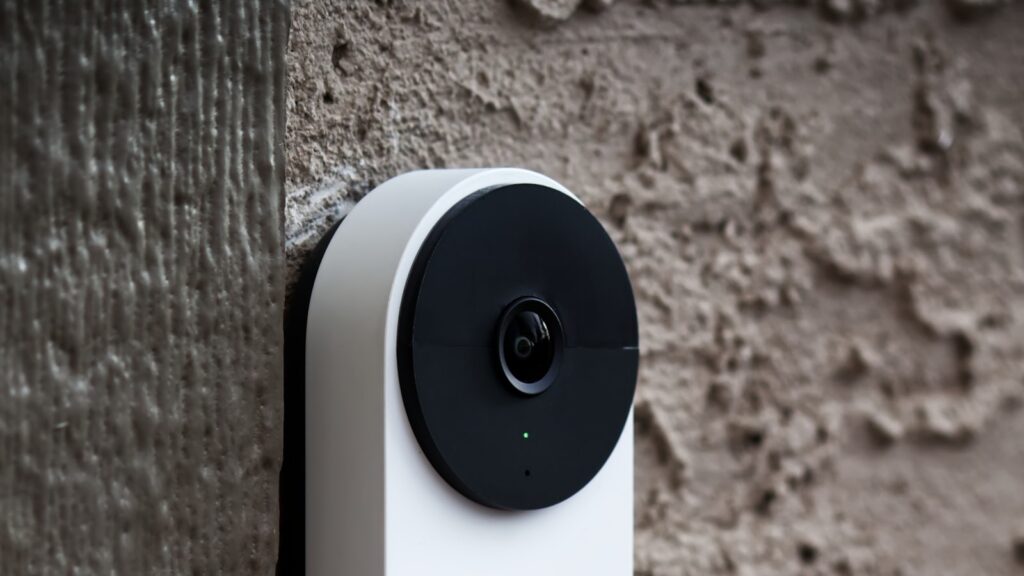
Tapo D235 (around £90-£100). This is the one I’d fit at most UK front doors. It pairs a 5MP 2K sensor with a 180-degree head-to-toe view, ships with a plug-in chime, runs on a 10,000mAh battery or 8-24V existing wiring, and records everything to local storage with no subscription attached. Battery life in normal use runs to three months or so. Expert Reviews rates it their overall pick, and I’d agree. The catch is 2.4GHz Wi-Fi only, which is a problem in more UK homes than you’d think – see below.
Tapo D230S1 (around £60-£80). The D235’s older sibling, and the value buy if you can find it discounted. Same free local recording, same included chime, a slightly narrower view and a smaller battery. For a flat door or a covered porch it’s plenty. I’ve seen it drop under £55 in the past year, which is remarkable for what it does.
Aqara G410 (around £90-£110). Worth the extra if you already own, or intend to own, other smart home kit. It records 2K in a 175-degree 4:3 view onto a microSD card in the indoor chime, and doubles as a Zigbee hub, a Matter controller and a Thread border router. That’s a genuinely useful bit of consolidation if you’ve got sensors and bulbs scattered about. As a plain doorbell it isn’t better than the Tapo.
Ring Battery Video Doorbell (around £80-£100). Buy this only if your household already runs on Alexa and you want the doorbell announcing itself through the Echo in the kitchen. The hardware is fine. The app is the slickest of the lot. But without a subscription it won’t store a single second of video, and that changes the maths entirely.
And the one that keeps getting recommended but shouldn’t be: the eufy E340. It’s a good doorbell – two cameras, on-device storage, no fees – but it sits at £120 to £150 in the UK, which puts it outside this bracket. Buying it doesn’t get you £40 of extra usefulness over a D235.
The subscription is the real price
Ring renamed its plans in 2026. Ring Home Basic is £4.99 a month or £49.99 a year; Standard is £7.99 a month; Premium is £15.99. Arlo works the same way. Buy a £90 Ring doorbell on Basic and you’ve spent £140 in year one, £190 by year two, £240 by year three. The doorbell was never the expensive part.
Tapo, eufy, Aqara and Reolink store footage on the device or a card in the chime and charge nothing, ever. Motion alerts, person detection, two-way audio, video history – all of it works with no plan. Tapo doorbells also keep recording when your broadband drops, which Ring cannot do.
There’s a reasonable counter-argument, and it’s worth hearing. Cloud storage survives someone ripping the doorbell off the wall; a microSD card in your hallway doesn’t survive a burglar who finds the chime. If that’s your threat model, pay the £50 a year. For the overwhelming majority of British households worried about parcels and cold callers, it’s £50 a year for nothing.
One thing a doorbell almost certainly won’t do is cut your home insurance. There’s no standard UK discount for smart security, and the handful of insurers who acknowledge it at all tend to want a professionally monitored alarm system rather than a camera you fitted yourself on a Saturday. It’s the same pattern we found with dash cams and motor premiums – the gadget helps enormously with a claim, and does nothing at all to the quote.
Your doorbell is CCTV, and the law treats it that way
This is the part almost nobody reads, and it has cost at least one person around £100,000.
In Fairhurst v Woodard (Oxford County Court, 2021), a homeowner’s Ring doorbell and associated cameras were found to have breached the Data Protection Act 2018 and to amount to harassment of his neighbour. The judgment is worth reading properly if you share a drive or a communal path with anyone. The decisive issue wasn’t the video. It was the audio.
Doorbell microphones pick up conversation at a range far beyond the property they’re protecting – the court found the range wide enough to capture people well down the street. Video of a public pavement can usually be justified as protecting your home. Recording what passers-by are saying to each other almost never can, and the ICO’s own position is that most domestic systems shouldn’t record audio at all.
The practical upshot, and it takes about ninety seconds:
Turn audio recording off unless you have a specific reason for it. Angle the camera down and towards your own door rather than across a neighbour’s window or a shared parking area. Use privacy zones to black out anything that isn’t yours – every app in this price bracket has them, buried two menus deep. Put a small sign up if the camera covers anything beyond your boundary; it’s not legally mandatory for a domestic system but it’s the single cheapest way to defuse a neighbour dispute before it starts. And if you rent, check your tenancy – a fair number of agreements treat a drilled doorbell as an alteration requiring written consent.
None of this is theoretical. Neighbour camera disputes are one of the fastest-growing categories of complaint the ICO deals with, and the ones that end badly almost always started with a microphone nobody thought about.
The two questions to answer before you buy anything
Is your Wi-Fi 2.4GHz, and does it reach the front door? Nearly every doorbell in this bracket is 2.4GHz only. Modern mesh systems and most ISP routers broadcast a single combined network name across both bands, and the setup process will fail in a way that tells you nothing useful. You’ll need to split the bands temporarily or use a guest network on 2.4GHz, and if your router sits in a back bedroom you may need a repeater near the front of the house. This is the number one reason doorbells go back to Amazon. If your signal is patchy generally, our guide to fixing UK home Wi-Fi is the place to start.
Battery or wired? A battery doorbell fits anywhere with four screws and takes twenty minutes. A wired one never needs charging and gives you a proper mechanical chime, but it needs an existing 8-24V transformer, and most British houses simply don’t have one – our wired doorbells run on mains through a separate transformer or on batteries in the bell push, neither of which is what these cameras expect. Getting one installed properly is £80 to £150 of electrician time. Unless you already have a wired system, take the battery.
Renting complicates both. If you can’t drill, there are no-screw mounting options and the doorbells that work best without permanent fixings are covered in our renter’s smart home guide.
What to skip
Anything under about £35 from a brand you’ve never heard of. The sensor will be a genuine 720p pretending to be 1080p, the app will be a rebadged shell shared across a dozen other brands, and the firmware will stop being updated within a year. A camera pointing at your front door running abandoned firmware is a worse security position than no camera.
Solar charging panels sold as accessories. In a British winter, on a north-facing porch, they’ll add almost nothing between November and February – exactly the months you need the battery to last.
Bundles that pair a doorbell with two outdoor cameras for “£30 off”. You’ll fit the doorbell and the cameras will sit in the box until you move house. I’ve watched three separate people do this.
Why now rather than late October
Two reasons, and the second is the better one.
The first is that doorbell prices firm up as the nights draw in. The genuinely good discounts on this category land in the summer lull and again in late November, and the six weeks either side of the clock change is when retailers have the least reason to cut. It’s the same seasonal logic that makes August the sensible month to buy a dehumidifier rather than November, when everyone else has noticed the condensation.
The second is that fitting one takes longer than you think. Not the drilling – the fiddling. Working out why the app won’t see your router, deciding where the motion zone should stop so the passing bus doesn’t trigger it forty times a day, working out that the chime volume is too low to hear from the kitchen. That’s an evening’s faff, and it’s better done in daylight in August than by torchlight on the last Sunday in October.
Which? makes the same seasonal point about installation, and it holds for most autumn home kit. If you’re already planning purchases around the October energy cap, a doorbell belongs on that list too – not because it saves money, but because it’s the kind of thing that gets bought in a hurry after something happens rather than calmly before.
The harder question is what you’ll actually do with the footage. Most people fit a doorbell expecting to catch a burglar and end up using it to check whether the postman really did try the door. Which of those two are you buying it for?