EU Entry/Exit System: Why UK Travellers Need a New Border Routine for Europe in 2026
There is no stamp in your passport any more. That single change, more than any of the headlines about queues, is what summer 2026 has quietly done to the British holiday. The EU Entry/Exit System went fully live on 10 April 2026, after a phased rollout that began the previous October, and it has rewritten the basic mechanics of crossing into Europe for every UK traveller. Your face and fingerprints are recorded the first time you arrive, a digital record tracks every entry and exit afterwards, and the friendly thud of a border officer’s stamp has been retired for good. For most people the change is manageable. But the first summer of a new border system is rarely the smoothest, and the gap between “manageable” and “missed your connection” comes down to preparation.
In This Article
- What the EU Entry/Exit System actually is
- Why summer 2026 is the messy transition period
- Who is exempt
- What changes at the border
- How to prepare before you fly
- What it means for families
- What it means for frequent travellers
- The 90/180 rule is now automated – and that matters more than the queues
- The bigger picture: ETIAS is next
- The practical takeaway
What the EU Entry/Exit System actually is
The EU Entry/Exit System, almost always shortened to EES, is a digital border register covering 29 European countries. It applies to non-EU nationals – including UK citizens – travelling for short stays of up to 90 days in any 180-day period. The old routine of an officer flicking through your passport and stamping a blank page has gone. In its place, the first time you enter you give a facial image and fingerprints, which are stored alongside your passport details for three years. On later trips inside that three-year window, the check should be quicker because your biometric record already exists.
It helps to be clear about what EES is not. It is not a visa. And it is not the same thing as ETIAS, the separate travel authorisation UK travellers will need to apply for online before they fly. The two are constantly muddled in news coverage, so here is the plain version:
| EES (live now) | ETIAS (coming Q4 2026) | |
|---|---|---|
| What it is | Biometric entry/exit register | Pre-travel authorisation |
| Where you do it | At the border, in person | Online, before you travel |
| What it costs | Free | €20 (free for under-18s and over-70s) |
| What it collects | Face, fingerprints, passport data | Application details, security screening |
| Status in summer 2026 | Mandatory and operating | Not yet required |
So for this summer, the thing actually affecting your holiday is EES: a registration that happens at the border itself, not something you sort out at your kitchen table the night before.
Why summer 2026 is the messy transition period
EES was switched on gradually from 12 October 2025, reaching full operation across Schengen crossings on 10 April 2026. That phased approach was meant to avoid a single chaotic switchover, and at most crossings the system now works as intended. But “most” is carrying weight in that sentence.
The official line and the airport reality have not always matched. Lengthy delays were reported at several crossings in the days after 10 April, and Greece took the striking step of suspending EES registration for British visitors entirely after queues built up at its borders. The European Commission has leaned on the “built-in flexibility” written into the rules, which lets individual countries pause parts of the process when things back up. In other words, the system is fully live on paper, and selectively switched off in practice whenever a border can’t cope.
The juxtaposed UK crossings have been their own headache. At Dover, the Eurotunnel terminal at Folkestone and the Eurostar platforms at St Pancras, where French border officers operate on British soil, EES had not been fully rolled out for most travellers on the launch date – operators blamed delays connecting to the French side’s software. If you are driving to Dover or taking the train, the experience this summer depends heavily on which day you happen to travel.
What all this means in practice is that your experience varies by country, by airport, even by terminal. A quiet regional airport on a Tuesday is a different animal from a major hub on a Saturday in August. The technology isn’t really the problem. The bottleneck is human throughput: registering biometrics for a first-time arrival simply takes longer than waving through a stamped passport, and that extra time stacks up fast across a full flight of holidaymakers.
Who is exempt
Not everyone with a British connection has to go through this. Irish passport holders are exempt from EES entirely, thanks to the Common Travel Area, so a dual British-Irish citizen can simply travel on the Irish document and skip the biometrics. British passport holders who hold EU residency are also exempt – if you live in France or Spain with the right paperwork, EES isn’t aimed at you. And children under 12 give a facial image but no fingerprints, though the whole family still has to be processed at the border.
If you fall into one of those groups, the new system is largely someone else’s problem. For the millions of British tourists travelling on a plain UK passport, it is not.
What changes at the border
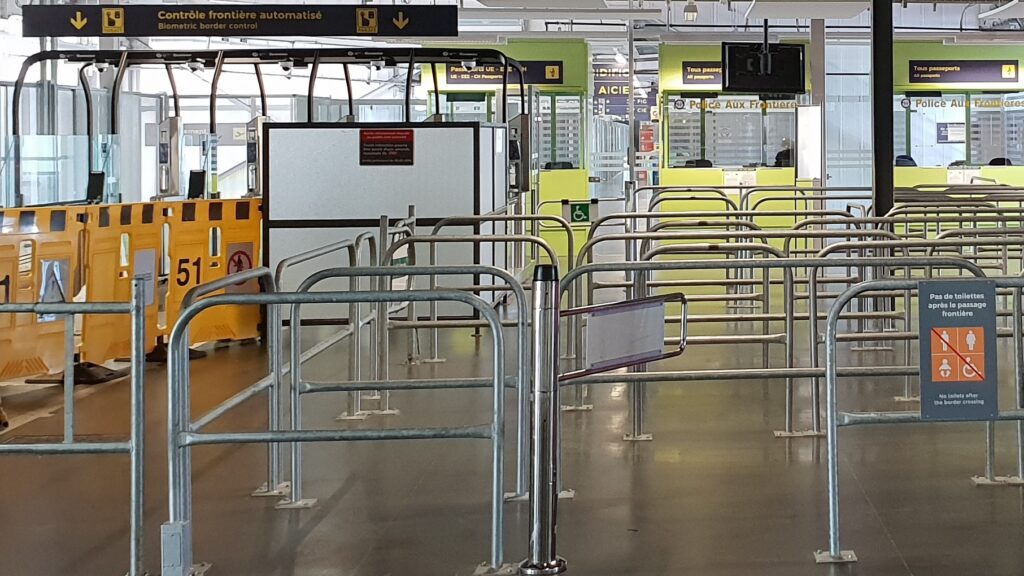
The most visible change is the kiosk. At many airports, first-time arrivals are pointed at self-service machines that scan the passport and capture a photo, with fingerprints taken either at the kiosk or by an officer. Returning travellers whose data is already on file should move faster, though they may still need a quick facial scan to confirm who they are.
Allow more time than you used to. If you normally build in a comfortable buffer for passport control, extend it – especially for your first EES trip, and especially at busy times. Connecting flights are the real pressure point. A tight transfer that worked fine in 2024 may not survive a first-time biometric registration in 2026, and missing the second leg because the first queue ate your margin is a miserable way to start a holiday.
How to prepare before you fly
There is no pre-registration you are required to complete. But a few habits genuinely help.
Check your passport properly. It must be valid under the EU’s rules on issue date and expiry, which still trip people up years after Brexit – your passport needs to have been issued within the last ten years on the day you travel, and have at least three months left after the day you plan to leave the EU. Confirm this well before departure, not at the gate.
Build the extra border time into your plans rather than your blood pressure. If you are booking connections, give yourself a generous transfer window – more than you think you need.
Some countries have launched a “Travel to Europe” mobile app that lets you pre-load your passport details and a biometric photo up to 72 hours before arrival, which can shorten the check at the border. As of late spring 2026 it is only live in a handful of places, Portugal and Sweden among them, with wider rollout promised. Check whether your destination supports it closer to your travel date. And if you are crossing borders within Europe, sorting your connectivity in advance is worth the ten minutes – our guide to eSIMs for European travel covers the options that beat roaming charges.
What it means for families
For families, the headline is patience. Under-12s don’t give fingerprints, but the whole group still has to be registered, and the first trip is the slow one. If you are planning a summer holiday with kids, treat the border as part of the itinerary rather than an afterthought – factor it in the way you would a long security queue with a tired four-year-old.
There is an honest case for sidestepping the whole thing this year. Our guide to the best UK seaside holidays for families in 2026 exists for anyone who decides the cross-border faff isn’t worth it while the system settles, and a domestic trip removes the border admin entirely. For a slower, more romantic version of the same idea, UK sleeper train holidays get you a long way from home without a single biometric scan.
What it means for frequent travellers
Frequent travellers get the opposite deal. The first registration is the bottleneck; every trip after that, inside the three-year window, should be smoother because the biometric record already exists. If you cross into the EU several times a year for work or to see family, the initial friction is a one-off cost in exchange for a faster routine later. The same logic applies to short city breaks – once you’re in the system, a weekend in Lisbon or Berlin should feel much as it always did. If anything, the people who suffer most this summer are the once-a-year holidaymakers hitting the system cold, not the regulars.
The 90/180 rule is now automated – and that matters more than the queues
Here is the change almost nobody is talking about, and arguably the most consequential one. The 90-days-in-180 limit is now tracked digitally and automatically. Under the old paper system, counting your days relied on stamps and a fair amount of good faith. Now the clock is exact.
For most holidaymakers this is irrelevant. A fortnight in Spain is nowhere near the limit, and you could take three of them and still be fine. But for second-home owners, people with family across the Channel, remote workers and anyone splitting their year between the UK and the EU, the days genuinely count now, and overstaying is far easier for authorities to spot. If that’s you, keep your own running tally rather than guessing – the system certainly will. The digital record cuts both ways: faster checks on return trips are the upside, and a permanent, accurate log of your movements is simply the new baseline.
The bigger picture: ETIAS is next
EES is only half the story. The European Commission has confirmed that ETIAS, the online travel authorisation, is expected to become a requirement for UK passport holders in the final quarter of 2026 – so roughly autumn or early winter. It will cost €20, with under-18s and over-70s exempt from the fee, and it is applied for online and linked digitally to your passport. There will be a transitional grace period of at least six months where ETIAS is available but not yet mandatory, so you won’t be turned away at the gate the moment it launches.
If you are planning a European trip for late 2026 or beyond, ETIAS is the thing to keep half an eye on. For summer, it changes nothing. Worth noting too that some of the early reporting quoted a much lower fee figure – the confirmed cost is €20, so ignore any guide still citing the old €7 number.
The practical takeaway
The EU Entry/Exit System is not a reason to cancel your summer plans. For the average two-week holiday, the real impact is little more than a longer queue on arrival and a slightly quicker one next time. The travellers who’ll find summer 2026 frustrating are the ones treating the border the way they did in 2019 – assuming it’ll move at the old pace and pricing in no extra time.
Check your passport early. Pad your timings. Look into the pre-registration app if your destination offers it, and keep an eye on the news for your specific country in the days before you fly, because the “flexibility” in the rules means conditions can change at short notice. For more on staying powered up through long airport days, our roundup of portable power banks for UK travellers covers the kit worth packing, and if you’re still deciding where to go, our pick of the best travel destinations for 2026 might help.
So here’s the question worth asking before you book: is your next trip a quick city break where a one-off registration barely matters, or a tightly connected family holiday where an extra hour at the border could unravel the whole day – and have you planned for which one it is? Consumer group Which? is tracking the rollout and the related ETIAS changes, and the European Commission’s official EES page has the current country-by-country detail.
Staying in the UK this year sidesteps the new border admin altogether. Our hideaway hotels under £200 guide has the domestic alternatives.
Read next: for travel that skips the airport queues altogether, there’s a quieter option making a comeback – the sleeper trains you can still catch from the UK.