Do Vibration Plates Work? 20 Trials Found No Fat Loss – the 2026 Evidence, and the 4 People Who Should Still Stand on One
Twenty randomised trials. 585 people. And when researchers pooled them last year, vibration plate training on its own made no measurable difference to body weight, BMI or fat mass. So do vibration plates work? For the thing most people buy them for, the answer from the best 2026 evidence is no – and yet they’re still turning up in hallways and spare rooms across Britain, usually wedged between the radiator and the sofa, humming away while someone scrolls their phone.
In This Article
- Why vibration plates are suddenly everywhere
- Do vibration plates work for weight loss? 20 trials say no
- "Ten minutes equals an hour at the gym" – the claim with nothing behind it
- Bones: the astronaut story and what 15 reviews actually found
- Balance and falls: where the evidence leans yes – with a catch
- Lymphatic drainage and "debloating": what the jiggle actually does
- Who should steer clear
- The four people who might get something from one
- If you're still buying one this winter
That isn’t the whole story, though. There are a handful of places where the research leans the other way, and a couple of groups who probably should give one a go. The trick is separating those from the TikTok claims about “debloating”, lymph and ten-minute workouts that replace an hour at the gym.
Why vibration plates are suddenly everywhere
The machines aren’t new. Gyms had big, expensive whole-body vibration platforms in the early 2000s, and most of them ended up as coat stands. What changed is the price and the platform. Compact oscillating plates now sell online for somewhere between £60 and £150, Lidl and Aldi have both put them in the middle aisle, and short videos of people wobbling on them with a caption about lymphatic drainage have done the rest of the marketing for free.
The timing also makes sense. The clocks go back on 25 October, the evening run stops being appealing, and a plate that fits under the bed looks like a tidy answer to a dark, wet winter. I get the appeal. A friend bought one in January, used it most mornings for six weeks while the kettle boiled, and swears her legs felt “lighter”. She also can’t tell you whether anything actually changed, which is roughly where the science sits too.
There are two kinds of plate, and it matters. Oscillating (or side-alternating) plates tilt like a see-saw, pushing one foot up while the other drops. Linear plates move the whole surface straight up and down. Most of the cheap home models are oscillating, and that turns out to be relevant for bones – more on that below.
Do vibration plates work for weight loss? 20 trials say no
This is the claim that sells the most plates, so it deserves the most scrutiny.
In 2025 the International Journal of Obesity published a systematic review and meta-analysis of every randomised controlled trial it could find on whole-body vibration and weight, up to December 2024. That came to 20 trials with 585 participants. The headline finding was blunt: vibration training alone “had no significant effect” on body mass, BMI, fat mass, fat-free mass or body fat percentage. The average difference in body weight between vibration groups and controls was 0.04kg. That’s roughly three Jaffa Cakes.
The fat mass figure looked a bit better at 0.9kg lower, but it wasn’t statistically significant, which means the researchers couldn’t rule out that it was noise. The authors still called the approach “promising” because of possible effects on muscle and metabolism, which is a generous way to describe a null result on weight.
There was one wrinkle worth knowing about. People aged 50 and over saw a drop in body fat percentage of about 1.8 points, while younger participants saw next to nothing. The paper doesn’t settle why. One plausible explanation is that older, less active people get more out of any muscle stimulus at all, because they’re starting from a lower base. But even in that group, we’re talking about a modest shift over months of regular use, not the “melt fat while you stand” promise on the box.
Where plates do seem to help with weight is when they’re combined with diet changes and ordinary exercise. And that’s the catch. When you bolt a vibration plate onto a calorie deficit and a walking habit, it’s very hard to know how much credit the plate deserves – and the honest reading is probably “not much”.
“Ten minutes equals an hour at the gym” – the claim with nothing behind it
You’ll see this line, or something like it, on product listings and in plenty of videos. Ten minutes on the plate, the pitch goes, is equal to an hour of conventional training.
I looked. I couldn’t find a single trial that tested it, and I’d be surprised if one exists, because the comparison doesn’t really make sense. An hour at the gym might mean lifting, rowing, a spin class or a sweaty circuit; each one does different things to your heart, lungs and muscles. A vibration plate causes rapid, reflexive muscle contractions – your legs twitch to keep you stable, many times a second – and that does raise muscle activity and blood flow a little. But it doesn’t load your heart the way brisk walking does, and it doesn’t load your muscles the way a heavy squat does.
So here’s my position, and plenty of fitness people will disagree with it: if you’re a healthy adult under 60 with no mobility problems, a vibration plate is one of the least efficient ways you could spend £100 on your fitness. A pair of adjustable dumbbells, a decent pair of walking shoes or three months of a council gym membership will almost certainly do more. We made a similar point about weighted vest walking – the gadget gets the headlines, the boring habit does the work.
If you want an actual number to aim for, the step count research is far more solid than anything in the vibration literature.
Bones: the astronaut story and what 15 reviews actually found
The bone claim has a better origin story than most wellness trends. According to the Royal Osteoporosis Society, vibration therapy was first developed to help astronauts, who lose bone and muscle quickly in space; standing on lightly vibrating plates for 10 to 20 minutes a day appeared to help prevent that loss. It’s easy to see how that turned into “vibration builds bone” on a product page.
Back on Earth, the picture is messier. A 2016 meta-analysis in PLOS One looked at nine trials covering 527 postmenopausal women and did find improvements in bone mineral density at the hip and spine compared with doing nothing. It also found that side-alternating plates worked better than the up-and-down kind, and that positive results tended to show up once people had clocked more than 1,000 minutes in total. That’s ten minutes a day, five days a week, for around 20 weeks. Not impossible, but it’s a lot of standing on a plate.
But there’s a big “however” in that same paper. When vibration was added to an exercise programme and compared with the exercise programme alone, the extra benefit was negligible. In other words, the plate seemed to help people who weren’t doing anything else, and didn’t add much for people who were.
Then, in 2024, a team published an overview in BMC Women’s Health that took a step back and assessed the reviews themselves. They found 15 systematic reviews on vibration and bone density in postmenopausal women, and rated 13 of them as “critically low” quality. Their overall conclusion was that vibration “does not have a significant advantage” for bone density in this group. They also found heavy overlap – the same small trials being recycled across review after review, which can make the evidence look bigger than it really is.
The Royal Osteoporosis Society’s own summary is careful: “it is not clear if vibration therapy can help make bones stronger and less likely to break.” Its page is due for review on 1 October, so it’ll be worth checking whether that wording shifts. I wouldn’t bet on it.
If bone health is the reason you’re looking at a plate, the stronger evidence is still for resistance training and impact work, alongside enough calcium and vitamin D. And if you’re a woman over 40 building strength, creatine has a far better research base than anything that plugs into the wall.
Balance and falls: where the evidence leans yes – with a catch
This is the section where vibration plates come out best, and it’s the one hardly anyone on social media talks about.
Falls are a huge deal for older people, and a lot of research has gone into preventing them. In 2024 the Canadian Task Force on Preventive Health Care published a large review of falls prevention for older people living at home, and concluded that whole-body vibration had moderate-certainty evidence for reducing the number of people who fall. That put it in the same broad conversation as balance training and tai chi, which is a genuine surprise for a gadget more often sold with a before-and-after waistline photo.
But in October 2025, a group of Cochrane falls-prevention researchers published a response urging caution, and their reasoning is worth spelling out. Most of the evidence came from a single trial of 710 people in Hong Kong, who had supervised vibration for 20 minutes a day, five days a week, for 18 months. That’s a big commitment, and the review authors themselves doubted it would be feasible outside a trial. The range of plausible effects on fractures even included the possibility of more fractures rather than fewer. There were also around five adverse events per 100 people – none serious, but not nothing when the users are frail. And in care homes, the two trials they found showed either no effect or a slight, non-significant trend towards more falls.
Their bottom-line advice: for older people, vibration should only be used after an individual assessment and with guidance from a trained professional.
That’s a long way from buying a £70 plate on a whim and parking your 82-year-old dad on it in front of Countdown. Balance training, strength work and tai chi have a much deeper and more consistent evidence base. The NHS’s physical activity guidelines for older adults recommend activities that improve strength, balance and flexibility on at least two days a week – and none of them require a plug.
Lymphatic drainage and “debloating”: what the jiggle actually does
The social media version of the vibration plate isn’t really about fitness at all. It’s about lymph. The claim is that the vibration “gets your lymph moving”, reducing puffiness, water retention and bloating, often filmed first thing in the morning with a green juice in shot.
There’s a sliver of physiology behind this. Your lymphatic system doesn’t have a heart to pump it; it relies partly on muscle contractions squeezing fluid along. A vibration plate makes your leg muscles contract rapidly, so it’s plausible it gives that system a small nudge, in the same way walking or flexing your calves does. For people with swollen ankles after a long day of sitting, a few minutes of movement of any kind can make legs feel less heavy.
What I couldn’t find is a good controlled trial showing that vibration plates reduce “bloat” or improve lymphatic drainage in healthy people in any way that matters. People with lymphoedema need specialist care, not a gadget from the middle aisle. And most of the before-and-after videos show changes you’d get just as easily from standing up, walking around the kitchen and having a wee. We looked at the same claim when it was being sold in a bottle – the lymphatic drainage drops trend – and the evidence was thin there too.
Who should steer clear
Here’s a slightly odd fact. Britain has a whole set of workplace regulations – the Control of Vibration at Work Regulations 2005 – that treat whole-body vibration as a health hazard. The Health and Safety Executive requires employers to act once a worker’s daily exposure passes 0.5 m/s², mainly to protect people like tractor and forklift drivers from back problems. That’s a very different situation – hours a day of low-frequency jolting, not ten minutes of deliberate training – and it doesn’t mean a home plate is dangerous. But it’s a useful reminder that vibration is a real physical force, not a gentle wellness vibe.
The Royal Osteoporosis Society lists groups for whom whole-body vibration isn’t suitable. If any of these apply to you, skip the plate or talk to your GP first:
- You have, or recently had, a blood clot
- Heart or circulation problems, including a previous heart attack or stroke
- You have a pacemaker
- You’re pregnant
- Dizziness or inner ear problems
- A hip or knee replacement
- Cochlear implants
- Spinal fractures, or multiple previous fractures
I’d add a practical one: anyone with poor balance should only use a plate with a sturdy handrail or a solid surface to hold. Most cheap home models don’t have one. Getting on and off is when people wobble most.
The four people who might get something from one
None of this means vibration plates are useless. It means they’re oversold to the wrong people. If I had to name who gets something from one, it’d be these four.
Older people who can’t manage conventional exercise yet. Someone deconditioned after illness, or too unsteady for a class, may get some strength and balance benefit from supervised vibration as a stepping stone. The key word is supervised – ideally via a physio, who can decide whether it’s right and set it up safely.
Postmenopausal women who genuinely can’t do impact or resistance work. If joint pain or another condition rules out the things that reliably help bones, a side-alternating plate used consistently (think 1,000-plus minutes over several months) has some low-quality evidence behind it. It’s a fallback, not a first choice.
People in rehab who’ve been told to use one. Some physiotherapy services do use vibration platforms. If a clinician has recommended it for your recovery, that’s a different conversation from buying one because of a video.
People who’ll actually use it. This one’s less scientific. If a plate by the telly gets you doing squats, lunges and calf raises most evenings when you’d otherwise do nothing, the exercises you do on it are worth something – even if the vibration itself adds little. Just don’t pay £300 for that motivation when a £20 mat might do the same job. If you’re after a more serious winter goal, our guide to Hyrox for beginners is a better use of the dark months.
If you’re still buying one this winter
Fair enough – it’s your living room. A few pointers so the money isn’t wasted.
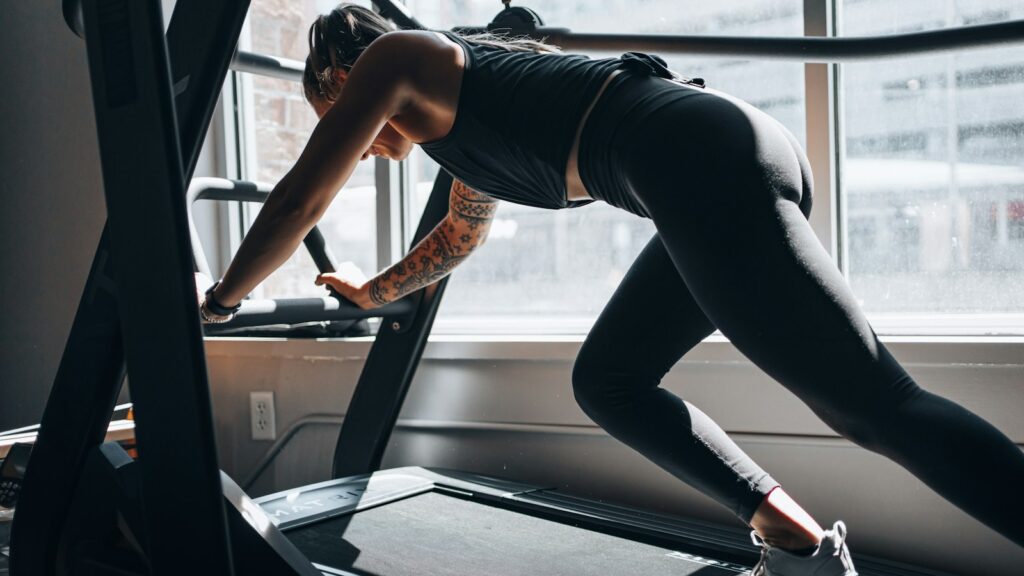
Go for side-alternating (oscillating) if bone health is part of the reason, since that’s where the better bone results were. Look for a model with a handrail or column if you’re older or have any balance concerns. Ignore the calorie-burn numbers on the display, which I’ve never seen validated against anything. And do exercises on it rather than just standing there: squats, split squats, calf raises, a plank with your hands on the plate. The standing-still-and-scrolling version is the one with the least going for it.
Start low. Short sessions of a few minutes, a couple of times a week, and stop if you feel dizzy, get a headache or notice any pain. It’s also worth putting it on a rubber mat, partly for grip and partly because the neighbours downstairs will thank you.
Most of all, treat it as an extra rather than the plan. The things that move the needle on weight, bone and falls are still walking, lifting, balance work and eating enough protein – dull, cheap and backed by far more than 585 people.
Have you got a vibration plate gathering dust in the spare room, or is yours one of the ones that actually gets used – and what made the difference?