

Hyrox for Beginners: The 90-Minute Race 2 Million People Will Enter in 2026/27 – and the Injury Rate Nobody Quotes
Manchester will host ten consecutive days of Hyrox racing next January. Not a weekend. Ten days, back to back, because four wasn’t enough to clear the waiting list. Birmingham was close to selling out by midsummer, and London’s ExCeL date in December is historically the fastest sell-out in the country. If you’re a gym member who keeps hearing the word and wondering whether to put your name down, consider this Hyrox for beginners, minus the hype: what the race actually involves, what it costs once you add everything up, what a new injury study found – and who’d be smarter to leave it a season.
In This Article
- What you’re actually signing up for
- Getting a place is now half the sport
- The training case is stronger than most trends we cover
- The injury numbers nobody puts on the poster
- Who Hyrox for beginners actually suits
- Four people who should sit this season out
- What it costs once you add everything up
- How it got this big, and why that matters for your first race
- Getting to race day in one piece
The scale first. HYROX (the brand shouts it in capitals; we won’t keep doing that) expects more than two million athletes across 107 race weekends worldwide in the 2026/27 season. For an event most British gym-goers hadn’t heard of four years ago, that’s a remarkable number – and it explains why your local leisure centre suddenly owns four sleds.
What you’re actually signing up for
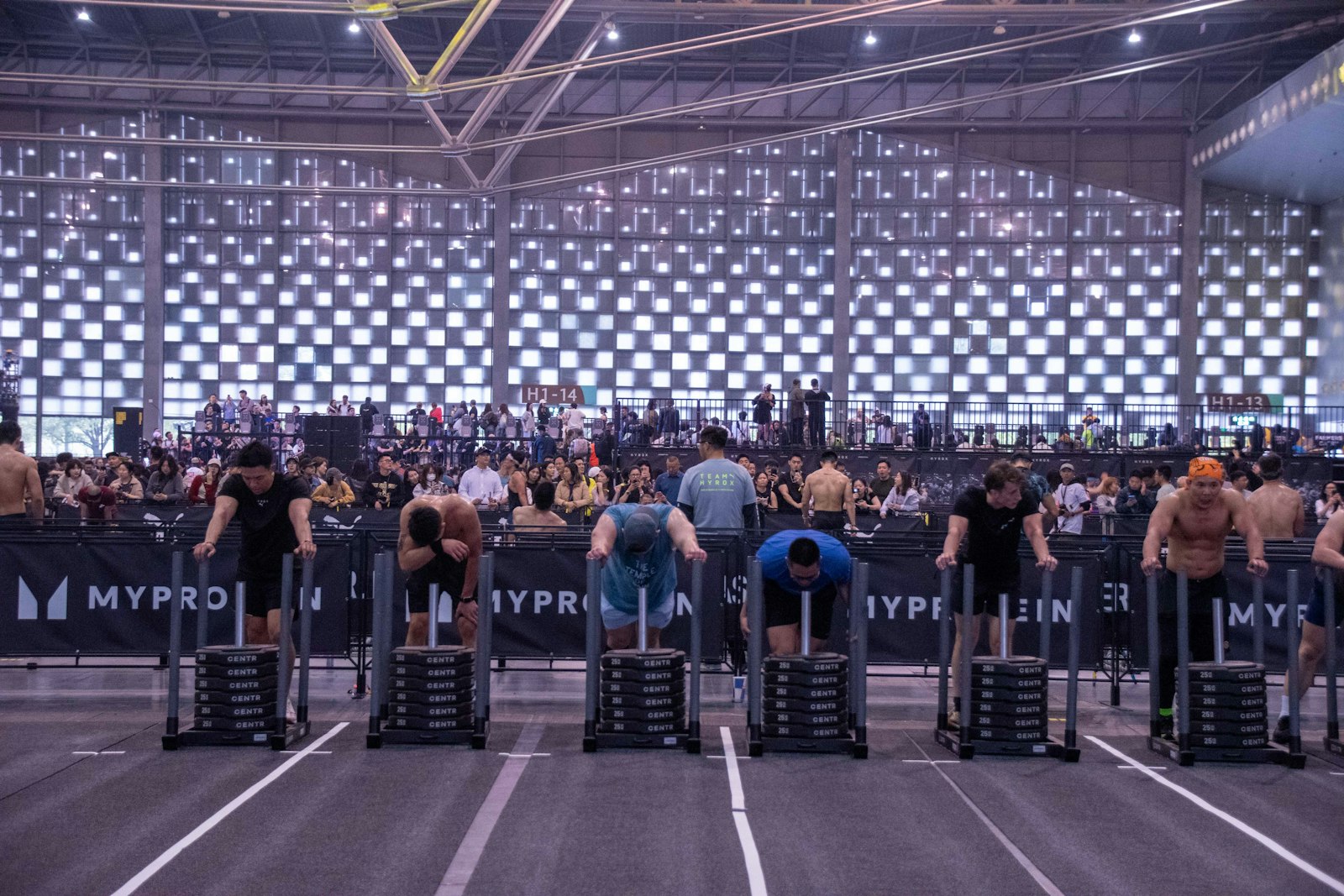
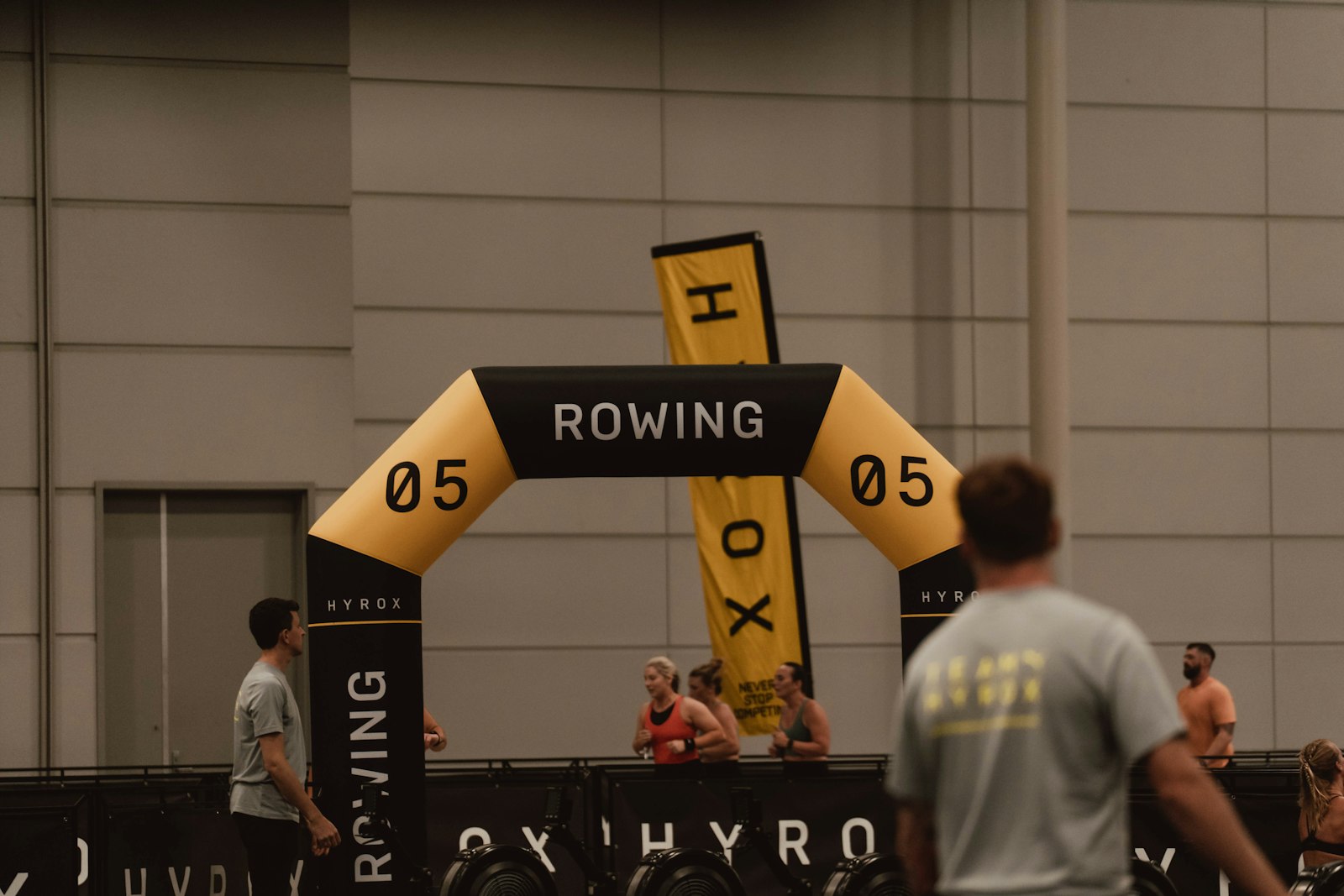
The format never changes, which is a large part of the appeal. You run 1km, then complete a workout station. You do that eight times. The stations come in a fixed order – SkiErg, sled push, sled pull, burpee broad jumps, rowing, farmers carry, sandbag lunges and finally wall balls – and the order matters, because those wall balls arrive when your legs have already done 8km and seven stations’ worth of work. Depending on your category that final station is either 75 or 100 reps, performed in front of a grandstand, with a judge counting and a crowd that has opinions.
Most first-timers finish somewhere around the 90-minute mark. Elites go under an hour. And there’s no cut-off time, which is the line the marketing leans on hardest: anyone can finish, at their own pace, in front of a crowd that treats the last finisher roughly the same as the first.
That bit, to be fair, is true. The atmosphere at a British Hyrox event is closer to a darts night than an athletics meet – loud music, announcers who know the regulars, several thousand spectators leaning over barriers, and at least one man racing in a dinosaur costume for a hospice. It’s a big part of why people come back.

Recovery matters as much as the race itself – our deep dive into cold water swimming benefits looks at whether an ice-cold dip actually helps you bounce back faster, or just feels like it does.
Getting a place is now half the sport
Entries have become their own competitive event. Tickets drop city by city, sell through in waves, and the big venues go fast – when Dublin released tickets in July the chatter in every UK Hyrox Facebook group was about who’d got through the queue and who hadn’t. London ExCeL runs from 2-6 December this year, and if previous form holds it will be the first to vanish.
The spring calendar is where the growth is most visible. Manchester gets that ten-day residency from 20-31 January, Glasgow returns to the SEC, and London shifts to Olympia for a run of similar length. Hyrox has also said it wants more than 16,000 charity racers across the UK this season, which is worth knowing about: charity places routinely stay open after general entry sells out, and a modest fundraising pledge is a legitimate side door into a sold-out race.
But scarcity does strange things to judgement. A race you had to fight a ticket queue for feels more valuable than one you strolled into, and that feeling has nothing to do with whether your body is ready for it. Book the race your training deserves, not the one the queue lets you have.
The training case is stronger than most trends we cover
We spend a lot of time on this site pouring cold water on fitness fads, so it’s worth saying plainly: as exercise, Hyrox holds up. A 2025 paper in Frontiers in Physiology put athletes through simulated races to map what the event demands, and the answer is a long, sustained effort at high intensity that mixes endurance with loaded strength work. Training for it means doing the two things the NHS activity guidelines say most British adults skip: regular cardiovascular exercise and strengthening work at least twice a week. Whatever you think of the branding, a trend that gets desk workers doing structured strength and endurance training for four months is doing more for public health than any supplement we’ve reviewed this year.
The same research points to something the Instagram clips hide, though. Hyrox is a running event with interruptions. The runs make up around half your total race time, and finishing times track running ability far more closely than gym strength. All the viral footage is sled pushes and wall balls, because a 1km run makes for boring content. But if you can’t comfortably run 8-10km, no amount of sled work will save you.
That mismatch – what the race rewards versus what the marketing shows – is where most beginner mistakes start.
Fuelling is its own minefield too; we’ve covered running gels for a half marathon and the 90-minute rule most runners still get wrong.
The injury numbers nobody puts on the poster
Until this year, injury talk around Hyrox was all anecdote. Now there’s data, and it deserves more attention than it’s getting. A 12-week prospective cohort study published in Frontiers in Sports and Active Living followed Hyrox athletes through their normal training and found that in any given week, 30% were dealing with a health problem, and 18% with one the researchers classed as substantial. Injury incidence came out at 14.4 per 1,000 training hours, with about two-thirds of injuries attributed to Hyrox training itself. Nearly three-quarters were overuse injuries, the knee was the most commonly affected joint, and the lower leg carried much of the remaining burden.
For context, when we covered padel’s injury problem earlier this month, the figure that alarmed physios was around 3 per 1,000 hours. Different studies count injuries differently, so treat any direct comparison loosely. But the gap isn’t subtle.
The pattern behind the numbers is the familiar one. Overuse injuries – shin splints, plantar fasciitis, Achilles trouble, runner’s knee – come from ramping up running volume too fast, which is exactly what a gym-strong beginner does when they book a race twelve weeks out and discover the running is the hard part. The study also found previous injury was the single biggest marker for trouble ahead, which matches what physios have said about every boom sport since squash.
None of this makes Hyrox dangerous in the way the scare headlines will eventually claim. It makes it a real endurance sport with real endurance-sport injury rates, sold to people who’ve been told no fitness base is required.
Who Hyrox for beginners actually suits
The ideal first-timer already exists in most British gyms. If you can run 5km without stopping, you’ve touched a barbell or a kettlebell in the past year, and you can give it ten to sixteen weeks of structured build-up, Hyrox for beginners is honestly one of the better goals you can pick. It gives aimless gym-going a deadline, and a reason to train the things you avoid.
Parkrunners with a bit of gym history are probably the single best-placed group. So are lapsed team-sport players – the engine remembers.
And if the solo race sounds like too much, that instinct is worth listening to. More on that below.
Four people who should sit this season out
First, anyone starting from the sofa. Twelve weeks from sedentary to an 8km race with loaded carries is a shin-splint subscription, whatever the “no cut-off, anyone can do it” messaging implies. Build a running habit this winter and enter the spring 2027 races instead – the calendar above gives you three long windows to choose from.
Second, anyone currently carrying an injury. The cohort study is blunt on this: previous injury was the strongest predictor of future problems. A niggly knee won’t enjoy 100 wall balls.
Third, pure lifters who don’t run. You’re the group the format quietly punishes – strong enough to muscle through the stations, aerobically unprepared for the 8km wrapped around them, and most likely to spend the following fortnight limping.
Fourth, anyone doing it purely because their gym has started chalking HYROX PREP on the whiteboard. Gyms have found the trend commercially useful in the way they once found reformer pilates useful. A race entry is a goal, not a personality. If the appeal is the class, just do the class – it’s the cheapest way to consume Hyrox by a distance.
What it costs once you add everything up
The entry fee alone is £80-130 for the open division, depending on the city and how early you book. That’s before the branded kit, the compression socks, the grip gloves and the £40 finisher’s tee, and before travel – most people don’t live next to the NEC. Budgeting guides aimed at first-timers put a realistic all-in figure at £300-500 including a hotel night, and having watched the merch queue at a London event move slower than the sled lanes, I’d call that conservative for anyone with a weakness for branded kit. Skip the carbon-plate racing shoes too: they’re built for straight-line road pace, not sled pushes.
Here’s the contrarian bit: for a first race, the solo open division is overrated, and doubles is better in almost every way. You split the station work with a partner, run the full 8km each, finish faster, and have someone to talk you through the sled pull when your grip goes. It’s also the easiest way to rope in the training partner who got you into this mess. Nobody hands out extra credit for suffering alone, and you can go solo next season with a time to beat.
How it got this big, and why that matters for your first race
The numbers are silly. Hyrox was founded in Germany in 2017 by event organiser Christian Toetzke and former Olympic hockey player Moritz Fürste, and the first race in Hamburg in 2018 drew around 600 competitors. The 2023/24 season saw 175,000 athletes across more than 65 races. SportsPro reports that participation then jumped from 570,000 in 2024/25 to roughly 1.5 million in 2025/26 as the calendar grew from 74 to 105 events, with Puma on the kit deal through 2027 and MyProtein on nutrition.
Britain took to it harder than almost anywhere. The first London Hyrox in 2021 pulled in 679 racers; by late 2024 the same city needed a marathon-style ballot to cope with more than 15,000 entries. By then there were an estimated 60,000 Hyrox athletes in the UK, around 38% of them women, up from 24% in 2020. On TikTok the sled-push form debates alone have passed 55 million views, which is where a fair chunk of the country first met the sport.
Why that matters if you’re a beginner: the growth is dragging in people who haven’t competed at anything physical since school sports day, the race day has turned into a festival with five-figure spectator crowds and a finisher patch people sew onto gym bags, and the social pull is strong enough to get you entered before you’ve asked whether your Achilles agrees. That’s the whole reason the injury section above exists.
Getting to race day in one piece
Nobody warns you that a Hyrox venue is a trade show with a race in the middle. Heats go off throughout the day, so you might be racing at 8.40am or 4.20pm, and the difference matters for how you eat and sleep beforehand. There’s a warm-up area, a bag drop, and a connecting zone between the running loop and the stations – the Roxzone – where the walking adds up and where slow transitions quietly cost beginners several minutes. Wear the chip, learn the floor plan before your heat rather than during it, and accept that you will at some point jog past a stand selling protein doughnuts.
Fuelling is the other race-day surprise. A 90-minute effort is firmly in carbohydrate territory – the same logic we covered in our piece on running gels for a half marathon applies here, and turning up on a black coffee and nerves is a classic first-timer error. And ignore anyone who says the race demands a bulking phase; as we found when we looked at how much protein you actually need, British gym culture already overshoots on that front.
As for the training itself: you don’t need a branded £250 online programme, and you don’t need to train the stations every week. What the evidence says you need is mileage. Build your running gradually – the old rule of adding no more than about 10% a week is imprecise but points the right way – and get comfortable running when your legs are already tired, because that’s the entire sensation of the back half of a Hyrox. Two strength sessions a week covers the stations: squats, lunges, carries, some rowing, and wall balls often enough that the movement stops being novel. If you have access to a sled, a few sessions will teach you what it does to your calves; if you don’t, hill sprints are a decent stand-in and cost nothing.
Racing this winter? September is the build window. UK race season clusters in the colder months, so if you’re starting from a normal gym routine now, eight to twelve weeks of adding one quality run and one station-strength session a week gets you to a December or January race in reasonable shape without the crash-plan tendon bill. Book December or later rather than October if you’re starting from scratch; the entry fee is the same and the extra eight weeks are free tendon insurance. Sled sessions in a tin-roofed unit gym are also one of the few legitimate uses for the electrolyte powders we were sniffy about for desk workers.
Recovery is where the Hyrox crowd overspends, mind. The £5-a-session ice bath habit is optional; sleep and rest days aren’t. A £7 foam roller from Decathlon does most of what the £400 massage gun does.
Mostly, give it enough runway. The people who love their first Hyrox trained for it for three or four months. The people who limp out of it gave it four weeks and assumed fitness earned in the weights room would transfer. It doesn’t, and now there’s a study quantifying exactly how it doesn’t.
One thing worth stacking alongside the first training block: Sober September. Four weeks without alcohol does more for sleep and recovery than most of what’s in your supplement basket.
Two million people will cross a Hyrox start line this season, and a decent number will be doing their first. The only question worth asking is whether you’re giving yourself the sixteen weeks to arrive at yours ready – so which race are you booking, this winter’s or the spring?