
Why Tablescaping Quietly Took Over British Dinner Parties in 2026
My friend Priya spent more on the table than she did on the food last month. Eight of us round her kitchen table in Walthamstow, and the lamb was perfectly nice, but nobody talked about the lamb. They talked about the amber glasses, the slightly mismatched pudding plates she’d been picking up from car boots since spring, the stubby candles set at four different heights down the middle. That’s tablescaping, and somewhere in the last couple of years it stopped being a niche Instagram hobby and turned into the thing British hosts quietly compete over.
In This Article
And I’m genuinely torn about it.
Part of me thinks a beautifully laid table is one of the cheapest bits of pleasure you can buy. Another part watches people drop sixty quid on linen napkins they’ll wash twice a year and wants to stage an intervention. So this is a piece about what tablescaping actually is in 2026, what’s worth your money, and the bits I’d skip entirely.
The setting matters as much as the settings, mind – there’s a reason the separate dining room is making a comeback in British homes.
How a laid table became the main event
The simplest explanation is the price of going out. A mid-range dinner for two in any British city now lands somewhere north of £90 once you’ve had a couple of drinks, and that’s before the taxi. People did the maths and decided they’d rather host. The dinner party, written off as a sad relic of the 1970s about a decade ago, is back, and it’s being thrown by people in their late twenties and thirties who can’t really afford the restaurant version.
Once you’re hosting at home, the table becomes the room. There’s no view of an open kitchen, no waiter, no buzz of forty other diners doing the work of atmosphere for you. You have to make the atmosphere yourself. Candles, glasses, flowers, a runner, the lot. The food still matters, obviously, but a roast chicken on a properly dressed table reads as an occasion in a way the same chicken on bare pine simply doesn’t. A jug of something homemade earns its place on the table too – our elderflower recipes cover a cordial and a fizz that work for the non-drinkers without feeling like a consolation prize.
Social media did the rest. Pinterest and Instagram are wall to wall with overhead shots of tables that look like still-life paintings, and the algorithm rewards them because they photograph beautifully. Writer Megan Murray clocked this years ago in a piece for Stylist, noting that for women in their twenties the dinner party had become the entertainment style of choice, and that the table itself had turned into a place to be creative. She wasn’t wrong. She was just early.
It also slots neatly into the wider direction British interiors have taken. The same instinct that’s got everyone colour-drenching their dining rooms and hunting down small homeware labels is the instinct behind a carefully built table. We’ve decided plain and beige is boring. The table is just the latest surface to get the treatment.
What tablescaping actually looks like in 2026
Coloured glass is the big one. If there’s a single object that signals you’ve been paying attention this year, it’s a set of tumblers in amber, smoke, cobalt or sage rather than plain clear glass. Ideal Home called it the tablescaping trend of the season, and for once the trend forecasters are describing something real. Coloured glassware does an enormous amount of work for very little effort. You can keep everything else plain and let six green wine glasses carry the whole table.
Then there’s the scalloped edge, which has crept onto napkins, placemats, plates and lampshades to the point of saturation. Matilda Goad more or less built a business on the scalloped napkin, and you can now find versions of her look in every homeware shop on the high street. Anna + Nina’s twisted candlesticks are doing the same job at the taller end of the table. Designer Luke Edward Hall’s clashing stripes and just-picked tulips set the template that thousands of home cooks are now copying, whether they know his name or not.
The other shift is away from matching. The dated version of a “nice table” was a boxed dinner service where every plate was identical. The 2026 version is deliberately mixed: an inherited side plate here, a charity-shop bowl there, three different but tonally related glasses. Done well it looks collected over years. Done badly it looks like you ran out of clean crockery. The line between the two is finer than people admit.
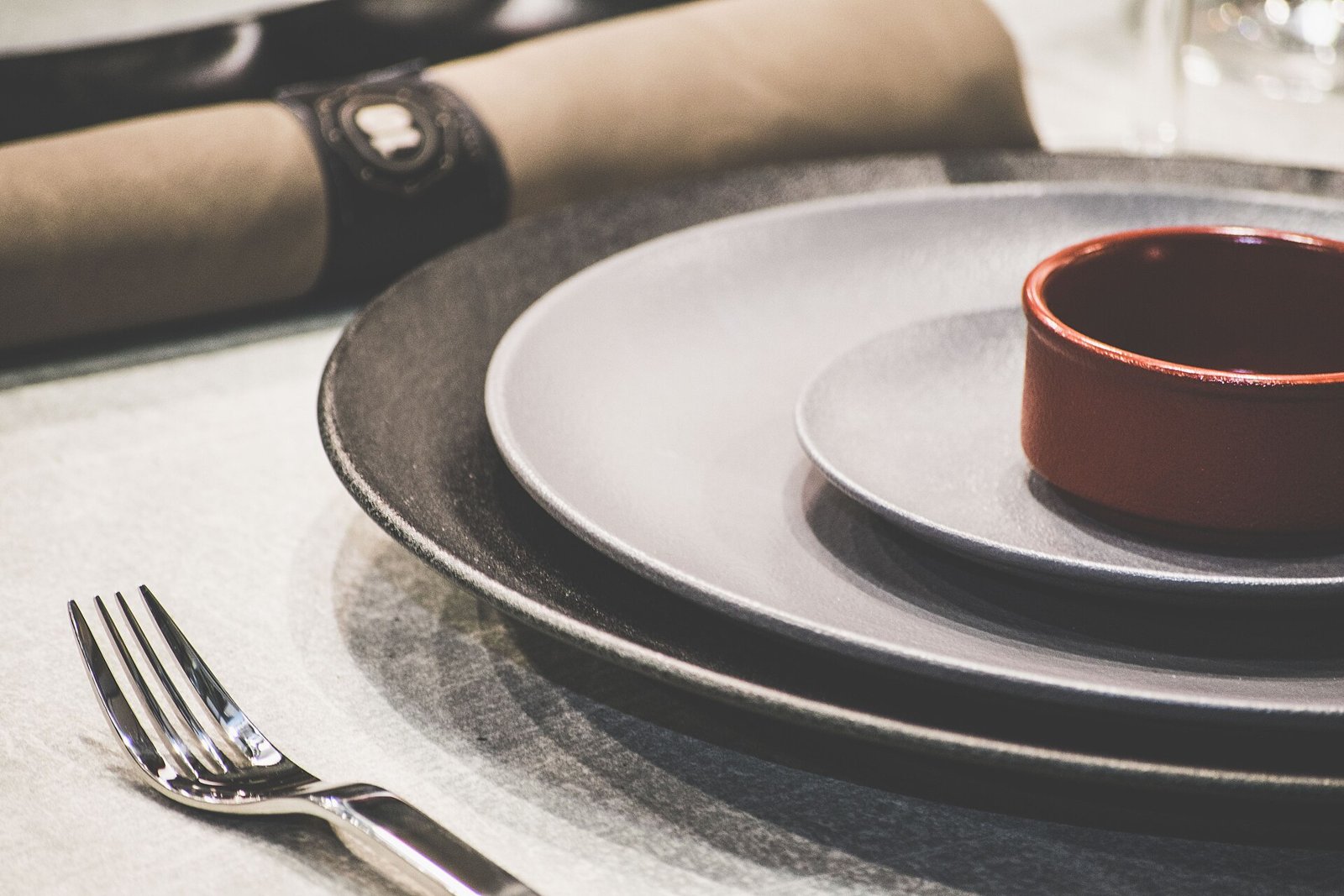
Texture is carrying a lot of weight too. Linen rather than cotton, raw-edged ceramics with visible throwing marks, woven rattan chargers under the plates. Homes & Gardens has been pushing the “Hollywood Cottage” look for the year, which is a fancy way of saying old silver, warm wood and monogrammed linen, the kind of thing that turns up in a Nancy Meyers film. It’s a soft, lived-in version of formality, and it suits British rooms better than the cold minimalism it’s replacing.
Where to spend, and where you’re being fleeced
Start with the glasses, because they give you the most for your money. A set of six coloured tumblers is the single best thing you can buy, and you don’t need to spend a fortune. H&M Home regularly has them around £6 to £10 each, IKEA’s coloured glasses are a couple of quid, and B&M’s Mediterranean-style range turns up for even less. I bought six smoke-grey tumblers in the January sales for under twenty pounds the lot, and they’ve earned their place at every dinner since.
Napkins are where I start to twitch. Real linen napkins are lovely, and they do change how a table feels. But the designer ones are properly expensive, and a set of four good ones from a name like Matilda Goad will set you back the better part of fifty quid. If you host once a month, fine. If you host twice a year, you’re buying status, not utility. The honest move is to find plain linen napkins from a department store own-brand, or hunt vintage on eBay and Vinted where embroidered ones go for a few pounds because nobody under sixty wants them. They’re better quality than most new ones, too.
Candles are cheap and they do more than almost anything else, so spend the small amount they cost without guilt. Unscented dinner candles in odd numbers, set at varying heights, will transform a table for the price of a coffee. Skip the scented ones at the table though. Nobody wants fig and cassis fighting with the food.
Plates are the trap. The temptation is to buy a whole new “collected” set in one go, which rather defeats the point and usually costs a fortune. The cleverer route is to keep your existing white plates as the base and add character with the cheap stuff around them. If you do want new ceramics, the small British makers are where the genuinely nice pieces live. I’ve written before about the British homeware brands worth buying from, and the same rule applies here: one good handmade bowl you’ll use for a decade beats a trolley-load of trend tat you’ll be sick of by Christmas.
The bits that are a waste of money
Place cards. Unless you’re seating thirty people who don’t know each other, you don’t need calligraphed place cards for a dinner with your mates. It reads as try-hard, and it slows everyone down while they squint to find their name. Tell people where to sit. It takes four seconds.
Single-use floral runners are the other one. Those dense ribbons of fresh flowers running the length of the table look incredible in photos and cost a genuinely silly amount from a florist, and they’re dead by Sunday. A few stems in a couple of small jars does ninety per cent of the job for a tenth of the price, and you can actually see the person across from you. Tall arrangements at eye level are a hosting crime regardless of budget.
And the “tablescaping starter kit” bundles that have started appearing online? Skip them. They’re a way of selling you matching things at a markup, which is the exact look the trend moved away from. The whole appeal of a good table is that it doesn’t look bought in one transaction. Buying it in one transaction misses the point entirely.
How to do it without it looking like a wedding-hire showroom
The failure mode of tablescaping is over-coordination. When every element matches every other element, you’ve made a display, not a table, and it has the slightly chilly perfection of a furniture catalogue. The tables that actually work have one or two things that don’t quite belong: a chipped jug your nan left you, a candle in the wrong colour, a stack of odd side plates.
Build it slowly. The people whose tables you envy didn’t buy it all in a weekend. They’ve been quietly accumulating for years, a glass here, a linen runner there, picking things up in charity shops and on holiday and at the occasional car boot. Pick one thing to be the hero, usually the glasses or the candles, and keep the rest calm around it. A table fighting itself for attention is exhausting to sit at.
Restraint is the bit nobody Instagrams. You don’t need a charger plate and a side plate and a bread plate and three glasses and a name card and a sprig of rosemary tied to the napkin. Pick a few things, do them properly, and leave room for the actual dinner. A table so dressed there’s nowhere to put the serving dishes is a table that’s forgotten what it’s for.
One more thing, and it’s the bit the trend tends to skip over. The point of all this is the people sitting at it. If the styling is making you stressed and snappy in the hour before guests arrive, you’ve got the ratio wrong. A relaxed host at a slightly imperfect table beats a frazzled one at a flawless table every single time. I’ve sat at both. I know which dinner I’d go back to.
The room around the table matters too
A table doesn’t sit in a vacuum. It sits in a room, and the room sets the rules. The reason warm, layered tablescaping has taken off is that British homes have moved decisively away from cold white minimalism, and a moody dining room asks for a different table than a stark one did.
Look at where the colour is going. The same year everyone started buying amber glasses, chocolate brown took over British interiors, and the two trends feed each other. Smoke-grey tumblers and brass candlesticks look properly good against a brown or deep-green wall, and frankly a bit lost against magnolia. If your dining room is still builder’s beige, the table will always be doing the work alone.
It cuts the other way as well. Some of the bigger structural fads, like the return of the conversation pit, change how a table even functions. I was sceptical about sunken living rooms making a comeback, and I still think most British homes should leave the floor where it is. But the broader move toward sociable, broken-up spaces is exactly why the dinner table is having its moment. We want to sit round things again.
So before you spend on the table, look up at the walls. A fiver of paint sometimes does more than fifty quid of napkins.
Where this goes next
There are early signs of a correction. The same forecasters who pushed maximal, layered tables are starting to murmur about “quiet” tablescaping, which seems to mean spending less and using what you own, which is what sensible people were doing anyway. The coloured-glass moment will pass, as these things do, and in two years a cupboard full of amber tumblers will date a dinner party as firmly as a fondue set dates a 1974 one. The good news is that none of the genuinely useful habits go out of fashion. Candles, linen, a few stems in a jar, plates you actually like. That’s not a trend. That’s just laying a table nicely, which people have done for as long as there have been tables.
And if the hosting bug properly bites, the upgrade that changes the food rather than the table sits outside the back door – we’ve picked out the best pizza ovens under £300 for exactly that job.
The honest version of this trend costs almost nothing and takes fifteen minutes. The expensive version costs hundreds and impresses people who were going to enjoy the evening anyway. So before you add another set of napkins to the basket, it’s worth asking: are you setting the table for your guests, or for the photo you’ll take before they arrive?
It also helps to have somewhere to host, which is one reason garden rooms are edging out extensions for entertaining space.




Pingback: How to create an elegant dinner party table setting