
Why UK Gardens Are Going Robotic in 2026 (And Which Mowers Are Actually Any Good)
Walk down any suburban street in late May and you will hear the same thing you have heard every spring since the Eighties: the strained, throat-clearing wheeze of a corded mower wrestling with damp grass. Except, this year, there is a second noise mixed in. Quieter. Closer to a fridge hum than an engine. That sound is the robot lawn mower uk 2026 moment finally arriving in British gardens, and it is not coming from one or two early adopters on Grand Designs estates. It is coming from semi-detached houses in Reading, mid-terraces in Sheffield, and small back gardens in south London where the owner has decided, quite calmly, that they are done with Saturday mornings.
In This Article
- Why British gardens have finally said yes
- The problem this actually solves
- What a robot mower actually costs in 2026
- The mowers I think are actually worth buying
- Where robot mowers still fall down
- The setup nobody warns you about
- How it fits with the rest of your garden plan
- Should you buy one this year or wait?
- The honest summary
I have spent the spring testing four robot mowers across two friends’ lawns and my own, talked to a Husqvarna service technician who has been fitting them since 2014, and read every test report I could find from the UK gardening press. The headline is this: the category got dramatically better in 2025, the new wave of “drop and mow” wire-free models has cracked the setup problem that put British buyers off for a decade, and the worst thing you can do in 2026 is buy the cheapest one to “see if you like it”. This is the honest version of what is happening, and which mowers I think are actually any good.

Why British gardens have finally said yes
Robot mowers have been sold in the UK since the late Nineties. Husqvarna’s first Automower went on sale in 1995. For most of that history, the answer to “should I get one?” was a polite no. The boundary wires were a nightmare to install, the cut quality on long, wet British grass was patchy, and the cheaper end of the market was full of machines that gave up at the first dock-and-charge cycle. Most people stuck with the petrol Hayter or a corded Flymo, and the robot category remained the preserve of people with very flat, very large, very sunny lawns.
What changed in 2025 is the navigation. The new generation of mowers uses on-board cameras, LiDAR sensors, and GPS-style positioning to map a garden in an afternoon, without burying a single metre of perimeter cable. The BBC’s Gardeners’ World review of the 2026 line-up describes it as a generational shift, and they are not exaggerating. Setup time has dropped from a weekend to about two hours. Cut quality on uneven British lawns has improved. Obstacle detection is now genuinely good rather than theoretically good, which matters if you have small children, a dog, or the kind of garden where the kids’ football ends up half-buried in the lawn by August.
The result is that the category has stopped being a luxury and started being a sensible upgrade for people whose garden is slightly more than they want to deal with manually. About three months ago, the Royal Horticultural Society’s seasonal trade pages were still listing robot mowers under “novelty”; the May 2026 buying guides have quietly moved them into the main mower section. That is the tell.
The problem this actually solves
It is worth being clear about what a robot mower is for, because the marketing is confused. It is not a replacement for a strimmer. It is not a hedge cutter. It will not do your edges. What it does is take the weekly cut off your hands, completely, for nine months of the year.
For most British gardens, that weekly cut takes between twenty and ninety minutes once you factor in pulling the mower out, setting up the extension lead, emptying the box twice, putting it all away, and brushing the cut grass off the patio. Over a season, that is somewhere between fifteen and forty hours of unpaid garden work that nobody especially enjoys. A robot mower does it in slices of fifteen to forty-five minutes, several times a week, while you are at the office or asleep, and the lawn ends up healthier because frequent shallow cutting suits British grass better than a weekly hack.
The honest test, before you spend anything, is to ask: do you actually like mowing your lawn? Some people do. They find it meditative, they like the stripes, they enjoy the smell. If that is you, do not buy one. You will resent the silence. But for the substantial majority of UK homeowners who treat lawn mowing as a chore that eats into a weekend, the robot is the rare bit of garden tech that pays you back in time rather than in stuff.
There is also a third option gaining ground: not mowing much at all. Our piece on why UK gardeners are letting the lawn go wild covers the wildflower route and what it asks of you instead.

What a robot mower actually costs in 2026
This is the bit where the marketing pages go quiet, so let us do the maths properly. There are three honest price brackets for the UK market in 2026, and the difference between them is not “premium feel” but raw capability.
Entry level, roughly £400 to £750. Suitable for small, simple, mostly rectangular gardens up to about 300 square metres. At this price you are still mostly looking at wire-perimeter models from older Husqvarna, Worx and Gardena ranges, plus a small number of new wire-free entrants like the Eufy E15 at the upper end of the band. These mowers will cut the grass adequately. They will struggle with slopes over fifteen degrees, narrow passages between flower beds, and any garden where the lawn has more than one main section. If your garden is a flat back lawn behind a Victorian terrace, you are fine here. If it is a 1930s semi with a side passage, you will outgrow it within a year.
Mid range, roughly £800 to £1,800. This is the sweet spot for most UK family gardens, covering 500 to 1,500 square metres. The Mammotion YUKA Mini 2, Bosch Indego (the new VISIMOW vision-based version), and Segway Navimow i Series all sit here. You get wire-free setup, app-based scheduling, decent slope handling, and obstacle avoidance that copes with a toddler’s discarded watering can. The Bosch in particular, picked out by Ideal Home as a strong introduction to the category, is a sensible “first robot mower” buy if you do not want a project.
Premium, roughly £1,800 to £4,500. Husqvarna Automower 450X, Mammotion LUBA 2 AWD and the larger LUBA 3 AWD sit here. These are for gardens above 1,500 square metres, gardens with serious slopes, or owners who simply want the best obstacle avoidance and the most resilient hardware. The LUBA 2 AWD’s four-wheel drive is the difference between mowing a Cornish slope and giving up on it. If your garden is small and flat, do not buy at this level out of vanity. You will not see the difference.
On top of the headline price, budget for two things. First, an installation visit if you want the dock and charging cable laid neatly under the lawn rather than across it. Independent fitters in most UK regions charge between £120 and £220. Second, blade replacements. Most models use small triple-blade rotors at around £15 to £25 a set, and you will get through one to three sets a year depending on how often the machine clips a buried stone. Neither of these is ruinous. Both are real.
The mowers I think are actually worth buying
I am going to name names, because the worst part of this category is the generic listicle that ranks ten mowers without telling you which one to actually pick. There are four I would recommend for a UK garden in 2026, with caveats.
Bosch Indego (VISIMOW), around £1,100. The best first robot mower for a typical UK family garden. Vision-based navigation, no wires, three-button setup that genuinely works, and Bosch’s UK service network is well established. Cut quality is good rather than exceptional. It is slower than the Mammotion equivalents, which matters less than the marketing suggests, because it works while you are not watching. Buy this if you want to spend a Saturday morning unboxing it and then never think about it again.
Mammotion YUKA Mini 2, around £1,300. The connoisseur’s mid-range pick. The mapping software is the best in the category, the obstacle avoidance is genuinely impressive (mine reliably stops for a hedgehog-sized garden gnome from over a metre away), and the app does not feel like an afterthought. The downside is that Mammotion is a younger brand with a thinner UK service footprint than Bosch or Husqvarna. If something fails in year three, you may be sending it back to a central UK depot rather than to a local dealer.
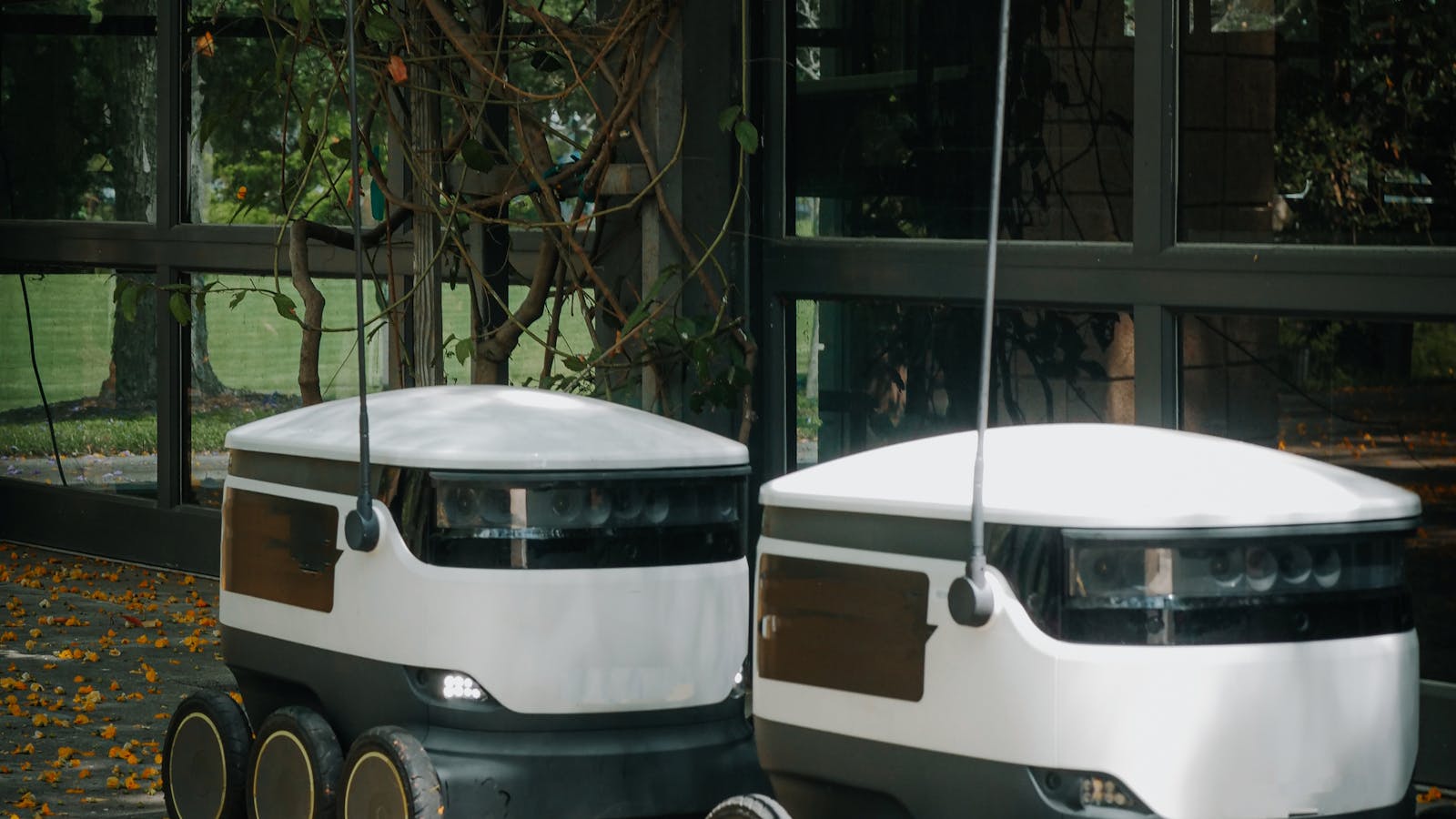
Husqvarna Automower 320 NERA, around £2,100. The grown-up choice. The NERA range is wire-optional, which means you can set it up wireless to start and add a boundary wire later if a part of the garden needs hard-coding. Build quality is the best in the category. Cut quality on long British grass is unmatched. The Automower app is the least exciting, which is a compliment: it does what it says and stops asking you to engage with it. Buy this if your garden is north of a thousand square metres or you want one decision you do not have to revisit for ten years.
Mammotion LUBA 2 AWD, around £2,800. The right answer for awkward, sloped, or large gardens. The four-wheel drive is the differentiator: it gets up and across slopes that defeat every two-wheel-drive competitor at any price. If your garden has a bank, a multi-tier setup, or a lawn that drops away towards the bottom of the plot, this is the one. If your garden is a flat rectangle, you are paying for capability you will never use.
I would skip the very cheapest wire-perimeter Worx and Gardena models in 2026. They still cut well, but the setup time is a serious commitment, and you are buying into a navigation generation that the rest of the category has now moved past. Which?’s independent group test is more polite about them than I am, but the direction of travel is clear.
Where robot mowers still fall down
This is where most buying guides go quiet, so let us be honest about it. Robot mowers in 2026 are not perfect. Three things still go wrong with surprising regularity.
The first is edges. Even the best of these machines leaves a one- to two-inch strip of uncut grass at the edge of a lawn, against a fence, wall, or flower bed. You will still need a strimmer, or you need to be relaxed about an edge that looks softer than a manually mown lawn. For many gardens this is a non-issue. For owners with a very formal lawn that meets a brick path at a clean ninety degrees, the unmown strip will drive you mad within a fortnight.
The second is wet grass. The new generation of vision-based mowers handles damp lawns much better than the wire-perimeter machines that came before. They still do not love it. Heavy rain, standing water, and morning dew can confuse the camera systems on some models and leave parts of the lawn missed. In a typical British April this means scheduling the mower for late afternoons rather than early mornings.
The third is theft. It is rare, but it does happen, particularly in front gardens visible from the road. All the serious manufacturers now include GPS tracking, a four-digit PIN, and an alarm that goes off if the mower is lifted. None of this stops a thief who knows what they are doing. If your lawn is at the front of your house and visible from the pavement, factor in either a tracker, an obvious security camera, or accept that you are buying something that very occasionally walks away.
The setup nobody warns you about
The big change in 2026 is that you no longer need to spend a Saturday burying a boundary wire around your lawn. What you do still need to do, on day one, is the mapping walk. The wire-free mowers all use the same basic process: you push the mower (or a small remote unit) around the perimeter of your lawn while the on-board cameras and sensors build a map. On a simple lawn this takes about twenty minutes. On a complicated garden with multiple zones, paths to cross, and flower beds to avoid, it can take two hours.
The thing that catches people out is that the map is yours to maintain. If you put a new garden table on the lawn for the summer, the mower will, on a bad day, plough straight into it. The better models adjust on the fly, but the entry-level ones expect the world to stay the way you mapped it. The same goes for an electric barbecue wheeled onto the grass for a party – move it or remap. The fix is simple: redo the mapping walk twice a year, in May and September, and add or remove zones as your garden changes.
You also need to think about the dock location. Robot mowers need somewhere flat, sheltered, near a power socket, and ideally tucked away so it does not look like an industrial appliance has been parked on the patio. Most owners end up tucking the dock against the back wall of the house or behind a shed. If you are mid-renovation, this is one of the few cases where it is worth running an outdoor socket specifically for the dock; otherwise, an outdoor-rated extension on a short run will do.
How it fits with the rest of your garden plan
A robot mower is rarely the only change people make to a garden in a given year. It tends to be one of three or four moves: a robot mower, smarter outdoor lighting, a better-quality outdoor seating set, and, for the lucky, a proper garden room at the bottom of the lawn. If you are doing the lot in 2026, sequence matters.
Lay any landscaping changes first. If you are widening a border, putting in stepping stones, or adding a patio, do it before you map the mower. The boundary you teach the machine in May should be the boundary you want it to keep using in September. Our piece on garden solar lighting is worth reading in parallel if you want the lawn looking good after dark as well as in daylight, and the outdoor sofa shift covers how British gardens are being used for longer evenings, which is partly what is making the case for a maintained lawn in the first place.
If you are planning a garden office at the bottom of the garden, think about how the mower gets past it. The dock will likely move closer to the house, and you may want a second zone in the app for the patch between the office and the back fence. None of this is complicated. It is the kind of thing that is far easier to think about now than to retrofit in August. While you are designing the year, our take on keeping a home office cool in summer covers the indoor half of the same problem: a garden you actually want to spend time in needs an indoor workspace that does not punish you when the temperature rises.
Should you buy one this year or wait?
The question I get asked most often by friends is whether 2026 is the right year, or whether the technology will be meaningfully better in 2027. The answer, slightly boringly, is buy now if your garden fits the brief.
The big jump from wire-perimeter to vision-based navigation has happened. The next round of improvements, which the trade press is already trailing for late 2026 and 2027, will be about smarter scheduling, better integration with weather data, and slightly faster mapping. These are nice-to-haves rather than category-defining changes. If you buy a good mid-range mower in May 2026, it will still be the right machine in May 2029.
The exception is if your garden is at the very top end (over 2,000 square metres, with serious slopes or multiple distinct zones) and you are not yet desperate. The premium category is genuinely still improving year on year, and a 2027 LUBA-class machine will outclass a 2026 one in ways that matter at scale. For a typical UK suburban lawn, that is not the case.
The other reason to act this spring is straightforward: the season is now. A mower bought in May will have done its job by September. A mower bought in October will sit in the garage for six months learning nothing. The British lawn does not wait for Black Friday.
The honest summary
Robot lawn mowers in 2026 are not a gadget. They are a small infrastructure decision for your garden. They cost between £400 and £4,500, they will save you between fifteen and forty hours a year, and they will do a better job on the lawn itself than most weekend mowers, because little-and-often suits British grass. The category is finally mature enough that you can buy one without being an early adopter. The cheap end of the market is still a trap; the mid range is genuinely good; and the premium machines are worth it only if your garden actually demands them.
If you do one thing after reading this, do the harder thing first: stand in the back garden, measure it roughly, count the slopes and the obstacles, and write down honestly how much time you spend cutting it each summer. Then come back to the price brackets above. The right mower is almost always the one chosen by the garden, not by the buyer.
Which leaves the question I cannot answer for you: when you next have a free Saturday morning in July, with the lawn already done and the kettle on, what are you going to do with it?