
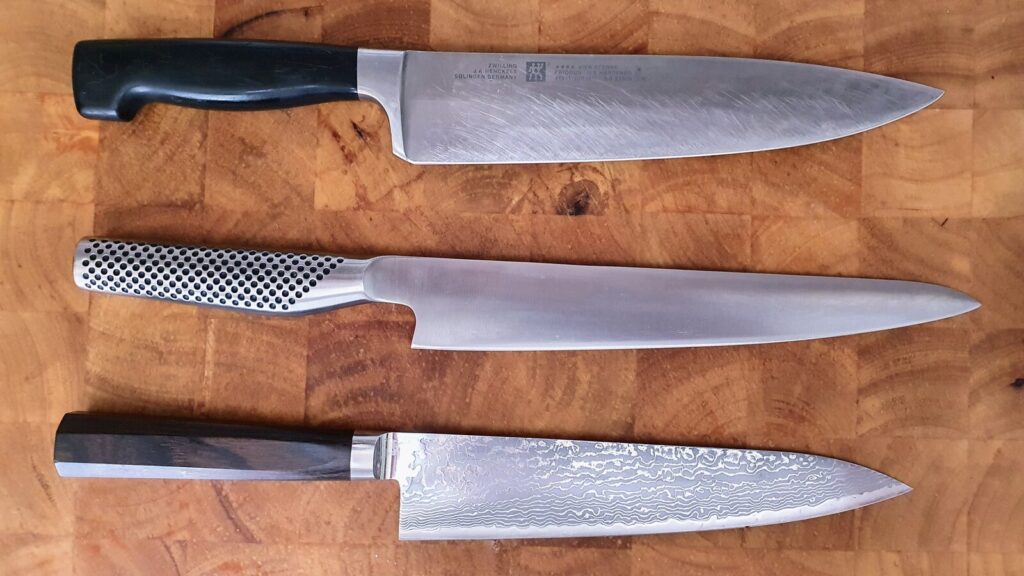
Best Chef Knife UK 2026: How to Choose the One You’ll Actually Use
Buying a chef’s knife in the UK in 2026 is more confusing than it should be. The supermarket aisles, the sponsored Instagram reels and the half-price Black Friday “Damascus steel” specials all blur together, and most of the advice you find online is American. So this is a practical guide to the best chef knife UK 2026 buyers should actually look at, written for British home cooks who want one knife that handles 90% of what they cook – not a glass-cabinet collection.
In This Article
- The quick answer: our picks at a glance
- What "best chef knife UK 2026" actually means
- Forged vs stamped: which actually matters
- Blade length and weight: what suits a UK kitchen
- Steel and edge retention, without the jargon
- Best chef knife for each kind of cook
- Handle comfort and balance
- Five knife myths worth ignoring in 2026
- Where to buy, and what's a fair price in 2026
- Pros and cons: budget stamped vs premium forged
- How to actually keep it sharp
- Frequently asked questions
- So, which one should you buy?
If you only buy one knife in the next year, this is the one to spend on. A good chef’s knife earns its keep every single day: dicing onions, breaking down a chicken thigh, chopping herbs, slicing a Jersey Royal in half. Get this right and the rest of your block can sit in a drawer. This guide covers what actually matters when choosing, names specific knives at each price, debunks the marketing, and answers the questions people email us most.
The quick answer: our picks at a glance
If you want the shortlist before the detail, here are the knives worth your money in 2026, with rough UK prices. Prices are RRP and move around constantly – all of these are regularly discounted, so treat the figures as a ceiling, not a fixed cost.
| Knife | Type | Approx UK price | Steel | Best for |
|---|---|---|---|---|
| Victorinox Fibrox 20cm | Stamped, light | ~£40 RRP (often under £30) | X50CrMoV15 | Best budget / first proper knife |
| Robert Welch Signature 20cm | Forged | ~£55-70 | German stainless | Best value forged knife |
| Tojiro DP Gyuto 21cm | Stamped, light | ~£75-95 | VG-10 core | Best Japanese-style all-rounder |
| Zwilling Pro 20cm | Forged | ~£90-120 | German stainless | Best for big hands / heavy prep |
| Wüsthof Classic 20cm | Forged | £139 RRP (often ~£100) | X50CrMoV15 | Best buy-it-for-life workhorse |
If you genuinely cannot decide, the honest two-way split is this: get the Victorinox Fibrox if you want maximum knife for minimum money, or the Wüsthof Classic if you want one knife to keep for a decade. Everything below explains why.
What “best chef knife UK 2026” actually means
There is no single best chef knife UK 2026 reviewers all agree on, and anyone telling you otherwise is selling something. What there is, instead, is a sensible bracket: an 18-21 cm blade, balanced enough to use all evening, hard enough to hold an edge for months between sharpenings, and priced somewhere between £40 and £180. Below £40 you tend to get steel that goes dull in weeks. Above £180 you’re paying for finish, branding and (sometimes) genuine craftsmanship – but you’re well past the point where most domestic cooks will notice the difference.
Which? has spent years quietly reviewing kitchen knives and tends to find that mid-priced Japanese-influenced European knives outperform far pricier rivals on edge retention. The takeaway: in 2026, the sweet spot is firmly in the middle of the market.
Forged vs stamped: which actually matters
Forged knives are made by hammering a single piece of steel into shape; stamped knives are punched out of a sheet. Forged blades are usually heavier and have a bolster – the thick collar between blade and handle – which adds balance and finger protection. Stamped blades are lighter, often more nimble, and cheaper to make.
For most UK home cooks the forged-vs-stamped argument is overrated. A well-made stamped knife from a reputable maker will outperform a poorly forged one. What matters is that the steel is hard enough to take an edge, the geometry is right, and the spine has been rounded so it doesn’t dig into your index finger after twenty minutes of chopping.
If you cook a lot of dense root veg through autumn and winter, a forged knife with a bolster gives you confidence on swede and squash. If you mostly do quick suppers – the kind of cooking covered in our chicken thigh recipes for UK weeknights – a lighter stamped blade is often more pleasant to use.
Blade length and weight: what suits a UK kitchen
The default chef knife is a 20 cm blade, but plenty of British kitchens have boards too small for one. Measure your chopping board honestly – if it’s under 30 cm long, an 18 cm knife will feel less unwieldy and your knuckles will thank you.
Weight is more personal. Heavier knives (around 230-260 g) cleave through harder produce with less effort, but tire the wrist on long prep. Lighter blades (170-200 g) reward technique. If you’re not sure, lean lighter – you can always add weight by buying a cleaver later; you can’t make a heavy knife feel quick. For high-volume spring veg prep, the kind of evening behind something like our Jersey Royals weeknight dinners or a big tray of British asparagus recipes, the lighter end of the range is genuinely easier on the hand.
Steel and edge retention, without the jargon
The phrase “Damascus steel” on a 2026 product page almost always refers to layered cladding wrapped around a harder cutting core. It looks beautiful and tells you very little about how the knife performs. The numbers that actually matter are the Rockwell hardness rating (HRC) of the cutting edge and the steel grade.
For UK home use, look for HRC 58-62. Below 58 the edge dulls quickly. Above 62 the steel is hard enough to chip if you hit a bone or chopping board edge. Steels worth knowing: VG-10 and AUS-10 (Japanese, take a fine edge), X50CrMoV15 (the workhorse German steel – softer but very tough), and SG2 / R2 powder steels (premium, hold an edge for ages but need careful sharpening).
Best chef knife for each kind of cook
The “best” knife depends far more on who you are than on any league table. Here is how the picks above map onto real kitchens.
Best on a tight budget: the Victorinox Fibrox 20cm. It is the knife professional kitchens buy by the dozen, it is light, it takes a keen edge, and it is almost always under £30 on offer. It will not feel special in the hand, but it will out-cut anything else at the price.
Best all-rounder for most people: the Wüsthof Classic 20cm. Forged, tough, balanced, and the closest thing to a buy-it-once knife on this list. RRP is £139 but it is frequently nearer £100, which is the price to wait for.
Best Japanese-style blade: the Tojiro DP 21cm Gyuto. A harder VG-10 core means a finer, longer-lasting edge; the trade-off is that you need to be a little more careful with it (no bones, no frozen food, no scraping the board with the edge).
Best for big hands or heavy weekend prep: the Zwilling Pro. The fuller handle and weight suit cooks who batch-cook or break down larger cuts.
Best for small boards and flats: drop to an 18cm blade in any of these ranges. The difference in control on a cramped worktop is bigger than the loss of cutting length.
Handle comfort and balance
You’ll be holding this thing for years. Pick it up before you buy it where you can. John Lewis, Divertimenti and most independent kitchen shops will let you try a few in store. The pinch grip – thumb and index finger on the blade itself, three fingers on the handle – should feel obvious and comfortable. If the bolster is in the way of your pinch, the knife is wrong for you, regardless of the price.
Octagonal Japanese-style handles divide opinion: lovely in a dry hand, slippery for some when wet. Western moulded handles are more forgiving for everyday cooking. Wood looks beautiful but needs more care – rinse and dry, never soak. The Guardian’s Filter has worked through this in more detail, and the conclusion is roughly: handle material is preference, handle shape is the bit that matters.
Five knife myths worth ignoring in 2026
Most bad knife purchases come from believing marketing. These are the claims to discount.
“Damascus steel is better steel.” It isn’t a steel at all – it’s a layered finish. The cutting core underneath is what matters, and you can buy a plain-looking knife with a better core for less.
“More expensive means sharper.” Sharpness out of the box is down to the final grind, not the price. A £30 Victorinox can arrive sharper than a £200 designer knife. Edge retention is where money sometimes buys you something; initial sharpness is not.
“You need a full block of knives.” You need a chef’s knife, a paring knife and a bread knife. That is roughly 95% of home cooking. Blocks exist to sell you six knives you’ll never reach for.
“Stainless steel never rusts.” Stainless resists rust; it does not prevent it. Leave any knife wet in the sink overnight and you can still get spotting, especially on higher-carbon Japanese steels.
“A serrated edge stays sharp forever.” Serrated edges hide bluntness rather than avoid it, and they are far harder to sharpen at home. For a main knife, you want a plain edge you can maintain.
Where to buy, and what’s a fair price in 2026
Prices have crept up since 2024. A reasonable benchmark for the best chef knife UK 2026 sits at around £100-£140 for a knife you’ll keep for a decade, though you can spend far less and still cook well. Below that, look at Victorinox Fibrox, IO Shen and Robert Welch Signature – all genuinely good at sub-£70 if you catch them on offer. In the middle, Wüsthof Classic, Zwilling Pro and the Japanese-influenced Tojiro DP are sensible benchmarks. Above £150, you’re choosing a knife as much for how you feel using it as for how it cuts.
Buy from somewhere with a real returns policy. Amazon Marketplace listings for premium knives include a depressing number of fakes; stick to the brand’s own UK site, John Lewis, Sous Chef, ProCook or a named independent. Independent kitchen shops will often sharpen your knife for free for the first year, which is worth more than people realise.
Pros and cons: budget stamped vs premium forged
Most of the real decision comes down to two camps. Here is the honest trade-off.
A light stamped knife (Victorinox, Tojiro) – the case for: cheaper, nimbler, easier on the wrist over long prep, and quick to learn good technique with. The case against: less heft for dense produce, plainer in the hand, and the very cheapest can feel insubstantial.
A forged German knife (Wüsthof, Zwilling) – the case for: tough, confidence-inspiring on hard veg and joints, and built to last decades. The case against: heavier on long sessions, more expensive, and the bolster can get in the way of a proper pinch grip on some models.
How to actually keep it sharp
Even the best chef knife money can buy in 2026 turns into a blunt knife within six months if you ignore it. Three habits, in order of importance: use a wooden or soft plastic board (never glass, never granite, never the worktop); hone weekly with a steel or ceramic rod to realign the edge; sharpen properly twice a year on a 1000/4000 whetstone, or send it to a sharpener.
A blunt knife is the leading cause of kitchen injuries, because you push harder and slip. If sharpening yourself feels intimidating, post it to a UK service like Hone or Knifesharp (£8-12 a knife), or take it in to your nearest John Lewis branch. The skill curve here is shallower than it looks – and once your knives are sharp, the rest of your cooking gets easier, the way good baking tips and tricks start to compound once you’ve nailed the basics. The same knife earns its keep on a quick supper too, like our halloumi weeknight dinners.
Frequently asked questions
How often should I sharpen a chef’s knife? Hone weekly with a rod to keep the edge aligned, and properly sharpen on a whetstone or via a service roughly twice a year for a knife in regular home use. Honing and sharpening are different jobs: honing straightens the edge, sharpening removes metal to create a new one.
Can I put a chef’s knife in the dishwasher? No. The heat, harsh detergent and knocking against other items dull and corrode the edge, and can damage wooden handles. Hand-wash and dry immediately – it takes ten seconds and adds years to the knife.
Is one good knife really enough? For most home cooks, a chef’s knife plus a paring knife and a bread knife covers almost everything. A single well-chosen chef’s knife is a better buy than a cheap five-piece block.
Are Japanese or German knives better? Neither is universally better. Japanese blades (Tojiro) are harder and take a finer edge but need more care; German blades (Wüsthof, Zwilling) are tougher and more forgiving. Choose by how you cook, not by nationality.
What’s a sensible budget? Around £30 buys a genuinely good Victorinox; around £100 buys a forged knife you’ll keep for a decade. Spending much above £150 is about feel and finish, not performance.
So, which one should you buy?
If forced to pick one for a typical UK kitchen in 2026: a Wüsthof Classic 20 cm or a Tojiro DP 21 cm Gyuto, depending on whether you want a German workhorse or a lighter Japanese-style blade. Both will last a decade with basic care, and both will outperform the £40 starter knife you’re probably about to replace. If money is tight, the Victorinox Fibrox is no compromise – it is simply the most knife you can buy for the price.
What matters more than the brand, in the end, is honest self-assessment about your own kitchen: which weight, which length, which handle suits your hand and your board.
What’s the one knife in your kitchen you reach for first – and is it actually the right one for the job?





Bought a Wusthof Classic about 15 years ago and other than a yearly trip to a sharpener it’s still the only knife I genuinely use. The Damascus steel marketing is the bit that always makes me wince in John Lewis, looks pretty, performs no better. Did you find any of the British-made options worth the premium or is it still mostly German and Japanese steel for value?
Same camp – my Wusthof has outlasted three sets of pans and a marriage and still does 90% of the work. Damascus is mostly aesthetic at the home-cook level. The bit I’d push back on is the yearly trip to a sharpener though – a £15 ceramic rod and two minutes a fortnight does the job for me without paying someone else for it.